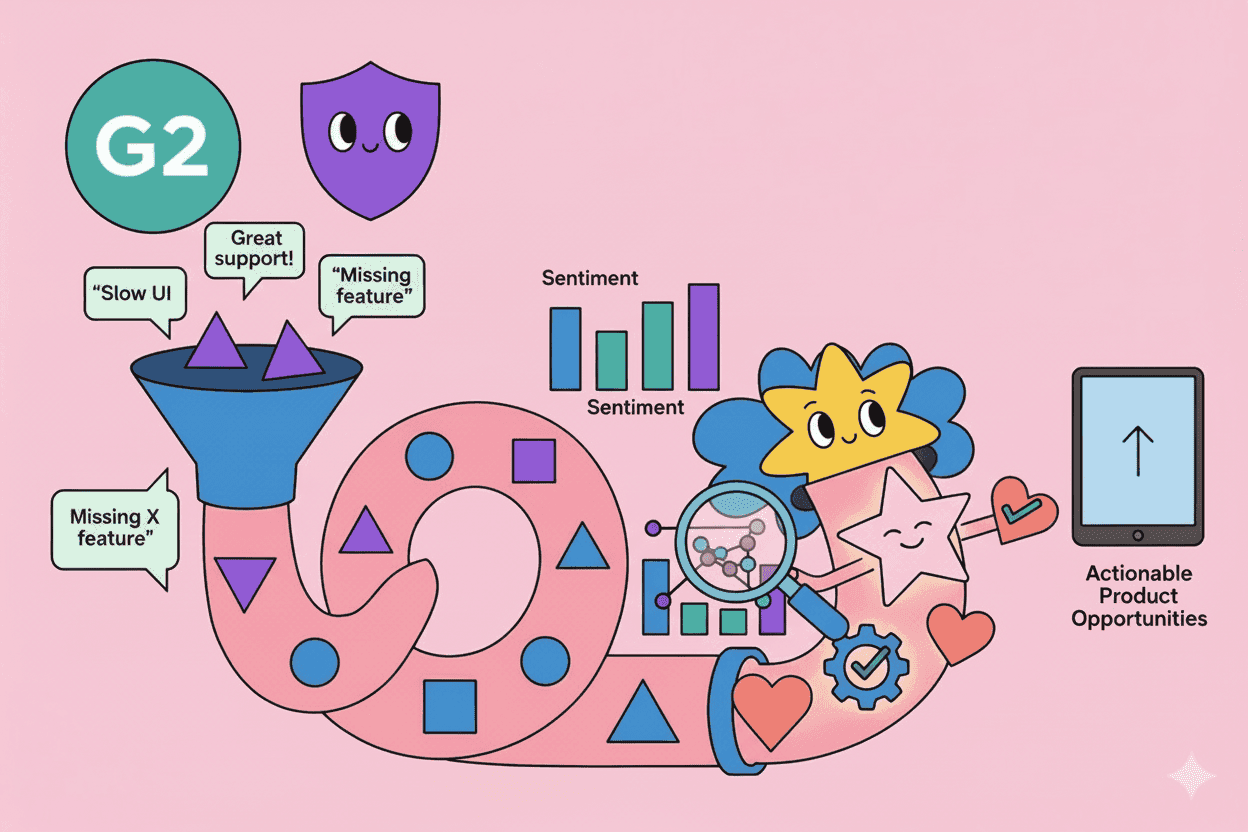
Your competitors' unhappy customers are telling you exactly what to build next. They're posting reviews on G2, venting on Reddit, and asking questions in forums. The question is: are you listening?
Competitor customer feedback mining is the practice of systematically analyzing what customers say about competing products to identify gaps, frustrations, and opportunities your product can address. It's competitive intelligence that comes straight from the source—people who've actually used the alternatives.
TL;DR: Key Takeaways
- Competitor reviews on G2, Capterra, and Reddit reveal product gaps you can exploit
- Focus on recurring complaints and unmet needs, not one-off gripes
- Structure your analysis by feature category, customer segment, and sentiment
- Use AI tools to process large volumes of reviews efficiently
- Turn insights into prioritized product opportunities with clear customer evidence
Why Competitor Feedback Mining Matters
Traditional competitive intelligence focuses on feature comparisons and pricing. But knowing what competitors offer doesn't tell you how well it works for real users.
According to Gartner research, B2B buyers spend only 17% of their purchase journey talking to vendors—the rest involves independent research, including reading reviews and peer experiences. Your prospects are already mining competitor feedback. You should be too.
Here's what competitor feedback reveals that feature lists don't:
Pain points in practice: A competitor might advertise "robust reporting," but reviews reveal their reports are slow, hard to customize, or missing key metrics.
Implementation realities: Features that look great in demos might require weeks of setup, expensive consultants, or technical expertise customers don't have.
Support quality signals: How a company handles problems often matters more than the product itself. Review patterns expose support gaps.
Segment-specific frustrations: Enterprise customers complain about different things than SMBs. Mining feedback by segment reveals targeted opportunities.
Where to Find Competitor Customer Feedback
Review Platforms
G2 is the gold standard for B2B software reviews. With over 2 million reviews, it provides structured feedback covering specific aspects like ease of use, support quality, and feature satisfaction.
Capterra and TrustRadius offer similar structured review data with different user bases. Cross-referencing multiple platforms catches feedback you'd miss on just one.
Product Hunt comments reveal early adopter reactions and first impressions that set product narratives.
Community Platforms
Reddit hosts active communities for nearly every software category. Subreddits like r/SaaS, r/ProductManagement, and industry-specific communities contain candid product discussions that review platforms miss.
Slack and Discord communities in your industry often include frank tool discussions. Research from CMX shows 86% of community professionals report members actively discuss tool recommendations.
LinkedIn and Twitter/X discussions, while noisier, surface real-time frustrations and switching triggers.
Support-Adjacent Sources
Stack Overflow and technical forums reveal integration pain points and developer experience issues.
App store reviews for mobile components show usability frustrations end users experience.
YouTube comment sections on competitor tutorial videos often contain user questions that reveal confusion points and missing features.
How to Structure Your Competitor Feedback Analysis
Random review reading doesn't scale. You need a systematic approach.
Step 1: Define Your Competitive Set
Don't try to analyze everyone. Focus on:
- Direct competitors: Products your prospects actively compare you against
- Adjacent competitors: Tools that solve overlapping problems differently
- Aspirational competitors: Market leaders whose customers you want to attract
Start with 3-5 competitors maximum. You can expand later.
Step 2: Create Your Feedback Categories
Structure your analysis around consistent categories:
Core functionality: Does the product do what it claims? How well?
Usability: How easy is it to learn and use daily? What causes friction?
Integration: How well does it connect with other tools? What breaks?
Support and service: How responsive and helpful is the team? What falls through cracks?
Pricing and value: Do customers feel they get fair value? What triggers "not worth it" sentiment?
Reliability: Uptime, bugs, data issues—what technical problems surface repeatedly?
Step 3: Segment by Customer Type
A complaint from a 5-person startup means something different than the same complaint from a Fortune 500 company. Tag feedback by:
- Company size (SMB, mid-market, enterprise)
- Industry vertical when identifiable
- Use case or job function
- Tenure with the product (new user vs. long-term customer)
G2 and Capterra include company size data. Reddit posts often mention context in discussions.
Step 4: Track Frequency and Trends
One angry reviewer isn't a pattern. Ten people mentioning the same problem over three months is a signal.
Track:
- How often each complaint appears
- Whether issues are getting better or worse over time
- If recent reviews mention problems that older reviews don't (indicating product regression)
- Seasonal patterns (e.g., performance issues during high-volume periods)
Mining Techniques That Actually Work
The Negative Review Deep Dive
Start with 1-2 star reviews. These contain the richest problem data.
For each negative review, extract:
- The specific complaint (what happened)
- The customer context (who experienced it)
- The impact (why it mattered)
- Any comparison (what they wish it did instead)
Example extraction from a real G2 review pattern:
"The dashboard takes forever to load when we have more than 10K records. We're a mid-size company and this is basic functionality."
- Complaint: Performance issues at scale
- Context: Mid-market company
- Impact: Blocks daily workflows
- Implicit need: Dashboard that handles 10K+ records smoothly
The Feature Request Scan
Many reviews include explicit feature requests or "I wish it could..." statements.
Create a running list of requested features across competitors. When multiple competitors' customers want the same thing, you've identified an industry gap, not just a competitor weakness.
The Switching Trigger Analysis
Pay special attention to reviews that mention switching—either to or from the competitor.
Questions to answer:
- What made customers leave for this competitor?
- What's making customers consider leaving now?
- What would bring churned customers back?
These switching triggers reveal high-stakes pain points worth solving.
The Positive Review Flip
Positive reviews aren't just for your competitors to celebrate. They tell you:
- What customers value most (your table stakes)
- What differentiates the competitor (what you're up against)
- What "good enough" looks like (your minimum bar)
If every positive review mentions "incredible customer support," you know that's a competitive requirement, not a differentiator opportunity.
Using AI to Scale Your Analysis
Manually reading hundreds of reviews works for initial exploration but doesn't scale for ongoing intelligence.
Modern AI tools can process large volumes of competitor feedback and surface patterns:
Sentiment clustering: Group similar complaints together automatically, even when customers use different words to describe the same issue.
Trend detection: Identify when complaint volume about specific issues increases—potentially signaling product problems or market shifts.
Quote extraction: Pull specific review quotes that illustrate patterns, useful for product briefs and stakeholder communication.
Cross-competitor synthesis: Find issues that appear across multiple competitors, indicating industry-wide gaps rather than single-product problems.
Pelin's competitive intelligence features automatically aggregate and analyze competitor review data, surfacing patterns that would take weeks to find manually. Instead of reading 500 reviews, you get synthesized insights with supporting evidence.
Turning Insights Into Product Opportunities
Analysis without action is just expensive reading. Here's how to convert competitor feedback into product decisions.
Create Opportunity Statements
For each significant pattern you identify, create a structured opportunity statement:
For [customer segment]
Who [face this problem with competitors]
We can [provide this solution]
Unlike [competitor approach]
Our solution [delivers this benefit]
Example:
For mid-market analytics teams who struggle with slow dashboard performance in [Competitor X], we can offer real-time dashboards that handle 50K+ records. Unlike [Competitor X]'s batch processing approach, our streaming architecture delivers instant insights without waiting.
Score Opportunities by Evidence Strength
Not all competitor complaints deserve product investment. Score opportunities on:
- Frequency: How often does this appear? (1-5)
- Severity: How painful is this for customers? (1-5)
- Segment fit: Does this affect customers we want? (1-5)
- Feasibility: Can we actually solve this well? (1-5)
- Differentiation potential: Would solving this set us apart? (1-5)
Multiply scores for a rough priority ranking. A high-frequency, high-severity issue affecting your target segment with strong differentiation potential should jump to the top.
Validate Before Building
Competitor feedback shows you problems worth exploring. It doesn't prove your solution will work.
Before committing resources:
- Interview your own customers to confirm the problem exists for them
- Talk to competitor churners if you can access them
- Prototype solutions and test with target users
- Check that solving this aligns with your broader product strategy
Research from CB Insights shows 35% of startups fail because there's no market need. Competitor complaints suggest need—but your solution still needs validation.
Building a Sustainable Competitor Feedback Practice
One-time analysis gives you a snapshot. Ongoing practice builds competitive advantage.
Set Up Monitoring
Use tools like Mention, Brand24, or native platform alerts to track new reviews and discussions about competitors.
Configure alerts for:
- New reviews on major platforms
- Competitor mentions in relevant subreddits
- Social mentions with negative sentiment
- Forum discussions about competitor problems
Create a Regular Review Cadence
Monthly competitive feedback review works for most teams:
- Scan new reviews and discussions (30 min)
- Update your tracking spreadsheet/database (15 min)
- Identify any new patterns or trend changes (15 min)
- Share highlights with product and go-to-market teams (30 min)
Quarterly, do a deeper synthesis to update your competitive opportunity roadmap.
Share Insights Across Teams
Competitor feedback isn't just for product managers:
- Sales can use competitor weaknesses in positioning
- Marketing can address prospect concerns proactively
- Customer success can set expectations vs. alternatives
- Support can prepare for questions about competitor migration
Create a shared competitive intelligence brief that any team member can reference.
Common Mistakes to Avoid
Over-indexing on single reviews: One angry customer might be an edge case. Look for patterns.
Ignoring context: An enterprise customer's complaint about pricing means something different than an SMB's.
Copying features without understanding problems: Just because a competitor lacks a feature doesn't mean you should build it. Understand why customers want it.
Analysis paralysis: Don't wait for perfect data. Start acting on strong signals while continuing to gather intelligence.
Neglecting your own feedback: Competitor analysis should complement, not replace, listening to your own customers.
Start Mining Today
You don't need expensive tools or weeks of preparation to start.
This week: Pick your top competitor. Read their 20 most recent G2 reviews. Note every complaint in a simple spreadsheet.
This month: Expand to 3 competitors. Add Reddit and one community source. Start categorizing complaints by type and segment.
This quarter: Establish a monitoring routine. Create your first competitive opportunity brief. Share with your team.
Your competitors' customers are telling you what to build. The only question is whether you're listening—or whether your competitors are listening to yours first.
Want to automate competitor feedback analysis? Pelin aggregates reviews, forum discussions, and social mentions across your competitive landscape, using AI to surface actionable patterns without the manual review reading. See how it works.