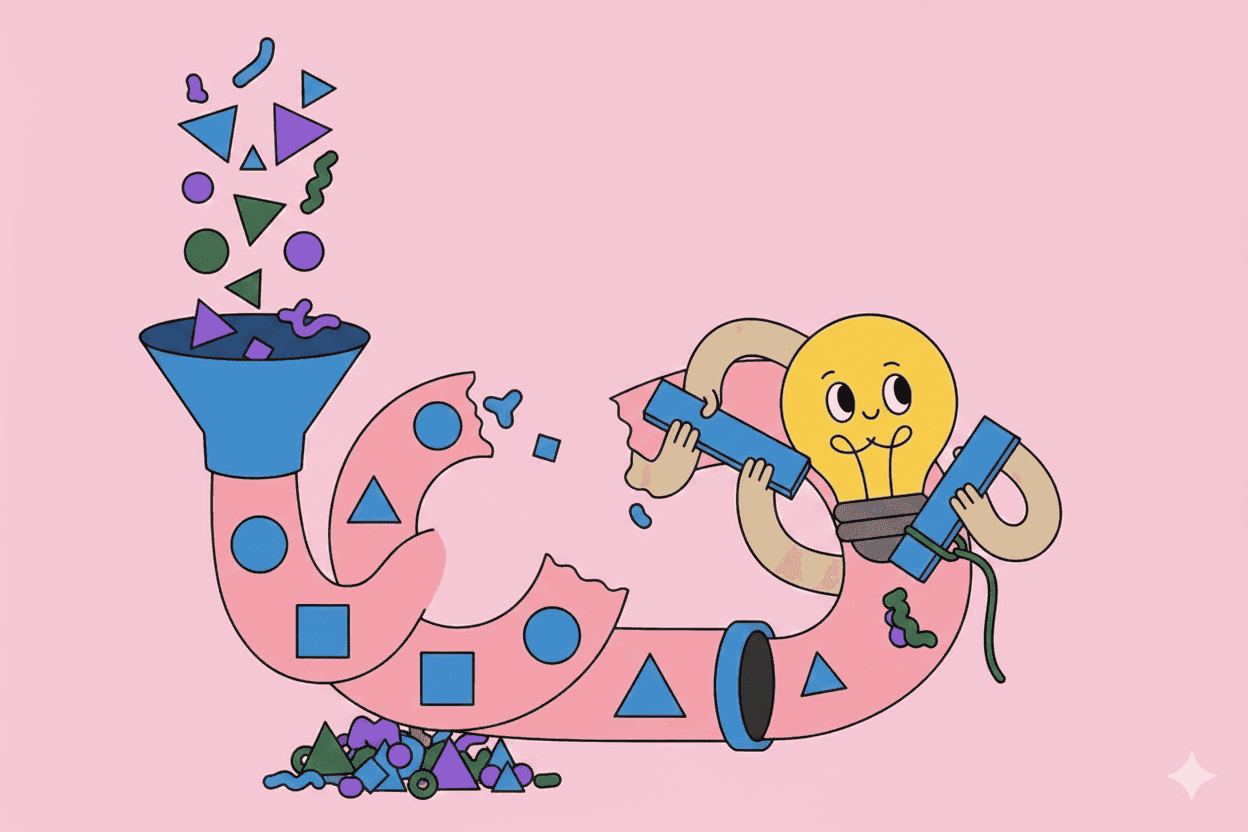
Here's a stat that should make every product leader uncomfortable: 62% of organizations say they aren't fully capitalizing on the customer experience insights they collect.
Let that sink in. Nearly two-thirds of companies are sitting on mountains of customer feedback, survey responses, support tickets, and user interviews—and can't actually do anything meaningful with it.
This isn't a data collection problem. It's an insight-to-action problem. And it's costing companies more than they realize.
The Great Customer Data Paradox
We've never had more ways to hear from customers. NPS surveys. In-app feedback widgets. Support tickets. Social mentions. App store reviews. Sales call recordings. User interviews. The list keeps growing.
But having data isn't the same as using data. According to CX Today's 2026 benchmarking report, while 40% of CX leaders claim real-time access to customer insights, 23.5% still wait more than a week for role-specific guidance. In product management, a week might as well be a quarter.
The consequences are brutal. Salesforce found that 43% of consumers will walk away from a repeat purchase after just one poor service experience. That's not a slow leak—that's a burst pipe. And most teams don't even see it coming because they're staring at dashboards instead of making decisions.
Why Traditional VoC Tools Create More Noise Than Signal
The Voice of Customer (VoC) industry has exploded over the past decade. According to Gartner's 2026 Magic Quadrant for VoC Platforms, the market is more competitive than ever, with enterprise platforms battling AI-native startups for customer attention.
But competition hasn't solved the fundamental problem: most VoC tools are really just reporting systems with prettier visuals.
Here's what typically happens:
- Collection overload: Teams set up multiple feedback channels because more data feels better
- Dashboard proliferation: Everyone gets a custom dashboard showing their slice of the feedback
- Meeting culture: Teams convene weekly to "discuss the data" without clear ownership of action items
- Analysis paralysis: By the time anyone decides what to do, the data is stale
The result? What CX Today calls "dashboard culture"—teams arguing about numbers instead of improving them.
The Data Decay Problem Nobody Talks About
Here's something even experienced product leaders overlook: customer data has a half-life.
Research suggests customer data typically deteriorates 30-40% per year as customer preferences, situations, and sentiments evolve. But some signals decay much faster—particularly emotional and intent data that captures how customers feel in a specific moment.
That frustrated user who mentioned they're "considering alternatives" three weeks ago? They're probably already gone. That feature request from your power user? Their needs have already shifted based on how your competitors evolved.
Traditional quarterly or monthly feedback analysis cycles are fundamentally broken for this reason. By the time insights reach decision-makers, the underlying reality has changed.
Why CIOs Are Abandoning Legacy Customer Service Tools
The insight-action gap isn't just frustrating product teams—it's reshaping enterprise software budgets.
Redpoint's March 2026 survey of 141 CIOs found that customer service management is the most vulnerable software category right now, with 26% of CIOs having seriously considered replacing their vendor in the last year.
Why? Because AI-native tools are proving they can close the gap between insight and action in ways legacy platforms can't.
A separate Gartner survey of 321 customer service and support leaders found that 91% are under pressure to implement AI in 2026. This isn't hype-driven adoption—it's recognition that the old way of processing customer feedback simply doesn't work anymore.
The pressure is coming from everywhere. 45% of AI budgets are replacing existing software budgets, not adding to them. When your customer buys a new AI tool, there's a nearly one-in-two chance they're cutting something else to pay for it.
What Actually Works: From Insight to Action
So what separates teams that successfully use customer feedback from those drowning in it?
1. Surface patterns, not just data points
Individual pieces of feedback are almost useless in isolation. What matters is identifying patterns across feedback sources—themes that emerge from support tickets, sales calls, user interviews, and app reviews simultaneously.
This is where AI genuinely helps. Not by generating reports, but by connecting signals that humans would miss. When three different customers mention "workaround" in three different contexts, that's a pattern worth investigating.
2. Connect feedback to revenue impact
Product teams love talking about user pain points. Finance teams love talking about revenue. The disconnect between these conversations is why so much feedback goes unactioned.
Effective insight-to-action systems tie customer feedback directly to retention risk, expansion opportunity, and acquisition barriers. When leadership can see that a specific complaint pattern correlates with a 23% higher churn rate, prioritization becomes obvious.
3. Assign ownership at the moment of insight
Here's the dirty secret of customer analytics: most companies can generate insights. Far fewer can point to the person responsible for acting on them.
Gartner predicts that 60% of organizations will soon supplement traditional surveys with conversational analytics and peer intelligence. But analytics without ownership just creates more sophisticated ways to ignore customers.
The teams that win build explicit handoffs into their insight workflows. When a pattern emerges, someone specific is responsible for investigating it. When a theme reaches a threshold, someone specific decides whether to act.
4. Reduce time-to-insight dramatically
Speed is the overlooked dimension of customer feedback. A perfect analysis delivered two months late is worth less than a directionally-correct signal delivered today.
Microsoft's 2025 Work Trend Index found that 81% of leaders expect AI agents to be moderately or extensively integrated into AI strategy within 12-18 months. The reason isn't cost savings—it's speed. When you can identify a customer pain point in hours instead of weeks, you can actually do something about it.
The Product Team's Reality Check
Let's be honest about what's happening in most product organizations:
- Too many feedback channels, not enough synthesis: You're probably collecting feedback from 5+ sources but analyzing them separately
- Quarterly insights in a weekly world: Your roadmap planning cadence doesn't match how fast customer needs are evolving
- Qualitative vs. quantitative silos: User research and product analytics are treated as separate disciplines instead of complementary signals
- Feature factory incentives: Success is measured by features shipped, not problems solved
The insight-action gap isn't a tool problem—it's a workflow problem. And no amount of dashboard improvements will fix workflows that weren't designed for action in the first place.
What Changes When You Close the Gap
Teams that successfully bridge insight and action report dramatically different outcomes:
- Faster prioritization: Instead of debating what to build next, the evidence speaks for itself
- Reduced churn: Catching retention risks early means you can address them before customers leave
- More confident roadmaps: When you know why customers need something, you can build the right solution the first time
- Better stakeholder alignment: Data-driven discussions replace opinion-driven debates
The 62% of companies struggling with their customer data aren't doomed. But they do need to fundamentally rethink how feedback flows from collection to decision.
Moving Forward
The VoC industry is at an inflection point. Traditional survey-based, dashboard-heavy approaches are giving way to AI-native systems that treat insight-to-action as a continuous workflow, not a periodic report.
For product teams, the question isn't whether to adopt these new approaches—it's how fast. Every week spent debating what customers want is a week competitors are spending building what customers need.
The companies that figure this out first won't just have better products. They'll have the only products that matter.
Building a product and struggling to make sense of customer feedback? Pelin uses AI to surface patterns across all your feedback sources and connect them to the decisions that actually matter.