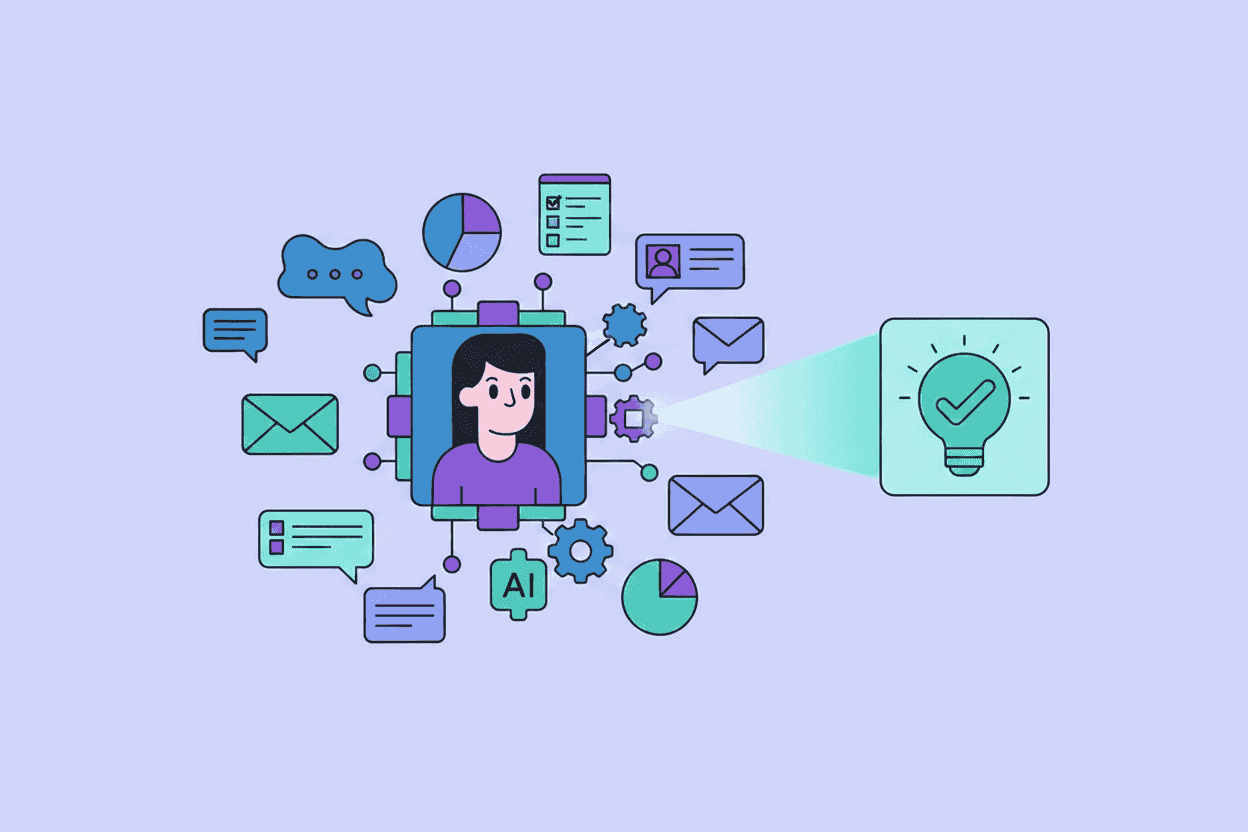
Last week, Dovetail launched what they're calling a "customer intelligence platform" — an AI-native system that promises to cut product teams' analysis time from 100 hours per week to just 10. One UX researcher reported that tasks previously taking days now take minutes.
Those aren't incremental improvements. That's a 10x productivity shift.
But here's the uncomfortable truth that launch announcement glosses over: most product teams don't need better analysis tools. They need to finally start analyzing the data they already have.
The Real Problem Isn't Access. It's Processing.
Let's be honest about what happens inside most product organizations today.
Support tickets stack up in one tool. Sales calls live in another. Survey responses sit in spreadsheets that were "temporary" two years ago. App reviews scroll past unread. NPS scores get glanced at quarterly, maybe. Customer interviews get transcribed, filed, and forgotten.
The data isn't missing. It's drowning you.
McKinsey research shows that 63% of leaders cite customer feedback as a top source for growth ideas, but only 15% say they consistently incorporate that feedback into decisions. That 48-point gap isn't a technology problem. It's an execution problem.
And the manual workflows most teams rely on make execution nearly impossible.
What 100 Hours of Manual Analysis Actually Looks Like
Picture a typical week for a product manager trying to "be customer-centric":
Monday: Export last week's support tickets. Import into a spreadsheet. Start manually tagging by theme. Get interrupted by a stakeholder meeting. Leave spreadsheet open.
Tuesday: Remember the spreadsheet. Realize you only got through 40% of the tickets. The sales team just shared five call recordings they want you to review "when you have time." Add them to the queue.
Wednesday: Customer success flags three churn signals. You need to cross-reference with previous feedback. Spend two hours searching through Notion, Google Docs, and that one Slack thread from March. Find partial answers.
Thursday: Product review meeting. Leadership asks "what are customers saying about [new feature]?" You have anecdotes. You don't have patterns. You promise a full analysis by next week.
Friday: Stare at the half-tagged spreadsheet. Realize you haven't even touched the NPS verbatims from last month. Order takeout. Work late.
This isn't a strawman. This is Tuesday for most product teams.
The Shift From Research Function to Infrastructure
What's actually interesting about Dovetail's platform launch — and similar moves from tools like Pelin — isn't the AI features themselves. It's the architectural shift they represent.
Traditional customer feedback tools treat analysis as a project. You decide you need insights about onboarding. You pull relevant data. You analyze it. You produce a report. Done.
That model made sense when data collection was expensive. If getting customer feedback required scheduling interviews, renting focus group rooms, or printing surveys, you treated each analysis as a discrete investment.
But collection isn't expensive anymore. Every interaction generates data. The problem inverted.
The new architecture treats customer intelligence as infrastructure — always-on, continuously processing, organization-wide. Data flows in automatically. Analysis happens in real-time. Insights surface when relevant, not when someone remembers to ask.
Deloitte's 2026 State of AI in the Enterprise report found that two-thirds of organizations are now reporting productivity gains from AI adoption. But only a third are genuinely reimagining their core workflows rather than bolting AI onto existing processes.
The gap between those two groups is where competitive advantage lives.
What "Always-On" Customer Intelligence Actually Means
Let's get specific about what changes when you treat customer feedback as infrastructure rather than research.
1. Themes Surface Before You Ask
In the old model, you noticed a pattern after manually tagging 200 tickets. In the new model, the system identifies emerging themes as they develop. You're not discovering that customers struggle with your new pricing page after a month of complaints. You're seeing the signal in the first week.
2. Stakeholders Get Self-Service Answers
Half the requests product managers field are some version of "what do customers think about X?" These requests create queues, delays, and back-and-forth about methodology.
With always-on intelligence, a sales rep can ask the system directly before a call. An exec can pull sentiment data for a board presentation. A designer can understand pain points without scheduling a research sync.
3. Insights Connect to Action
The gap between "we learned something" and "we did something about it" is where most customer feedback dies. When intelligence infrastructure connects directly to the tools teams already use — Linear for tickets, Slack for alerts, roadmap tools for prioritization — the path from insight to action shortens dramatically.
4. Institutional Memory Stops Being Institutional
The most common failure mode in growing companies: the person who understood why you made a decision two years ago left, and their context went with them.
When every customer conversation is captured, analyzed, and searchable, that context becomes organizational instead of personal. You can trace not just what you built, but why — back to the actual customer signals that drove the decision.
The Uncomfortable Implication
Here's what no vendor is eager to highlight: this shift makes most manual analysis work obsolete.
Not unnecessary — it was always producing value. But it's the kind of value that AI handles better. Transcription. Tagging. Theme identification. Summary generation. Pattern recognition across large datasets.
The product managers and researchers who treated "meticulous manual analysis" as their core value prop will need to rebuild around different skills: asking better questions, connecting dots AI misses, translating insights into strategy, building buy-in for uncomfortable findings.
Those skills matter more in a world where basic analysis is automated. But they're different skills.
What This Means for Your Team
If you're running a product organization today, here's the practical takeaway:
Audit your current workflow. How many hours per week does your team spend on manual categorization, transcription, and basic theme identification? That's your opportunity cost — and the upper bound of what automation saves.
Evaluate your data fragmentation. How many systems hold customer feedback? How often do people manually move data between them? Every hop is a place where signals get lost.
Question your analysis cadence. If you're doing monthly or quarterly customer insight reviews, ask why. Is that frequency driven by genuine need, or by how long manual analysis takes? If analysis were instant, would you want it more often?
Think about democratization. Who currently can answer "what do customers think about X?" If the answer is "only the product team," you're creating bottlenecks. What would change if anyone could ask?
The Bigger Picture
The Dovetail launch is one data point in a broader trend: AI is collapsing the time between customer signal and organizational response.
For years, product teams talked about being "customer-centric" while operating weeks or months behind what customers were actually saying. The feedback loop was so slow that "insight" meant "something a customer said a quarter ago that we just finished analyzing."
That's changing. The teams that adapt will build products that respond to customer needs in near real-time. The teams that don't will keep running manual analysis sprints that produce reports nobody has time to read.
The 100-hour problem isn't just about efficiency. It's about whether you're actually listening to customers, or just collecting their feedback and hoping someone eventually gets around to understanding it.
The tools to solve this exist now. The question is whether your organization is ready to use them — and what becomes possible when you do.
Pelin helps product teams turn scattered customer feedback into prioritized insights. No more spreadsheets. No more manual tagging. Just clarity on what to build next.