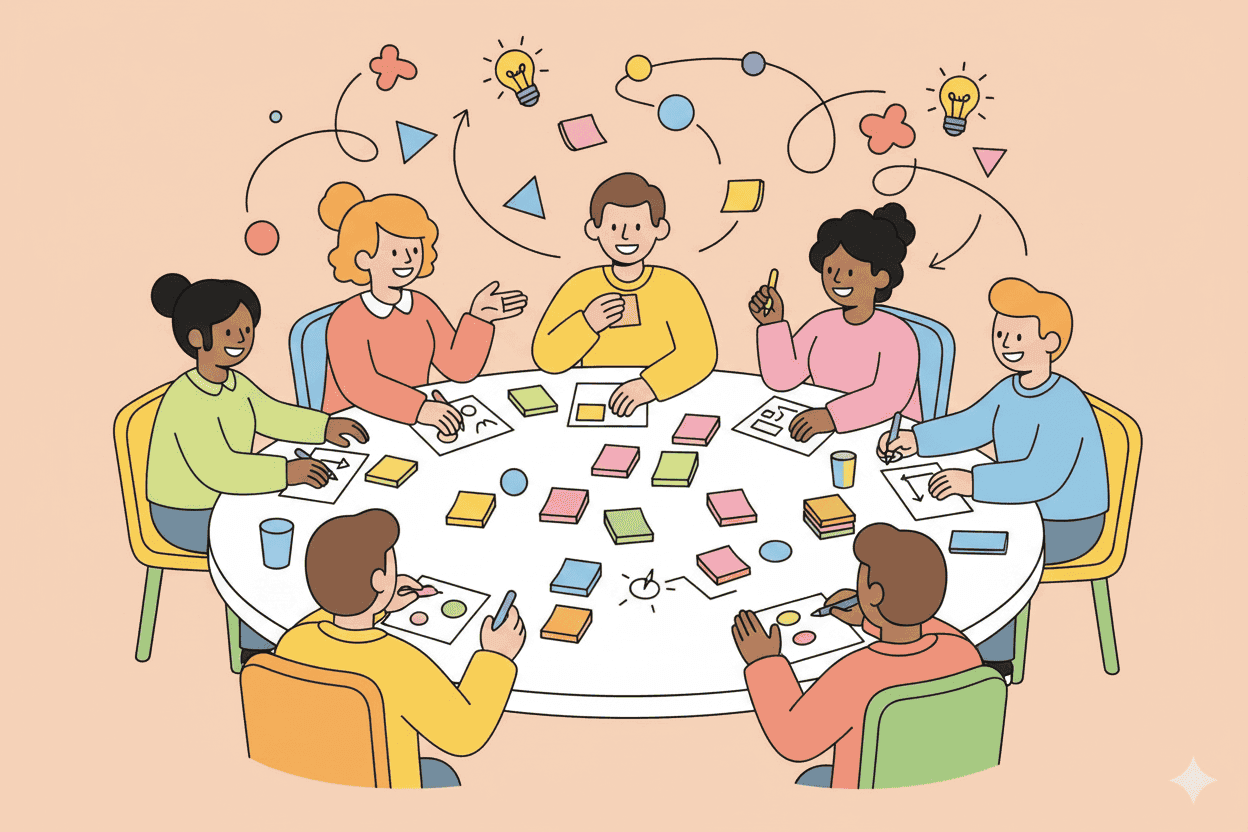
TL;DR: Co-creation workshops bring customers directly into your product development process, generating ideas that are pre-validated and building loyalty that surveys can't match. This guide covers how to plan, run, and extract value from co-creation sessions that transform customers from feedback sources into genuine product partners.
Why Co-Creation Beats Traditional Feedback Collection
Here's an uncomfortable truth: most product teams are still playing telephone with their customers.
You send surveys. You analyze support tickets. You watch session recordings. You build dashboards. And somewhere along the way, the actual human behind the feedback becomes an abstraction—a data point in your prioritization matrix.
Research from MIT Sloan shows that companies who actively involve customers in product development see 30% higher satisfaction rates and significantly faster time-to-market. Yet most B2B SaaS teams still treat customer involvement as an afterthought rather than a core competency.
Co-creation workshops flip this script entirely. Instead of extracting insights from customers, you build solutions with them.
What Exactly Is a Co-Creation Workshop?
A co-creation workshop is a facilitated session where customers actively participate in solving product problems alongside your team. Unlike focus groups (where you observe) or interviews (where you extract), co-creation puts customers in the driver's seat as collaborative designers.
Think of it as the difference between asking someone what they want for dinner versus cooking together.
Co-Creation vs. Other Research Methods
| Method | Customer Role | Output Type | Best For |
|---|---|---|---|
| Surveys | Respondent | Quantitative data | Validation at scale |
| Interviews | Informant | Qualitative insights | Deep understanding |
| Focus Groups | Reactor | Group opinions | Concept testing |
| Co-Creation | Partner | Collaborative solutions | Innovation & buy-in |
The magic of co-creation is that you're not just gathering requirements—you're building relationships. Customers who co-create feel genuine ownership over the product direction. They become your most passionate advocates because they've literally helped build what you're selling.
When Co-Creation Works (And When It Doesn't)
Co-creation isn't a replacement for other research methods. It's a powerful addition to your toolkit when used strategically.
Ideal Scenarios for Co-Creation
Entering new markets or segments. When you're building for unfamiliar territory, co-creation with target customers prevents expensive assumptions. According to CB Insights, "no market need" remains the #1 reason startups fail—co-creation directly addresses this by validating market need before you build.
Redesigning core workflows. When you're reimagining how users accomplish critical tasks, bringing power users into the design process ensures you don't break what's working while improving what isn't.
Building enterprise features. B2B buyers increasingly expect vendor partnerships, not just vendor relationships. Gartner research indicates that B2B buying decisions now involve an average of 6-10 stakeholders—co-creation helps you build for the whole buying committee, not just your primary contact.
Breaking through roadmap stalemates. When internal stakeholders disagree about direction, customer co-creation provides neutral ground and real data to resolve debates.
When to Skip Co-Creation
- Small UX tweaks: Don't assemble a workshop to decide button placement
- Technical infrastructure work: Customers care about outcomes, not architecture
- Highly regulated features: Compliance requirements may limit design flexibility
- When you need statistical significance: Co-creation generates depth, not breadth
Planning a Co-Creation Workshop That Actually Works
The difference between a productive co-creation session and an expensive waste of everyone's time comes down to preparation. Here's your planning checklist.
Step 1: Define the Problem Space (Not the Solution)
The biggest co-creation mistake is walking in with a prototype and asking customers to react. That's a focus group, not co-creation.
Instead, frame your session around a problem or opportunity area:
❌ "We're thinking about adding a Slack integration—what features would you want?"
✅ "How do you currently share customer insights across your team, and what breaks down in that process?"
The second framing invites genuine collaboration. The first just validates your existing idea.
Step 2: Recruit the Right Participants
Aim for 6-10 participants per session. Smaller groups lack energy; larger groups become unwieldy.
Ideal participant mix:
- 2-3 power users who know your product deeply
- 2-3 newer users who bring fresh perspectives
- 1-2 "churned" or at-risk customers (yes, really—they'll tell you what's missing)
- 1-2 prospects who haven't bought yet
This diversity prevents groupthink and ensures you're building for your entire customer lifecycle.
Recruitment tips:
- Offer meaningful incentives (gift cards work, but exclusive early access works better)
- Frame it as "help shape our roadmap" not "give us feedback"
- Recruit 50% more than you need—expect 30% no-shows
Step 3: Design Your Facilitation Framework
A co-creation workshop needs structure without rigidity. Here's a proven 90-minute format:
Opening (10 minutes)
- Welcome and context-setting
- Ground rules: "There are no bad ideas" and "We're here to explore, not decide"
- Quick intros (name, role, one thing they love about the product, one thing that frustrates them)
Problem Exploration (20 minutes)
- Present the problem space
- Individual reflection: "Write down 3 times you've experienced this problem"
- Pair share: Compare experiences with a partner
- Group synthesis: Identify common themes
Ideation (25 minutes)
- Crazy 8s or similar rapid ideation exercise
- Small group brainstorming (groups of 3-4)
- Dot voting to surface top ideas
Concept Development (25 minutes)
- Teams develop top 2-3 ideas into rough concepts
- Include: What it does, who it's for, why it matters
- Sketch or storyboard the user experience
Closing (10 minutes)
- Each team presents (2 minutes each)
- Open discussion and questions
- Next steps and commitment to follow up
Step 4: Prepare Your Team
Your internal participants matter as much as your customers. Bring:
- 1 facilitator: Keeps time, manages energy, ensures equal participation
- 1 product person: Provides context, answers "is this possible?" questions
- 1 note-taker: Captures insights, quotes, and ideas in real-time
- 1 observer: Watches for body language and unspoken dynamics
Brief your team beforehand: the goal is to listen and collaborate, not defend current decisions or pitch upcoming features.
Running the Workshop: Facilitation Best Practices
Even the best-planned workshop can derail without skilled facilitation. Here's how to keep things productive.
Create Psychological Safety First
Research by Google's Project Aristotle identified psychological safety as the #1 predictor of team effectiveness. The same applies to co-creation workshops.
Practical tactics:
- Acknowledge that you don't have all the answers
- Celebrate "weird" ideas publicly
- If someone's idea gets shot down, intervene: "Hold on—let's explore that further"
- Share your own mistakes and learnings to model vulnerability
Manage the Dominant Voice Problem
Every workshop has someone who loves to talk. Don't let them monopolize.
- Use written brainstorming before verbal discussion
- Call on quieter participants by name: "Sarah, we haven't heard your perspective—what do you think?"
- Break into smaller groups where introverts feel safer contributing
- Time-box contributions: "Everyone gets 60 seconds to share their top idea"
Navigate "Build This Feature" Requests
Customers will sometimes hijack co-creation sessions to pitch their pet features. Redirect without dismissing:
"I hear that you really need [feature]. Let's capture that. But for this session, I'm curious about the underlying problem you're trying to solve. If you had [feature], what would become possible that isn't possible today?"
This reframes feature requests as problem statements—which is what co-creation is designed to explore.
Document Everything (Seriously, Everything)
Real-time documentation is non-negotiable. Capture:
- Direct quotes (attributed, with permission)
- Ideas at every stage, including ones that get discarded
- Emotional reactions and energy levels
- Points of strong agreement or disagreement
- Questions that surface (even if unanswered)
Record the session if participants consent. You'll catch nuances you missed in the moment.
Extracting Value After the Workshop
The workshop is just the beginning. Most co-creation value is unlocked (or lost) in the follow-up.
Synthesize Within 48 Hours
Memory fades fast. Within two days of your session:
- Review all notes and recordings
- Cluster ideas into themes
- Identify top 3-5 concepts worth developing further
- Document participant quotes that bring concepts to life
- Note surprises—what did you learn that contradicted your assumptions?
Close the Loop With Participants
This is where most teams fail. Qualtrics research shows that closing the feedback loop increases customer satisfaction by up to 20%—and co-creation participants expect even more follow-through.
Within one week:
- Send a thank-you email with session highlights
- Share what you learned and what's next
- Give participants visibility into how their input shapes decisions
Within one month:
- Update participants on concept development
- Invite them to review prototypes if applicable
- Ask if they'd participate in future sessions
Feed Insights Into Your Product Process
Co-creation outputs should flow into your regular product workflows:
- Add concepts to your opportunity backlog
- Use customer quotes in PRDs and specs
- Reference workshop findings in prioritization discussions
- Create artifacts (personas, journey maps) that persist beyond the session
This is where AI tools become invaluable. Manually synthesizing workshop recordings, clustering themes, and connecting insights to existing feedback is tedious and error-prone. Tools like Pelin can automatically extract themes from co-creation sessions, connect them to patterns in your broader customer feedback, and surface opportunities you might miss in manual analysis.
Building a Co-Creation Program (Not Just One-Off Sessions)
The real power of co-creation comes from making it systematic. Here's how to scale.
Establish a Customer Advisory Board
Formalize your co-creation participants into an ongoing advisory board. This creates:
- A reliable recruiting pool for future sessions
- Deeper relationships that yield richer insights over time
- Brand advocates who feel genuine ownership
Structure: Quarterly sessions (1-2 hours each), clear expectations, meaningful recognition (early access, executive dinners, conference invites).
Rotate Focus Areas
Create an annual calendar that cycles through different product areas:
- Q1: Core workflow optimization
- Q2: New market/persona exploration
- Q3: Integration and ecosystem
- Q4: Future vision and strategic direction
This ensures comprehensive coverage and prevents co-creation fatigue around any single topic.
Measure and Iterate
Track metrics that matter:
- Participation rate: Are customers excited to join?
- Idea implementation rate: How many co-created concepts ship?
- NPS of participants: Do they feel valued?
- Revenue correlation: Do co-creation participants expand faster?
Common Co-Creation Mistakes (And How to Avoid Them)
Mistake #1: Treating it like a demo. If you spend more than 10% of the session showing your product, you're doing it wrong. Co-creation is about listening and building together, not pitching.
Mistake #2: Inviting only happy customers. Your cheerleaders will tell you what you want to hear. Mix in critics and churned customers for balance.
Mistake #3: Over-promising follow-through. Don't imply that everything discussed will get built. Be explicit that this is exploration, not commitment.
Mistake #4: Failing to bring insights back to customers. Nothing kills future participation faster than radio silence after a session.
Mistake #5: Running co-creation in isolation. Connect co-creation outputs to other research streams. A great idea from a workshop should be validated with broader customer data before you invest heavily.
Getting Started: Your First Co-Creation Workshop
Ready to try co-creation? Start small:
- Pick one problem area where you genuinely don't know the answer
- Recruit 6-8 customers with diverse perspectives
- Block 90 minutes and prepare a loose facilitation guide
- Run the session with curiosity and humility
- Follow up within a week with what you learned
The first session won't be perfect. That's fine. Like any skill, facilitation improves with practice. What matters is that you've started building products with your customers rather than just for them.
Key Takeaways
- Co-creation transforms customers from feedback sources into collaborative product partners
- Sessions work best when framed around problems, not solutions
- Diverse participant mix prevents groupthink and blind spots
- Psychological safety is essential—facilitate explicitly for it
- Follow-up determines whether co-creation generates lasting value
- AI tools like Pelin can help synthesize and connect co-creation insights to broader customer feedback patterns
- Build co-creation into a systematic program, not just occasional sessions
The best products aren't built in conference rooms by people guessing what customers want. They're built in partnership with the people who use them every day.
Start your first co-creation workshop this month. Your roadmap will thank you.