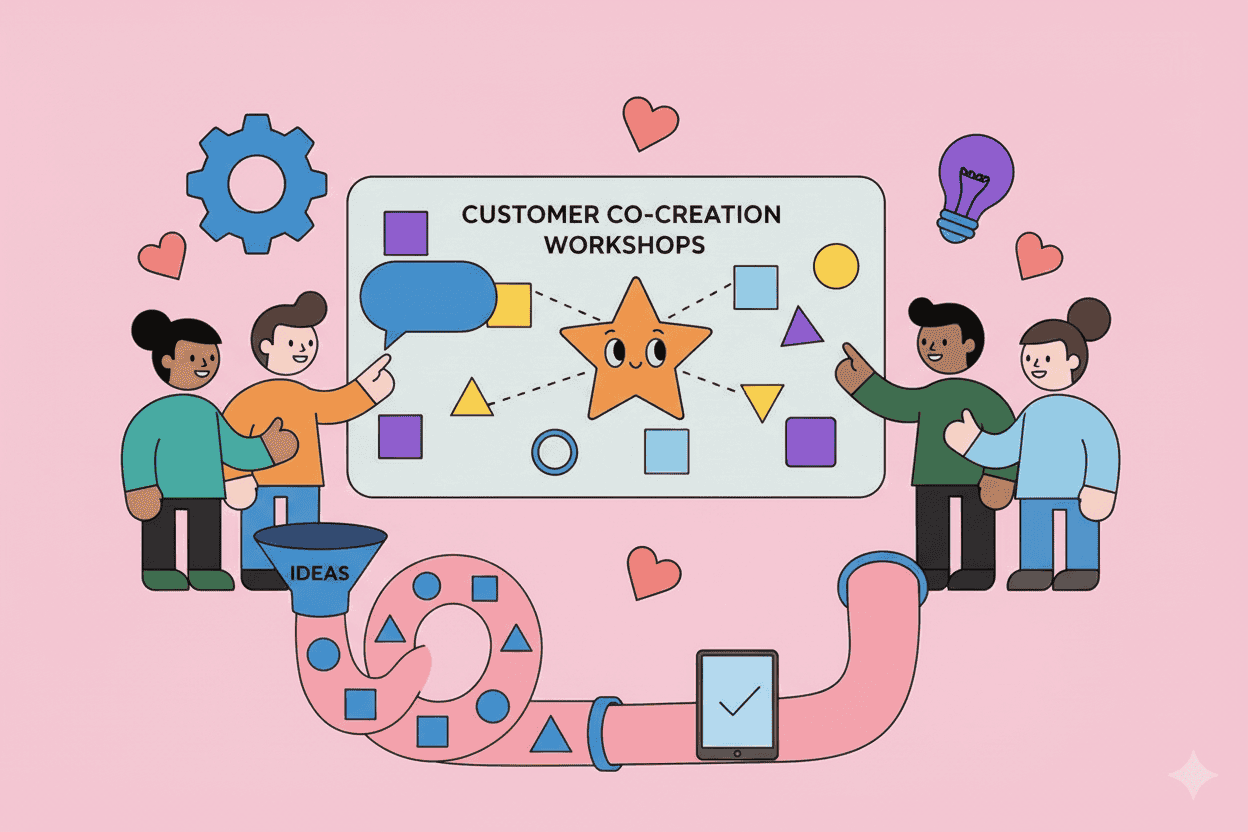
TL;DR: Customer co-creation workshops involve your users directly in product development—not just asking what they want, but building solutions together. Companies using co-creation see 41% higher market success rates compared to pure in-house development. This guide covers workshop formats, facilitation techniques, and how to translate collaborative sessions into actual product decisions.
You've done the user interviews. You've analyzed the NPS data. You've read through hundreds of support tickets. But somehow, when you ship the feature, it still misses the mark.
Sound familiar?
The problem isn't that you're not listening to customers—it's that you're asking them to describe solutions to problems they can't fully articulate. Co-creation workshops flip this dynamic by making customers active participants in the design process, not just sources of feedback.
What Are Customer Co-Creation Workshops?
Co-creation workshops are structured collaborative sessions where customers and product teams work together to solve specific product challenges. Unlike traditional focus groups where customers react to your ideas, co-creation puts customers in the driver's seat of solution design.
The concept comes from participatory design, a methodology developed in Scandinavian countries in the 1970s. But it's found new life in product-led organizations that recognize customers often understand their problems better than any research report can capture.
Co-Creation vs. Traditional User Research
| Approach | Customer Role | Output |
|---|---|---|
| Surveys | Respondent | Quantitative data |
| Interviews | Informant | Qualitative insights |
| Focus Groups | Evaluator | Reactions to concepts |
| Co-Creation | Co-designer | Collaborative solutions |
The distinction matters. When you ask customers "what do you want?" you get feature requests. When you invite them to design solutions alongside your team, you get insight into the underlying problems—and often, creative solutions you'd never have considered.
Why Co-Creation Works Better Than Asking
There's a reason 66% of new products fail within two years of launch: building products based on assumed customer needs rarely survives contact with reality.
Co-creation addresses this by:
Surfacing tacit knowledge. Customers know things about their workflow, constraints, and workarounds that they can't articulate in an interview. Watching them sketch solutions reveals these hidden requirements.
Validating problems before solutions. When customers participate in designing the solution, you get real-time validation that you're solving an actual problem.
Building customer investment. Customers who co-create feel ownership over the product. They become advocates, not just users.
Research backs this up. Focus group involvement during design phases cuts iteration cycles by up to 30%, according to McKinsey analysis. That's not just better products—it's faster time to market.
Four Workshop Formats That Actually Work
1. Problem Mapping Sessions (2-3 hours)
Best for: Early discovery, understanding the problem space
In this format, customers map their current workflow and pain points visually. Your team observes and asks clarifying questions, but doesn't propose solutions.
How to run it:
- Provide large paper sheets and markers
- Ask customers to draw their current process for [specific task]
- Have them mark frustration points with red stickers
- Cluster similar problems across participants
- Vote on which problems cause the most friction
Pro tip: Record these sessions with permission. The language customers use to describe problems is gold for your messaging and documentation.
2. Ideation Sprints (Half-day)
Best for: Generating solution concepts for validated problems
Once you understand the problem, bring customers in to brainstorm solutions. This isn't about feasibility—it's about capturing every possible approach.
How to run it:
- Brief participants on the specific problem being solved
- Run individual brainstorming (5 minutes silent sketching)
- Gallery walk: everyone reviews all ideas without discussion
- Small group refinement: combine and enhance promising concepts
- Pitch session: groups present top concepts to everyone
What you're looking for: Patterns across multiple customers' solutions often reveal the "obvious" answer you've been too close to see.
3. Prototype Testing Workshops (2-4 hours)
Best for: Validating concepts before engineering investment
Bring rough prototypes—wireframes, paper mockups, or clickable demos—and let customers interact with them while thinking aloud.
How to run it:
- Prepare 2-3 prototype variations of the same feature
- Give each customer time with each prototype
- Ask them to complete specific tasks while narrating their thought process
- Capture what confuses them, delights them, and what they'd change
- Group discussion: which approach best solves the problem?
Critical: Don't defend your designs. When customers critique something, ask "what would make this work better?" not "but did you see the button over here?"
4. Assumption Testing Sessions (1-2 hours)
Best for: De-risking major product bets
Every product decision contains assumptions. This workshop format surfaces and tests them directly with customers.
How to run it:
- List your top 5 assumptions about the product decision
- Frame each as a hypothesis: "We believe [customers] will [behavior] because [reason]"
- Walk customers through each assumption
- Ask: "Does this match your reality? What would need to be true for this to work for you?"
- Rate each assumption as validated, invalidated, or needs more research
This format is brutally efficient at killing bad ideas before they consume development resources.
Recruiting the Right Participants
Not all customers make good co-creators. You want people who:
- Use your product regularly (or would, if it solved their problem)
- Can articulate their workflow beyond "it just works" or "it's frustrating"
- Represent different segments of your user base
- Have time and interest to participate meaningfully
Avoid customers who are too agreeable (they'll validate everything) or too negative (they'll derail productive discussion).
How Many Participants?
- Problem mapping: 5-8 customers per session
- Ideation sprints: 6-10 mixed group (customers + team)
- Prototype testing: 3-5 customers per concept
- Assumption testing: 4-6 customers
Run multiple sessions if you need to cover different personas or segments. Cross-departmental teams increase project success rates by 29%, so consider including sales, support, and customer success alongside product.
Facilitation Techniques That Make or Break Workshops
Create Psychological Safety First
Customers need to feel comfortable disagreeing with your team. Start every session by explicitly stating:
- There are no wrong answers
- We want honest reactions, not politeness
- Criticism helps us build better products
- You're the expert on your own needs
Use "How Might We" Framing
Instead of asking "What should we build?" try:
- "How might we reduce the time you spend on [task]?"
- "How might we make [process] less frustrating?"
- "How might we help you avoid [problem]?"
This framing opens creative space without constraining solutions.
Silence Is Your Friend
After asking a question, wait. Count to ten silently. Customers need processing time, and the best insights often come from people who think before speaking.
Document Everything
Assign someone to capture:
- Direct quotes (verbatim language matters)
- Sketches and artifacts customers create
- Non-verbal reactions (confusion, excitement, frustration)
- Patterns across multiple participants
Turning Workshop Output Into Product Decisions
This is where most teams fumble. You've run a great workshop, generated pages of insights, and then... the momentum dies.
Within 24 Hours
- Send thank-you notes to participants
- Share raw notes with the broader team
- Schedule a synthesis session
Within One Week
- Cluster insights by theme
- Identify the top 3-5 actionable opportunities
- Create hypothesis cards for each opportunity
- Estimate effort and impact for prioritization
Within One Month
- Update your roadmap based on workshop findings
- Share back with participants what you learned
- Begin prototyping top opportunities
Closing the loop with participants isn't just polite—customers who see their input reflected in product decisions have retention rates 50% higher than those who don't.
Common Mistakes to Avoid
Treating workshops as validation theater. If you've already decided what to build and you're just looking for customers to confirm it, you're wasting everyone's time.
Including too many stakeholders. Your workshop shouldn't have more internal people than customers. Customers feel outnumbered and defer to "the experts."
Skipping synthesis. A workshop without structured follow-up is just an expensive conversation.
Only inviting happy customers. Your most frustrated customers often provide the best insights—if you can facilitate productively.
Running one workshop and calling it done. Co-creation is a muscle. The more you do it, the better you get, and the more valuable your customer relationships become.
Scaling Co-Creation Without Losing Quality
As your product and team grow, you can't run in-person workshops with every customer segment. Here's how to scale:
Async co-creation tools: Platforms like Miro or FigJam allow customers to contribute ideas asynchronously, which you can then synthesize.
Customer advisory boards: Build a standing panel of 10-15 engaged customers who participate in regular co-creation activities.
Beta communities: Create a dedicated space where power users can preview features and co-design improvements.
AI-assisted analysis: Tools like Pelin can analyze customer feedback across channels to identify co-creation opportunities—surfacing the problems worth workshopping before you schedule the session.
Getting Started This Week
You don't need a formal research ops team or a dedicated budget to start. Here's a minimal viable co-creation approach:
- Identify one specific product question you're trying to answer
- Reach out to 4-5 customers who'd be affected by the decision
- Schedule a 60-minute video call with a simple agenda
- Prepare 2-3 "how might we" questions and rough concepts to react to
- Document insights and share with your team within 48 hours
The first workshop is always rough. That's okay. The goal is to build the habit of involving customers in product decisions—not to run a perfect research study.
Key Takeaways
- Co-creation workshops involve customers in designing solutions, not just providing feedback
- Companies using co-creation see significantly higher market success rates and faster iteration cycles
- Four formats to try: problem mapping, ideation sprints, prototype testing, and assumption testing
- Recruit diverse participants who can articulate their needs—5-10 per session is usually ideal
- Close the loop: share what you learned and how it influenced your roadmap
- Start small: one focused question, a few customers, one hour—and build from there
The best products aren't built for customers—they're built with them. Co-creation workshops are how you make that collaboration concrete.