Your analytics dashboard shows what users do. Surveys tell you what they think. But neither reveals why they behave the way they do—or what they really need that you haven't built yet.
That's where customer focus groups shine.
Focus groups remain one of the most effective qualitative research methods for product teams, delivering the kind of rich, contextual insights that spreadsheets can't capture. When Pragmatic Institute surveyed product professionals, the message was clear: companies that regularly engage customers through structured dialogues build stronger, more profitable relationships and make better product decisions.
Yet many product teams skip focus groups entirely, dismissing them as "old school" market research. That's a mistake. Here's how to run focus groups that actually move the needle.
TL;DR: Key Takeaways
- Focus groups reveal the "why" behind customer behavior that surveys miss
- Optimal group size is 6-10 participants for dynamic conversation
- Plan for 60-90 minute sessions with clear objectives
- Mix participant types strategically—don't just invite your happiest customers
- Always close the loop by sharing what you learned and what you'll do about it
What Makes Focus Groups Different From Other Research Methods
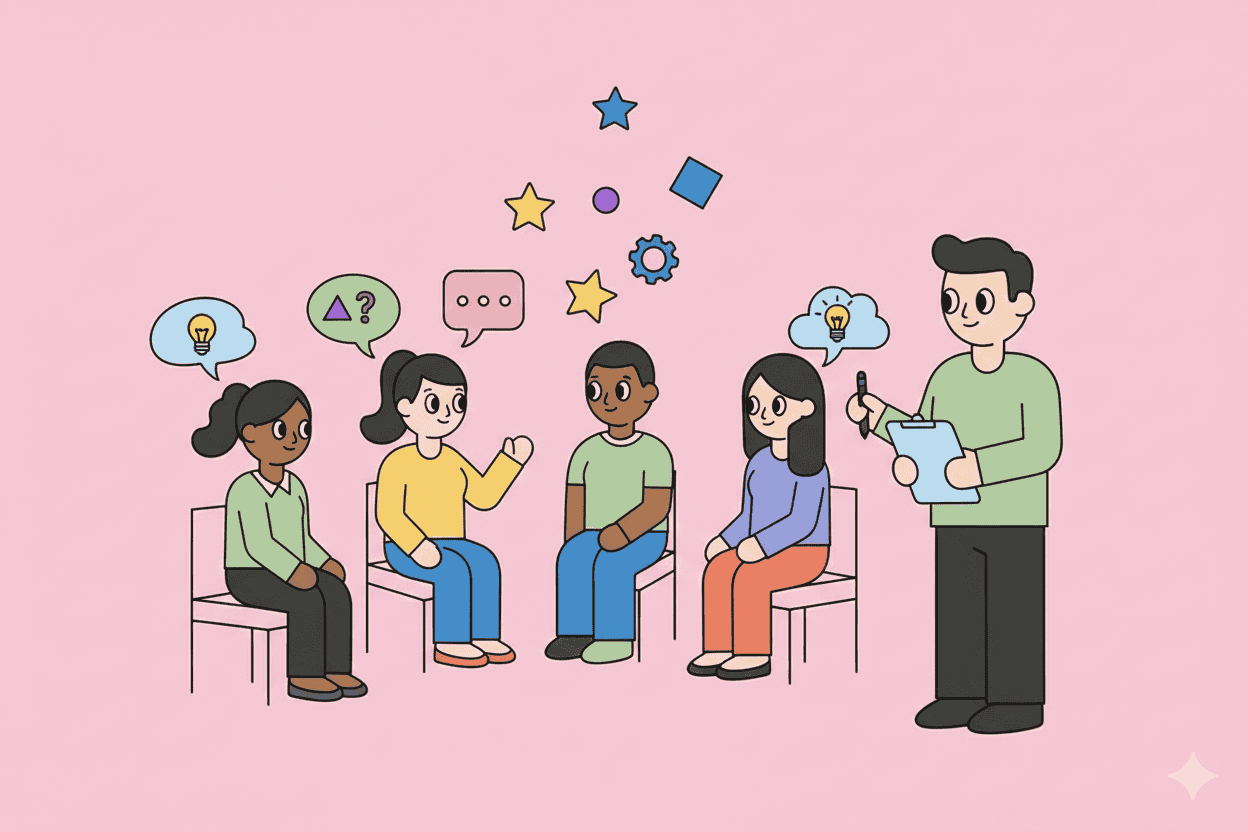
Focus groups are structured conversations with 6-10 carefully selected customers, led by a skilled moderator. Unlike one-on-one interviews, focus groups create dynamic interactions where participants build on each other's ideas and challenge assumptions.
According to Shopify's research guide, focus groups emerged during World War II as "focused interviews" to evaluate wartime propaganda. By the 1960s, the private sector adopted the method for product development and advertising—and it's stuck around because it works.
Focus Groups vs. Other Methods
| Method | Best For | Limitations |
|---|---|---|
| Focus Groups | Understanding motivations, testing concepts, generating ideas | Small sample size, group dynamics can skew results |
| Surveys | Quantifying opinions, measuring satisfaction | Misses the "why," limited depth |
| 1:1 Interviews | Deep individual exploration, sensitive topics | Time-intensive, no group dynamic |
| Usability Tests | Validating specific flows, finding friction | Narrow scope, task-focused |
The magic of focus groups is the group dynamic itself. When one participant mentions a frustration, others nod along or offer their own experience. You see patterns emerge in real-time that would take weeks to surface through other methods.
When to Use Focus Groups (And When Not To)
Focus Groups Work Best For:
Concept testing: Before investing months in development, put early concepts in front of customers. Watch their reactions—the raised eyebrows, the excited leaning forward, the polite but unenthusiastic "that's interesting."
Understanding purchase decisions: Why did they choose you over competitors? What almost made them leave? Focus groups reveal the emotional and practical factors that drive decisions.
Exploring pain points: Analytics show where users drop off. Focus groups tell you why—and often uncover problems you didn't know existed.
Generating new ideas: Sometimes your best product ideas come from customer conversations. Focus groups create space for "what if" discussions that spark innovation.
Validating messaging: Is your positioning resonating? Do customers understand your value prop? Hearing customers repeat (or struggle with) your messaging is revealing.
Skip Focus Groups When:
- You need statistically significant data (use surveys instead)
- The topic is sensitive or embarrassing (use 1:1 interviews)
- You're testing specific UI flows (use usability testing)
- You need immediate answers (focus groups take weeks to plan properly)
Planning Your Focus Group: The Pre-Work That Makes or Breaks It
Step 1: Define Clear Objectives
Running a focus group without objectives is shooting in the dark. Get specific:
❌ "Learn about customer needs" ✅ "Validate whether our proposed pricing tier structure matches how customers perceive value"
❌ "Get feedback on the product"
✅ "Understand which three features drive the most value for mid-market customers and why"
Your objectives should be measurable. According to Pragmatic Institute, you might count a session successful if "at least 80% of participants strongly endorse your product strategy" or "40% indicate serious purchase intent."
Step 2: Recruit the Right Participants
This is where most focus groups fail. Product teams often default to inviting their happiest customers—the ones who always respond to feedback requests. That gives you a skewed picture.
Mix your participant types:
- Power users AND casual users
- Long-time customers AND recent signups
- Satisfied customers AND churned/at-risk customers
- Different company sizes, industries, or use cases
Screening criteria to consider:
- Have they used your product recently (last 30-90 days)?
- Do they match your target persona?
- Have they participated in focus groups recently? (Screen out "professional participants")
- Do they have conflicts of interest?
Aim for 8-10 confirmed participants to account for no-shows. You want 6-8 people in the actual session.
Step 3: Create a Win-Win for Participants
Why would busy professionals spend 90 minutes talking to you? Make it worth their while:
- Early access to new features or product roadmap
- Peer networking with others in similar roles
- Executive access to your leadership team
- Incentives like gift cards, account credits, or swag
- Expense coverage for travel (for in-person sessions)
The best incentive is often simply feeling heard. When customers believe their input will actually influence product direction, they show up enthusiastic.
Step 4: Develop Your Discussion Guide
Your discussion guide is the backbone of the session. It's not a script to read verbatim—it's a roadmap that keeps conversation productive.
Sample 90-minute structure:
| Time | Section | Purpose |
|---|---|---|
| 0-10 min | Introductions | Build comfort, establish ground rules |
| 10-25 min | Context setting | Understand participants' situations |
| 25-55 min | Core exploration | Deep dive on main objectives |
| 55-75 min | Concept testing | Present specific ideas for reaction |
| 75-85 min | Prioritization | Force-rank what matters most |
| 85-90 min | Wrap-up | Thank participants, explain next steps |
Question types that work:
- Opening questions: "Tell us about your role and how you use [product category]"
- Exploration questions: "Walk me through the last time you [relevant task]"
- Probing questions: "You mentioned X was frustrating—can you tell me more?"
- Projection questions: "If you had a magic wand, what would you change?"
- Prioritization questions: "Of these three options, which matters most and why?"
Running the Session: Moderation Best Practices
Choose the Right Moderator
The moderator makes or breaks your focus group. They need to:
- Keep discussion on track without being controlling
- Draw out quiet participants without embarrassing them
- Prevent dominant personalities from taking over
- Stay neutral (no "great idea!" reactions that bias responses)
- Listen actively and probe deeper when needed
Many teams hire professional moderators for high-stakes sessions. The advantage: neutrality and experience. The disadvantage: they don't know your product as deeply as you do.
If moderating yourself, practice beforehand. Record yourself and watch for leading questions or biased reactions.
Set Ground Rules Early
Start the session by establishing expectations:
- "There are no wrong answers—we want honest reactions"
- "Please speak one at a time so our recording captures everything"
- "Feel free to disagree with each other—debate is valuable"
- "We'll have time at the end for questions about [topic]"
Watch for Non-Verbal Signals
Some of the best focus group insights come from what people don't say. Watch for:
- Nodding or head shaking when others speak
- Crossed arms or leaning back (defensiveness, disagreement)
- Leaning forward, animated gestures (engagement, excitement)
- Exchanged glances between participants (shared understanding)
- Hesitation or qualification before answering
These signals often reveal more than words. When you see strong non-verbal reactions, probe deeper: "I noticed some nodding when Sarah mentioned that—does that resonate with others?"
Manage Group Dynamics
Every focus group has the dominant talker who loves the sound of their own voice and the quiet observer who has great insights but won't volunteer them.
For dominant participants:
- "Thanks, that's helpful. Let's hear from some others."
- Direct questions to quieter participants by name
For quiet participants:
- "Alex, you've been in this situation before—what's your take?"
- Use "round-robin" questions where everyone responds in turn
For tangents:
- "That's interesting—let me capture that for later. For now, let's get back to..."
After the Session: Analysis and Action
Immediate Debrief
Within 24 hours of the session, gather everyone who observed and capture:
- Top 3-5 insights that surprised you
- Themes that multiple participants mentioned
- Specific quotes worth preserving
- Questions that need further exploration
- Preliminary recommendations
Don't wait. Memory fades quickly, and your "in the moment" impressions are valuable.
Systematic Analysis
For deeper analysis:
- Transcribe the recording (AI tools like Otter.ai can help)
- Code themes by tagging quotes with categories
- Count frequency of themes across participants
- Note intensity of emotional reactions
- Identify patterns across participant types
This is where AI-powered tools like Pelin become invaluable. Manually analyzing focus group transcripts takes hours. AI can surface themes, categorize feedback, and connect insights to patterns from other sources—support tickets, surveys, sales calls—giving you a complete picture instead of isolated anecdotes.
Close the Loop
This is the step most teams skip—and it's arguably the most important.
Tell participants what you learned and what you'll do about it. Even if you can't act on everything, acknowledging their input builds trust and ensures they'll participate again.
Send a follow-up email within two weeks:
- "Here's what we heard..."
- "Here's what we're planning to do about it..."
- "Here's the timeline for changes..."
As Pragmatic Institute emphasizes, "When customers see actual results from their efforts, they have a stronger stake in your success and are encouraged to participate in the future."
Common Focus Group Mistakes (And How to Avoid Them)
Mistake 1: Recruiting Only Happy Customers
The problem: You get a rosy picture that doesn't reflect reality.
The fix: Deliberately include churned customers, at-risk accounts, and users who've submitted complaints. Their feedback is the most valuable.
Mistake 2: Leading Questions
The problem: "Don't you think this new design is easier to use?" practically begs for agreement.
The fix: Use neutral phrasing: "What's your reaction to this design?" or "How does this compare to the current version?"
Mistake 3: Presenting Too Much
The problem: You spend 45 minutes presenting your roadmap, leaving 15 minutes for actual discussion.
The fix: Follow the 30/70 rule: spend 30% of time presenting, 70% listening.
Mistake 4: Not Recording
The problem: You're relying on memory and incomplete notes.
The fix: Always record (with permission). You'll catch nuances you missed live.
Mistake 5: Ignoring Conflicting Data
The problem: Focus group says X, but your analytics say Y.
The fix: Neither is "wrong." Focus groups reveal motivation; analytics reveal behavior. Investigate the gap—that's where the insight lives.
How AI Changes the Focus Group Game
Traditional focus group analysis is time-consuming. Transcription, coding, theme identification—it can take longer than running the session itself.
AI-powered customer insight platforms like Pelin can:
- Auto-transcribe recordings with speaker identification
- Surface themes across multiple focus group sessions
- Connect insights to patterns from other feedback sources
- Track sentiment shifts over time as you make product changes
- Generate summaries that highlight what matters most
This doesn't replace the human judgment needed to interpret focus group data. But it dramatically reduces the grunt work, letting you focus on what the insights mean for your product strategy.
Your Focus Group Checklist
2-4 Weeks Before:
- Define clear, measurable objectives
- Identify participant criteria and create screener
- Recruit 8-10 participants (expect 20-30% no-show)
- Book venue or set up video conferencing
- Draft discussion guide
1 Week Before:
- Send calendar invites with joining details
- Confirm participants (send reminder)
- Test recording equipment
- Brief observers on their role
- Finalize discussion guide
Day of Session:
- Arrive early, test tech again
- Prepare participant welcome materials
- Run the session
- Conduct immediate debrief
1-2 Weeks After:
- Complete full analysis
- Share insights with stakeholders
- Close the loop with participants
- Document learnings for future sessions
Start Small, Learn Fast
You don't need to run elaborate focus groups to get value. Start with a single session of 6-8 customers focused on your most pressing product question. Learn from what works and what doesn't. Then iterate.
The companies that build products customers actually want aren't the ones with the most sophisticated research operations. They're the ones who consistently show up, ask good questions, and actually listen to the answers.
Your customers have the insights you need. Focus groups are just a structured way to hear them.