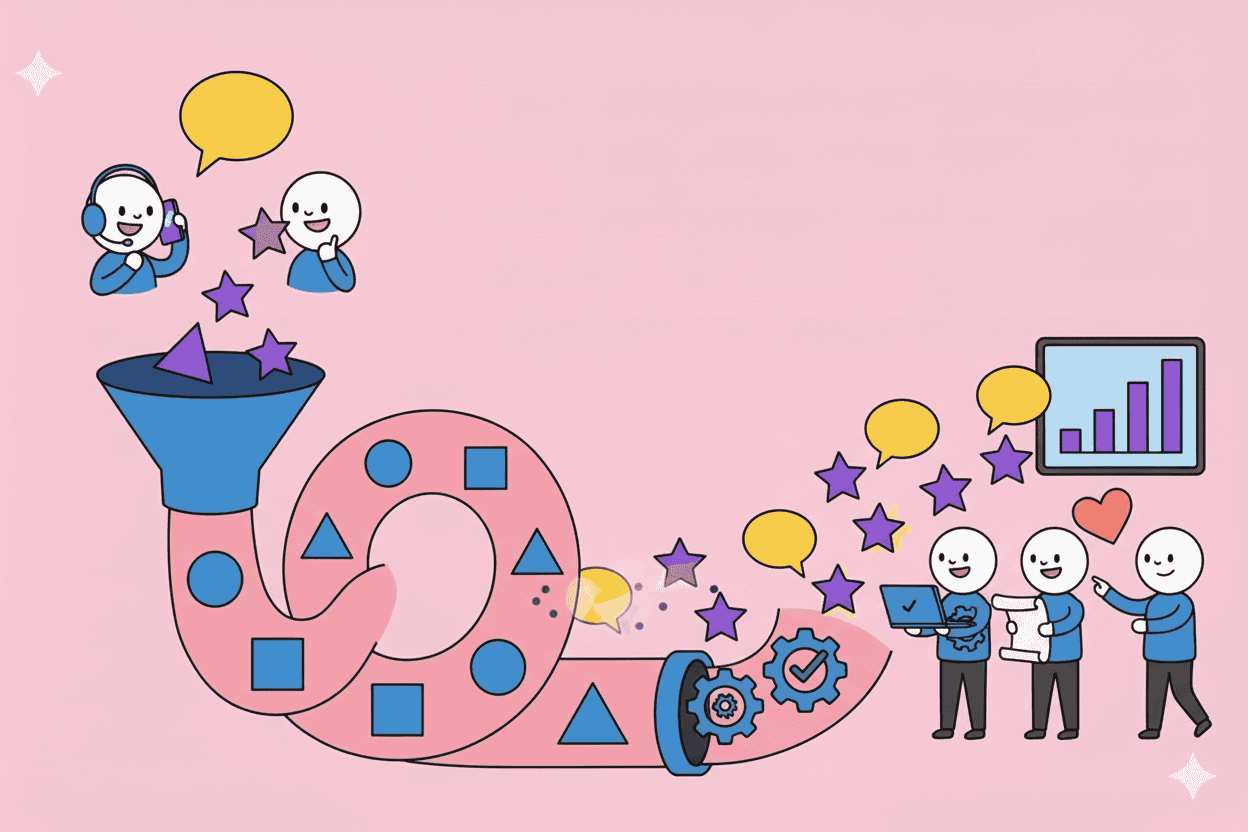
Your sales team talks to customers every single day. They hear the frustrations, the feature requests, and the "if only your product could..." conversations. Meanwhile, your product team is making roadmap decisions based on surveys from six months ago.
Sound familiar?
The gap between sales-gathered insights and product decision-making is one of the most expensive problems in SaaS. According to ProductPlan's 2024 State of Product Management report, 74% of product managers cite "getting quality customer feedback" as their biggest challenge—even when their sales teams are swimming in it.
TL;DR: Key Takeaways
- Sales teams collect invaluable customer feedback daily, but most of it never reaches product teams
- Structured feedback handoff processes can reduce wasted development cycles by up to 40%
- The key is making feedback capture effortless for salespeople while ensuring data quality for product
- AI tools can automate the heavy lifting—categorization, prioritization, and pattern detection
- Start simple: one feedback channel, one weekly sync, one shared dashboard
Why the Telephone Game Kills Products
Remember the telephone game from childhood? One person whispers a message, it passes through ten people, and what emerges barely resembles the original.
That's exactly what happens to customer feedback in most organizations:
- Customer tells sales rep about a pain point
- Sales rep mentions it in passing at a team meeting
- Sales manager summarizes it in a monthly report
- Report sits in someone's inbox for three weeks
- Product eventually hears a watered-down version
By the time insights reach product teams, they've lost context, urgency, and often accuracy. Research from Gartner suggests that companies with poor cross-functional feedback loops waste up to 35% of development resources building features customers don't actually want.
The Real Cost of Feedback Silos
Let's talk numbers. When sales and product operate in silos:
- Lost competitive deals: Sales knows exactly why you're losing to competitors, but product doesn't hear it until quarterly reviews
- Wasted sprints: Engineering builds features based on assumptions while real customer requests go unheard
- Churn you could've prevented: Forrester research shows that 67% of churn is preventable with better customer listening
- Demoralized sales teams: Nothing kills motivation faster than repeatedly flagging issues that never get addressed
Building an Effective Feedback Handoff Process
Step 1: Make Capture Effortless
The biggest mistake companies make? Creating elaborate feedback forms that salespeople never fill out.
Your sales team is busy closing deals. Every minute spent documenting feedback is a minute not spent selling. The solution isn't to guilt them into compliance—it's to make feedback capture nearly effortless.
What works:
- Slack/Teams integrations where reps can drop feedback in a dedicated channel
- CRM fields that auto-capture key phrases from call notes
- Voice-to-text tools that transcribe customer conversations
- One-click tagging systems with predefined categories
What doesn't:
- 15-field feedback forms
- Mandatory weekly written reports
- Separate systems from existing workflows
Step 2: Establish a Clear Taxonomy
Not all feedback is created equal. Without a shared language, "customer wants better reporting" could mean anything from "add a pie chart" to "completely rebuild our analytics engine."
Create a simple taxonomy that both teams understand:
| Category | Definition | Example |
|---|---|---|
| Bug Report | Something isn't working as expected | "Export fails for files over 10MB" |
| Feature Request | New functionality | "Need integration with HubSpot" |
| UX Friction | Existing feature is hard to use | "Can't find where to change settings" |
| Competitive Gap | Competitor has something we don't | "Competitor X offers bulk editing" |
| Praise | What's working well | "Love the new dashboard" |
Step 3: Create a Feedback Loop (Not a Black Hole)
Here's the uncomfortable truth: sales teams stop sharing feedback when they feel like it disappears into a void.
According to Salesforce's State of Sales report, 72% of high-performing sales organizations have formal feedback loops with product teams—compared to just 28% of underperformers.
The fix is simple: close the loop.
- Weekly sync meetings: 30 minutes where product shares what they heard, what they're building, and why
- Status updates: When feedback influences a roadmap decision, tell the person who shared it
- Public roadmap: Let sales see what's coming so they can set accurate customer expectations
Step 4: Prioritize Ruthlessly
You'll collect more feedback than you can ever act on. That's okay—but you need a system to separate signal from noise.
Effective prioritization frameworks consider:
- Frequency: How many customers are asking for this?
- Revenue impact: Are these requests coming from your highest-value segments?
- Strategic alignment: Does it support company goals?
- Effort-to-impact ratio: What's the development cost vs. expected benefit?
Weight feedback from churned customers heavily—they're telling you exactly why they left. According to Bain & Company, acquiring a new customer costs 5-25x more than retaining an existing one.
How AI is Transforming Feedback Handoffs
Manual feedback processing doesn't scale. When you're collecting insights from dozens of sales conversations daily, human categorization becomes a bottleneck.
This is where AI-powered tools change the game:
- Automatic categorization: AI can tag and sort feedback in real-time, eliminating the classification backlog
- Pattern detection: Spot trends before they become obvious—like a rising complaint category or regional variation
- Sentiment analysis: Understand not just what customers say, but how they feel about it
- Duplicate detection: Consolidate similar feedback so you see true demand volume
Tools like Pelin can automatically aggregate feedback from sales calls, support tickets, and surveys into a unified view—then surface the patterns that matter most for product decisions.
The AI Advantage in Action
Consider this scenario: Your sales team logs 200 pieces of feedback per month across Salesforce notes, Slack messages, and meeting recordings.
Without AI:
- Someone spends 10+ hours monthly categorizing and summarizing
- Patterns emerge only after manual analysis
- Feedback from three months ago gets equal weight to yesterday's
With AI:
- Real-time categorization as feedback arrives
- Automatic pattern detection ("mentions of competitor X increased 300% this month")
- Time-weighted prioritization that surfaces emerging issues
- Cross-reference with support data and NPS comments
Common Mistakes (and How to Avoid Them)
Mistake 1: Over-engineering the process
Don't build a complex system before validating that a simple one works. Start with a Slack channel and a weekly meeting. Scale from there.
Mistake 2: Ignoring negative feedback
Sales teams sometimes filter out criticism to protect customer relationships. Make it clear that negative feedback is the most valuable kind—it shows where to improve.
Mistake 3: No accountability
If feedback goes unreviewed for months, the process dies. Assign clear ownership: someone on the product team should review incoming feedback within 48 hours.
Mistake 4: Treating all customers equally
Enterprise customers and SMBs often have different needs. Segment your feedback analysis to avoid building for the wrong audience.
Mistake 5: Analysis paralysis
Don't wait until you have "enough data." Three customers saying the same thing is a signal. Act on patterns early.
Measuring Success
How do you know your feedback handoff is working? Track these metrics:
- Feedback volume: Are sales teams actually submitting more insights?
- Time to product awareness: How quickly does important feedback reach decision-makers?
- Feedback-to-feature ratio: What percentage of shipped features originated from sales feedback?
- Sales satisfaction: Do reps feel heard? (Survey them quarterly)
- Win rate on competitive deals: Are you closing the gaps that cost you deals?
Getting Started: Your 30-Day Action Plan
Week 1:
- Set up a dedicated Slack channel for customer feedback
- Create a simple feedback taxonomy (5 categories max)
- Schedule a recurring 30-minute weekly sync between sales and product
Week 2:
- Train sales team on what constitutes valuable feedback
- Establish ground rules (respond to every submission, no feedback is too small)
- Start documenting incoming feedback in a shared location
Week 3:
- Review first batch of feedback with product team
- Identify any quick wins that can be addressed immediately
- Share back with sales what you learned
Week 4:
- Evaluate process: What's working? What's friction?
- Consider tools to automate categorization and analysis
- Set monthly review cadence for process improvement
The Bottom Line
The feedback handoff problem isn't a technology problem—it's a systems problem. Your sales team has the insights. Your product team needs them. The gap between those realities is costing you deals, causing churn, and wasting development resources.
Start small. Make capture effortless. Close the loop. And as you scale, let AI handle the categorization and pattern-detection that humans can't do efficiently.
The companies that master this handoff don't just build better products—they build products that customers actually want. And in a market where switching costs keep dropping, that's the only competitive advantage that matters.
Ready to bridge the gap between customer conversations and product decisions? Explore how Pelin can help you automatically capture, categorize, and prioritize customer feedback across every touchpoint.