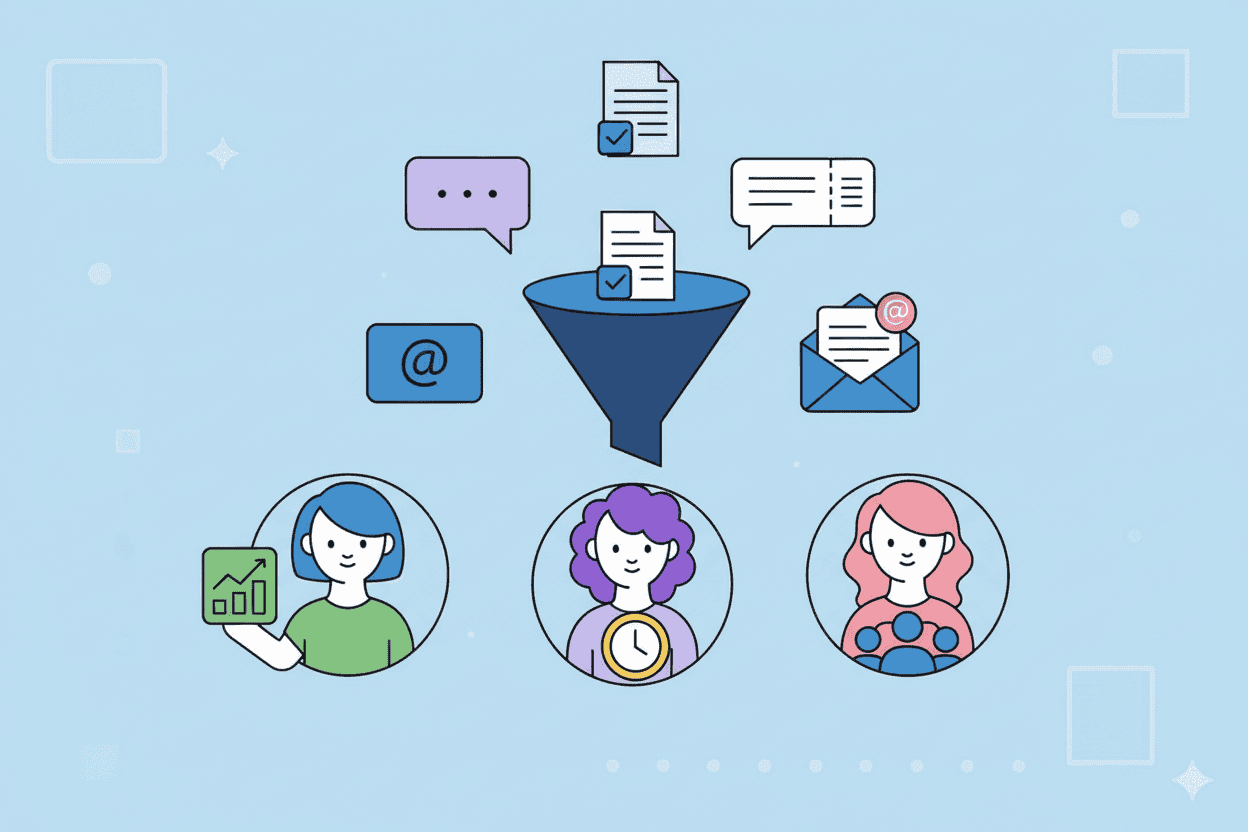
Most user personas are fiction. They're created in a workshop, based on assumptions, and stuffed into a slide deck that nobody looks at again.
The problem isn't personas themselves—it's how teams build them. When personas are based on gut feelings and stereotypes rather than actual customer data, they become useless artifacts that don't inform real product decisions.
This guide shows you how to build user personas that actually work: grounded in real customer feedback, continuously updated, and directly tied to product strategy.
TL;DR: Key Takeaways
- Traditional personas fail because they're based on assumptions, not data
- Real customer feedback (support tickets, interviews, reviews) contains the raw material for accurate personas
- Look for behavioral patterns, not just demographics
- Update personas continuously as new feedback flows in
- Connect personas directly to product decisions and prioritization
Why Most User Personas Fail
Research from the Nielsen Norman Group shows that personas are most effective when based on actual user research rather than stakeholder assumptions. Yet most teams skip the research phase entirely.
Here's what typically happens:
- A PM schedules a "persona workshop"
- The team brainstorms who they think uses the product
- Someone creates fictional names and stock photos
- The personas live in Notion, never to be seen again
The result? Personas that reflect the team's biases rather than customer reality. Marketing thinks users care about features A, B, and C. Sales thinks they care about X, Y, and Z. Engineering builds for an imaginary "power user" who doesn't exist.
The Feedback-First Approach to Personas
Instead of starting with assumptions, start with data. Your customers are already telling you who they are—through support conversations, feedback surveys, interview transcripts, and product reviews.
The key insight: behavioral patterns in feedback reveal persona distinctions more accurately than demographic surveys.
When you analyze what customers actually say, you discover:
- What problems they're trying to solve
- How they describe their goals in their own words
- What frustrates them about current solutions
- How they measure success
This is the raw material for personas that actually reflect reality.
Step 1: Aggregate Feedback From All Sources
Before you can find patterns, you need to gather feedback in one place. Most teams have customer insights scattered across:
- Support tickets (Zendesk, Intercom, Freshdesk)
- Sales call notes (Gong, Chorus, CRM notes)
- Customer interviews (transcripts, recordings)
- NPS/CSAT responses (open-ended comments)
- Product reviews (G2, Capterra, app stores)
- Social mentions (Twitter, Reddit, community forums)
- Feature requests (Productboard, Canny, internal trackers)
According to Gartner, companies collect customer feedback from an average of 11 different channels—but only 29% have a unified view of that feedback.
The first step is creating that unified view. This doesn't mean building a complex data warehouse. Start simple:
- Export feedback from each source
- Normalize the format (date, source, customer info, raw text)
- Store in a searchable repository
Tools like Pelin can automate this aggregation, pulling feedback from multiple sources and making it searchable in one place.
Step 2: Identify Behavioral Patterns
Once you have feedback aggregated, look for patterns in behavior and goals, not demographics.
What to Look For
Problem patterns: What problems do customers mention repeatedly? Group feedback by the underlying problem being solved.
Goal patterns: What outcomes are customers trying to achieve? "I need to save time" is different from "I need to impress my boss."
Usage patterns: How do different customers describe using your product? Some might use it daily for quick tasks; others might use it monthly for deep analysis.
Frustration patterns: What consistently frustrates different types of users? Power users get frustrated by missing advanced features; casual users get frustrated by complexity.
Language patterns: How do customers describe themselves? "I'm a solo founder" vs. "I manage a team of 50" tells you something important.
Practical Analysis Method
- Sample 100-200 feedback items across sources and time periods
- Tag each item with the problem mentioned, goal stated, and any self-description
- Look for clusters where multiple tags appear together consistently
- Name the clusters based on their defining characteristics
For example, you might discover:
- Cluster A: Mentions "saving time," describes themselves as "wearing many hats," frustrated by manual processes
- Cluster B: Mentions "team alignment," describes themselves as "leading a product team," frustrated by scattered information
- Cluster C: Mentions "proving ROI," describes themselves as "reporting to executives," frustrated by lack of metrics
These clusters become your persona foundations.
Step 3: Validate With Quantitative Data
Qualitative patterns from feedback should align with quantitative data from your product. Cross-reference your emerging personas with:
- Usage analytics: Do the behavioral clusters show up in product data?
- Customer segments: Do your personas map to existing customer segments (by company size, industry, plan type)?
- Conversion data: Do different personas convert differently? Retain differently?
Research from McKinsey found that companies using data-driven personalization see 40% more revenue from those activities. The same principle applies to personas: data-validated personas drive better product decisions.
If your qualitative clusters don't show up in quantitative data, you might be over-segmenting. If quantitative segments don't have corresponding qualitative patterns, you might be missing important distinctions.
Step 4: Build Living Persona Documents
Now create persona documents that serve as practical tools, not decorative artifacts.
What to Include
Behavioral description: What this persona does, how they work, what their day looks like. Based on actual feedback quotes.
Primary goals: The 2-3 outcomes this persona is trying to achieve. Written in their words, pulled from feedback.
Key frustrations: What consistently bothers this persona about existing solutions. Direct quotes from feedback.
Success metrics: How this persona measures whether a tool is working for them.
Representative quotes: 5-10 actual quotes from feedback that exemplify this persona.
Quantitative profile: What this persona looks like in your data (company size range, typical plan, usage patterns).
What to Skip
- Fictional names and stock photos (they make personas feel fake)
- Demographic details that don't affect behavior
- Long narratives that nobody reads
- Assumptions about what they "might" want
Example Persona Structure
## The Overwhelmed PM

**Behavioral Description:**
Manages multiple products or features simultaneously. Receives feedback
from sales, support, and customers but struggles to synthesize it.
Makes prioritization decisions under time pressure.

**Primary Goals:**
- "I need to know what customers actually want, not what stakeholders think they want"
- "I want to make faster decisions without second-guessing myself"

**Key Frustrations:**
- "Feedback is scattered across 10 different tools"
- "I spend more time organizing information than analyzing it"
- "Every team has a different view of what customers need"

**Success Metrics:**
- Time from feedback to decision
- Confidence in prioritization choices
- Stakeholder alignment on roadmap

**Representative Quotes:**
[Actual quotes from feedback...]
Step 5: Connect Personas to Product Decisions
Personas only matter if they influence decisions. Create explicit connections between your personas and your product work.
In Prioritization
When evaluating features, ask:
- Which persona does this serve?
- How does it address their stated goals?
- Does it solve a frustration they've actually expressed?
In Design
When designing features, reference:
- How does this persona describe their workflow?
- What language do they use for this concept?
- What have they said about similar features?
In Messaging
When writing copy, use:
- Goals in the persona's actual words
- Frustrations they've expressed
- Success metrics they care about
According to HubSpot research, marketing emails targeted to specific personas generate 18x more revenue than broadcast emails. The same targeting principle applies to product features.
Step 6: Update Personas Continuously
Static personas become outdated quickly. Build a process for continuous updates:
Monthly review: Sample recent feedback and check if patterns still hold Quarterly refresh: Re-run full analysis with new data, adjust personas as needed Trigger-based updates: When major customer segments shift, revisit personas immediately
This is where AI-powered tools become essential. Manually reviewing thousands of feedback items every month isn't practical. Tools like Pelin can continuously analyze incoming feedback, surface emerging patterns, and flag when persona definitions might need updating.
Common Mistakes to Avoid
Creating Too Many Personas
More personas isn't better. Research suggests 3-5 personas covers most products. If you have more, you're probably over-segmenting.
Conflating Roles With Personas
"Marketing Manager" isn't a persona—it's a job title. Two marketing managers might have completely different goals, frustrations, and behaviors. Personas should be based on behavioral patterns, not org charts.
Ignoring Negative Feedback
The most valuable persona insights often come from complaints, churn feedback, and negative reviews. Don't just analyze happy customers.
Building Personas in Isolation
Personas should be created with input from sales, support, success, and marketing—not just product. Each team sees different aspects of customer behavior.
How AI Changes Persona Development
Traditional persona development required manual review of hundreds or thousands of feedback items. This limited how often teams could update personas and how much data they could incorporate.
AI-powered analysis changes the equation:
- Scale: Analyze all feedback, not just samples
- Speed: Update personas in hours, not weeks
- Consistency: Apply the same analysis criteria across all sources
- Discovery: Surface patterns humans might miss
Tools like Pelin can automatically cluster feedback by behavioral patterns, extract representative quotes, and track how persona characteristics evolve over time. This turns persona development from a periodic project into a continuous process.
Getting Started: A 2-Week Sprint
Week 1:
- Day 1-2: Aggregate feedback from all sources
- Day 3-4: Sample and tag 100-200 items
- Day 5: Identify initial clusters
Week 2:
- Day 1-2: Validate against quantitative data
- Day 3-4: Build persona documents
- Day 5: Present to team, gather input, refine
This gives you working personas in two weeks. Not perfect—but real, data-grounded, and useful.
The Bottom Line
User personas don't have to be fictional characters gathering dust in a slide deck. When built from actual customer feedback, they become powerful tools for product decisions.
The key shifts:
- Start with feedback, not assumptions
- Focus on behavioral patterns, not demographics
- Update continuously, not annually
- Connect directly to decisions, not just documentation
Your customers are already telling you who they are. The question is whether you're listening systematically enough to hear them.
Building personas from customer feedback requires aggregating insights from multiple sources. Pelin helps product teams unify feedback from support, sales, interviews, and reviews—then uses AI to surface the patterns that define your real users.