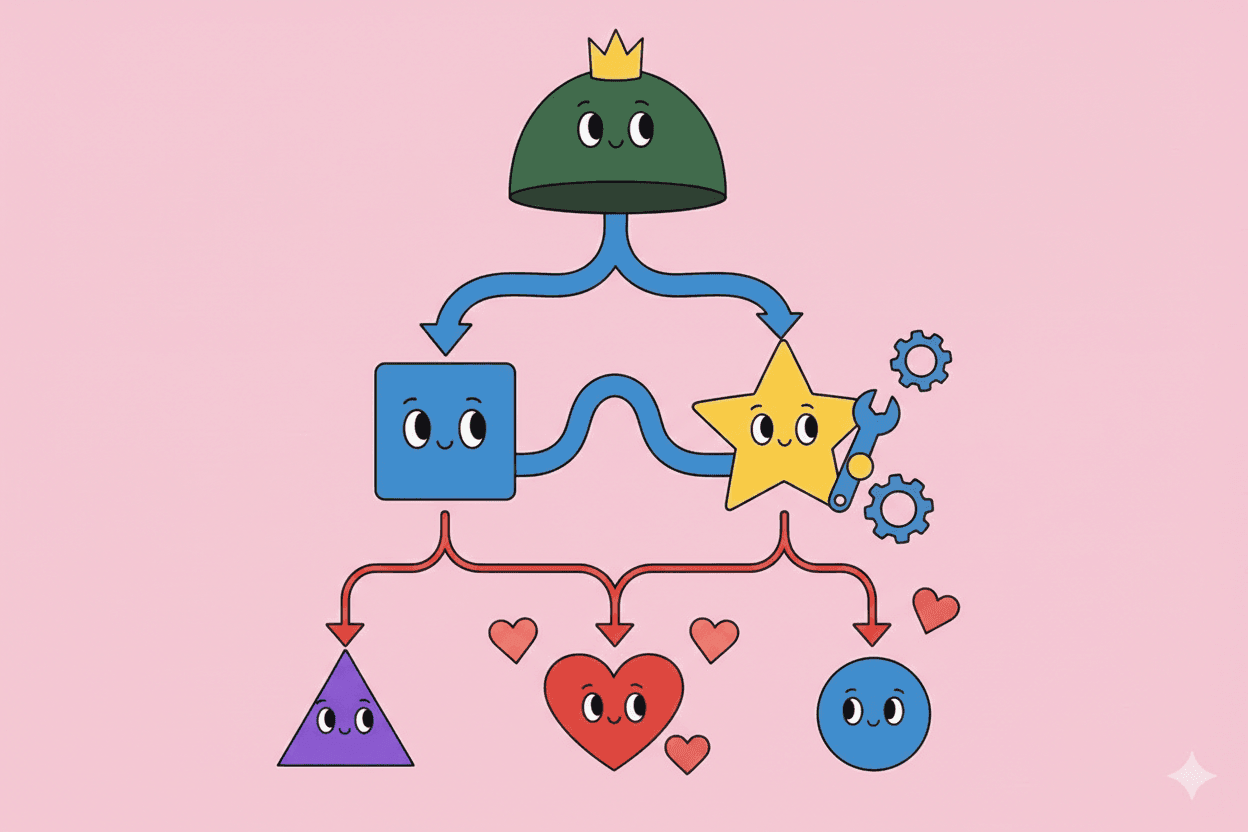
Most product teams claim to be cross-functional, but few truly collaborate on discovery. The PM talks to customers alone, the designer prototypes in isolation, and engineers only get involved when it's time to build. This siloed approach wastes time, misses insights, and creates solutions nobody believes in.
Effective discovery requires a team structure where everyone—PM, design, and engineering—participates in learning from customers together.
The Core Discovery Team
The Trio: PM, Designer, Engineer
The fundamental unit of product discovery is a trio:
Product Manager:
- Owns the outcome and strategy
- Facilitates customer conversations
- Synthesizes insights into opportunities
- Makes final decisions on prioritization
- Connects discovery to business goals
Designer:
- Leads solution exploration
- Creates prototypes for testing
- Facilitates usability testing
- Ensures solutions are usable and delightful
- Balances user needs with business constraints
Engineer (1-2 people):
- Validates technical feasibility
- Contributes solution ideas
- Identifies opportunities for technical leverage
- Ensures proposed solutions are buildable
- Estimates complexity and tradeoffs
Why all three roles matter in discovery:
Engineers catch technical impossibilities early, before designers invest weeks in unbuildable concepts. Designers push PMs to think beyond feature lists. PMs ensure solutions connect to business outcomes.
When all three participate in customer interviews, they build shared understanding that prevents the "lost in translation" problem.
Discovery Team Models
Model 1: Dedicated Discovery Team
Structure: One team focused entirely on discovery, separate from delivery teams.
When it works:
- Large orgs with multiple delivery teams
- High-uncertainty domains requiring deep exploration
- New product development
- Teams with significant technical or market risk
Pros:
- Deep, uninterrupted focus on learning
- Can explore multiple directions in parallel
- Validates before committing delivery resources
Cons:
- Handoff friction to delivery teams
- Discovery team may lose touch with implementation reality
- Can create "ivory tower" perception
Best practices:
- Rotate engineers between discovery and delivery
- Have discovery team participate in delivery kick-offs
- Embed delivery engineers in final validation testing
Model 2: Dual-Track Agile
Structure: Same team does discovery and delivery in parallel—some capacity for each.
When it works:
- Mature products with continuous evolution
- Teams practicing continuous discovery habits
- When you can afford 20-30% capacity for discovery
Pros:
- No handoffs—same team discovers and builds
- Engineers stay connected to customers
- Continuous learning informs ongoing development
Cons:
- Context-switching between discovery and delivery
- Discovery often deprioritized when delivery pressure hits
- Requires discipline to protect discovery time
Best practices:
- Reserve specific days for discovery (e.g., Tuesdays and Thursdays)
- Track discovery separately from delivery velocity
- Set explicit discovery goals each sprint (e.g., "3 customer interviews, 1 prototype test")
Model 3: Discovery Sprints with Delivery Teams
Structure: Delivery teams pause to run focused discovery sprints quarterly or as needed.
When it works:
- Teams with clear roadmaps but occasional ambiguity
- Before major feature investments
- When validating strategic initiatives
Pros:
- Focused intensity produces rapid learning
- Entire team participates, building alignment
- Minimal ongoing overhead between sprints
Cons:
- Episodic rather than continuous learning
- Long gaps between customer contact
- May miss emerging opportunities
Best practices:
- Schedule sprints well in advance
- Do prep work before sprint starts (recruiting, research review)
- Immediately incorporate learnings into roadmap
Model 4: PM-Led Discovery with Team Validation
Structure: PM conducts most discovery, brings findings to team for validation and decision-making.
When it works:
- Small teams or solo PMs
- Well-understood domains with lower risk
- When other team members lack discovery training
Pros:
- Doesn't require engineers' time for every interview
- PM can move quickly without coordination overhead
- Works with constrained resources
Cons:
- Team doesn't build customer empathy firsthand
- Risk of "PM ivory tower" syndrome
- Harder to get buy-in on solutions
- PM becomes bottleneck
Best practices:
- Record interviews for team to watch async
- Invite team to occasional "highlight" sessions
- Do prototype testing as a full team
- Share synthesized insights weekly
Important: This model should be temporary—evolve toward greater team participation as capacity allows.
Roles Beyond the Core Trio
Product Leadership
When to involve: Strategic decisions, resource allocation, cross-team coordination
How they participate:
- Review synthesized findings monthly
- Attend key customer conversations (1-2/quarter)
- Help prioritize which opportunities to pursue
- Remove blockers for discovery work
What they shouldn't do:
- Micromanage day-to-day discovery activities
- Override team decisions based on gut feel
- Prevent teams from testing risky ideas
Data Analysts
When to involve: Quantitative validation, pattern detection, measuring outcomes
How they participate:
- Provide behavioral data to complement interviews
- Help design experiments and define success metrics
- Analyze usage patterns to identify problems
- Track impact of shipped solutions
Integration:
- Include in weekly synthesis sessions
- Pair quantitative signals with qualitative insights
- Use data to prioritize which qualitative questions to pursue
User Researchers (if you have them)
When to involve: Complex research design, specialized methods, scaling research operations
How they participate:
- Train PMs and designers on research methods
- Run high-stakes studies (e.g., ethnographic research, large-scale surveys)
- Build research repositories and documentation systems
- Synthesize insights across multiple teams
Relationship to team:
- Embedded in teams, not service providers
- Enable teams to do their own research
- Handle studies requiring specialized expertise
Customer Success / Support
When to involve: Continuous feedback, problem identification, validation of solutions
How they participate:
- Share patterns from support tickets
- Connect teams with customers for interviews
- Validate whether solutions address real problems
- Monitor whether shipped solutions reduce support load
Regular touchpoints:
- Weekly sync on emerging issues
- Monthly deep-dive into top support themes
- Invited to relevant customer interviews
Sales
When to involve: Market validation, competitive intelligence, understanding buying process
How they participate:
- Share won/lost deal insights
- Connect teams with prospects and customers
- Validate whether solutions address buying objections
- Provide competitive intelligence
Integration:
- Attend quarterly discovery reviews
- Share recordings of relevant sales calls (with Gong, Chorus, etc.)
- Participate in validation of high-priority opportunities
Discovery Team Size: The Two-Pizza Rule
Amazon's principle applies: if you can't feed the core discovery team with two pizzas, it's too big.
Optimal: 3-5 people (1 PM, 1 designer, 1-3 engineers)
Maximum: 7-8 people (add specialists as needed)
Too big: 10+ people means you're running meetings, not doing discovery
For larger initiatives, split into multiple small teams with clear swim lanes.
Decision-Making in Discovery Teams
Who Decides What
Product Manager owns:
- Which opportunities to pursue
- Prioritization across the roadmap
- Strategic tradeoffs
- Final call when team is deadlocked
Designer owns:
- Solution design and user experience
- Prototype fidelity and testing approach
- Design principles and consistency
Engineer owns:
- Technical approach and architecture
- Feasibility assessments
- Estimates and complexity judgments
Team decides together:
- Which assumptions to test next
- Whether validation evidence is strong enough
- Which solution directions to explore
- When to move from discovery to delivery
Use consent-based decision-making: "Does anyone have a principled objection?" not "Does everyone love this?"
Resolving Disagreements
When the team can't align:
- Clarify the disagreement - What specifically do people believe differently?
- Identify the assumption - What would need to be true for each perspective to be right?
- Design a test - How could we learn which assumption is more accurate?
- Run the test quickly - Assumption testing resolves debates
- If time-sensitive - PM makes the call, but documents the decision and rationale
Don't debate for weeks. Test and learn.
Team Collaboration Practices
Weekly Discovery Sync
Agenda (30-45 minutes):
- Share highlights from this week's customer conversations
- Review any test results (prototypes, experiments)
- Update opportunity map with new insights
- Decide what to test next week
- Identify blockers or open questions
Attendees: Core trio, optional others
Output: Clear plan for next week's discovery activities
Shared Discovery Kanban
Track discovery work visually:
Columns:
- Assumptions to test - Hypotheses we need to validate
- Testing this week - Active experiments
- Learnings - Completed tests with results
- Decisions pending - Need to act on findings
This makes discovery progress visible, just like delivery work.
Pair Discovery
Rotate who does what:
- PM and engineer interview together
- Designer and PM run usability tests
- Engineer and designer explore technical solutions
Pairing builds shared understanding and spreads skills across the team.
Discovery Team Anti-Patterns
The PM Gatekeeper
Symptom: PM does all customer contact, "protects" the team from distractions
Problem: Team lacks customer empathy, doesn't trust PM's insights, solutions miss the mark
Fix: Mandate that every team member attends at least 2 customer conversations per month
The Design Silo
Symptom: Designer creates prototypes alone, reveals them in review meetings
Problem: Misses technical constraints, PM doesn't understand rationale, engineer sees solutions as arbitrary
Fix: Collaborative design sessions, earlier engineering input, shared prototype testing
The Discovery Theater
Symptom: Team "does discovery" but always builds what stakeholders wanted anyway
Problem: Discovery becomes checkbox exercise, team stops taking it seriously, waste of time
Fix: Give teams real authority to say no based on discovery findings, leadership must respect evidence
The Research Handoff
Symptom: User researcher does study, writes report, throws it over the wall to team
Problem: Team doesn't internalize insights, report sits unread, learning doesn't influence decisions
Fix: Embed research in teams, have team observe research firsthand, collaborative synthesis
The Engineer Exclusion
Symptom: Engineers only join when it's time to estimate and build
Problem: Miss context, don't understand customer problems, feel like ticket-takers
Fix: Include engineers in customer interviews and prototype testing, especially for technically complex areas
Scaling Discovery Across Multiple Teams
For organizations with many product teams:
Shared Research Operations
Centralize:
- Participant recruiting and management
- Research repository and documentation systems
- Training on discovery methods
- Tools and templates
Decentralize:
- Actual customer conversations
- Opportunity identification and prioritization
- Solution exploration and testing
Cross-Team Learning
Mechanisms:
- Monthly discovery demo (teams share what they learned)
- Shared Slack channel for interesting quotes/insights
- Rotating attendance at other teams' customer sessions
- Quarterly synthesis across all teams
Discovery Community of Practice
- Regular training sessions on new methods
- Peer review of research plans
- Shared templates and best practices
- Mentoring for new PMs/designers
Measuring Team Discovery Effectiveness
Track:
- Frequency - Customer touchpoints per week
- Participation - % team members in discovery activities
- Velocity - Time from insight to decision
- Confidence - Team confidence in priorities (survey)
- Waste reduction - Features killed in discovery vs. post-launch
Don't just measure activity ("we did 20 interviews"). Measure impact on decisions and outcomes.
Empower your entire team with customer insights. Pelin.ai automatically captures and analyzes feedback from Intercom, Zendesk, Slack, and sales calls, making customer intelligence accessible to PMs, designers, and engineers alike. Request a free trial and build shared customer understanding across your team.