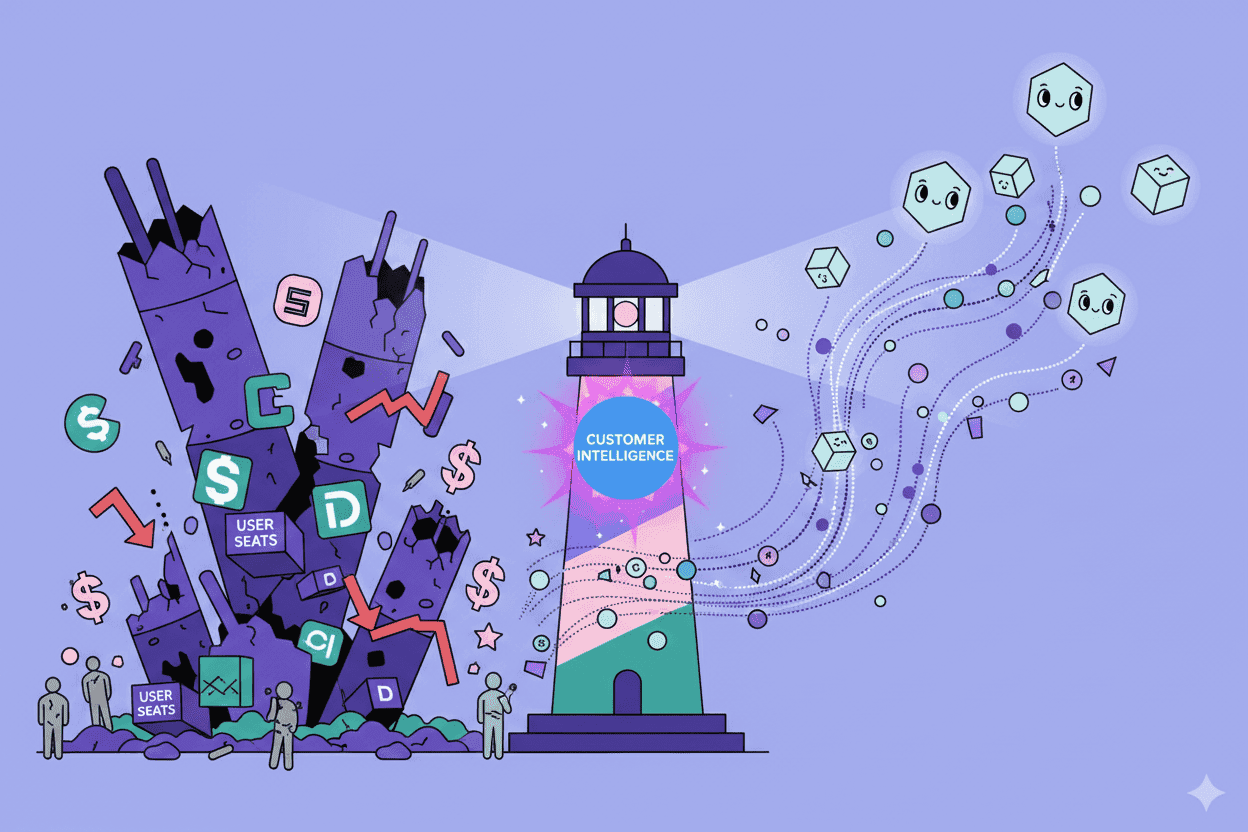
Something historic happened in Q1 2026. The enterprise software market didn't just correct—it fundamentally repriced. Analysts are calling it the "SaaSpocalypse," and it's already erased roughly $2 trillion in market capitalization from B2B software companies.
The culprit isn't rising interest rates or macro headwinds. It's something far more structural: AI agents are replacing human workers, and investors have suddenly realized that per-seat SaaS pricing doesn't work when there are fewer seats to fill.
For product teams, this isn't just a stock market story. It's an existential question: Is your product AI-defensible? Or are you building on a foundation that's about to disappear?
The End of "Software Eating the World"
For two decades, software companies grew by adding seats. More users meant more revenue. Simple. Predictable. Beautiful for margins.
That model is now under siege.
According to recent market analysis, companies deploying AI agents are reducing their human software seat requirements at a ratio of roughly 1:5. For every autonomous agent, five seats disappear. The iShares Expanded Tech-Software ETF has dropped nearly 21% year-to-date, and the bleeding isn't slowing.
Collaboration tools got hit hardest. Atlassian, Monday.com, and Asana have seen drawdowns of 40-50% from their 2025 peaks. The logic is brutal: if AI agents can manage tasks and timelines autonomously, who needs a collaborative interface designed for humans?
But here's what matters for product teams: the tools that help you understand customers are now more critical than ever. In a world where AI handles execution, the competitive advantage shifts to whoever truly knows what to build.
The Feedback Gap That's Killing Product Teams
The irony of modern product management is painful. We've never had more customer feedback. And we've never been worse at using it.
Support tickets pile up in Zendesk. Sales reps paste call notes into Slack. NPS responses rot in spreadsheets. G2 reviews go unread. Every quarter, someone promises to "finally get through all that feedback." Every quarter, it doesn't happen.
The numbers are damning:
- 73% of product managers report that manual feedback analysis creates significant delays in their decision-making process
- Only 23% of customer feedback collected by enterprises is ever analyzed or acted upon
- Manual analysis creates 3-4 week delays in product decisions—an eternity when competitors ship weekly
This isn't a workflow problem. It's a survival problem. Product teams drowning in feedback they can't process are making decisions based on gut instinct and recency bias while sitting on a goldmine of customer intelligence they'll never extract.
Why "AI as a Feature" Won't Save You
Here's where most companies get it wrong. They slap a ChatGPT wrapper on their existing product, call it "AI-powered," and hope investors don't notice the difference.
Investors noticed.
The market is now demanding proof of "AI-defensibility"—evidence that your software creates value that AI agents can't replace. The traditional moat of user familiarity and switching costs? It's evaporating. When an AI agent interacts directly with APIs, the aesthetic quality of your UI becomes irrelevant.
The companies weathering this storm aren't the ones with the prettiest interfaces. They're the ones providing outcomes, not seats. Insights, not dashboards. Decisions, not data.
Salesforce and ServiceNow stumbled initially, then began recovering when they announced shifts toward "outcome-based pricing"—charging for tasks completed rather than seats occupied. Their Agentforce platform has grown from zero to $800 million ARR in 15 months by embracing this model.
For product teams, the message is clear: your tools need to deliver outcomes, not just access.
The 85% Solution
What does outcome-based customer intelligence actually look like?
Consider the difference between a feedback repository and an insight engine. A repository stores what customers said. An insight engine tells you what to build.
Product teams using AI feedback analysis tools reduce time-to-insight by 85% on average, according to recent industry research. What took weeks now takes hours. What required a dedicated analyst now happens automatically.
But speed alone isn't the transformation. The real shift is from passive collection to active intelligence:
Pattern detection at scale: When a new release creates unexpected friction, AI surfaces the signal quickly—before it becomes a support surge or churn event. Patterns that would take humans weeks to spot become visible in minutes.
Real-time synthesis: Insights don't arrive in batches anymore. They flow continuously, reflecting what customers are experiencing right now rather than what they experienced when someone last ran a manual analysis.
Direct connection to decisions: The best systems don't just identify themes—they link those themes directly to features, roadmaps, and prioritization frameworks. No more interesting-but-inert summaries that require another step before action.
Companies that respond to customer feedback within 24 hours see 40% higher retention rates. That's not a nice-to-have in an AI-disrupted market. It's a survival metric.
From Systems of Record to Systems of Action
The SaaSpocalypse is forcing a fundamental rethinking of what software should do. The old paradigm was "systems of record"—tools that stored information and let humans do the work. The new paradigm is "systems of action"—tools that do the work themselves.
For customer insights, this means moving beyond feedback management to feedback intelligence:
Stop asking humans to tag and categorize. Manual tagging doesn't scale, and it introduces the exact inconsistencies and biases that make customer data unreliable. Two people reading the same feedback will categorize it differently. Tags drift over time. Recency bias means the last thing someone read carries disproportionate weight.
Stop separating insights from decisions. When feedback analysis lives in a separate system from roadmap planning, you're guaranteeing that insights get lost in translation. The teams making prioritization decisions need to see the evidence inside the same tools they use to make those decisions.
Stop treating discovery as a quarterly event. The product teams winning right now engage in continuous discovery, staying close to customer needs as they evolve rather than catching up after the fact. Quarterly feedback reviews are for companies that can afford to be three months behind.
What This Means for Your Roadmap
If you're a product leader reading this, here's your checklist:
Audit your current feedback flow. Where does customer intelligence come from? How long does it take to reach decision-makers? What percentage actually gets analyzed? If you're like most teams, the answers will be uncomfortable.
Quantify the waste. That spreadsheet of NPS comments someone meant to analyze? That's lost revenue hiding in plain text. Those discovery calls no one has time to review? That's your competitive advantage, unextracted.
Demand outcomes, not features. When evaluating tools—or building your own—ask what decisions they enable, not what dashboards they provide. The prettiest visualization is worthless if it sits in a separate tab from where work happens.
Plan for a seat-less future. The 1:5 ratio of AI agents to human seats isn't theoretical anymore. It's happening. Your customer insight infrastructure needs to deliver value whether your team is five people or fifty AI agents working alongside two humans.
The Companies That Will Survive
The SaaSpocalypse isn't killing software. It's killing software that exists to be used rather than to deliver outcomes. It's killing tools that charge for access instead of value. It's killing the assumption that humans will always be the ones clicking buttons.
The survivors will be the companies that made a different bet: that understanding customers matters more than managing them. That insights delivered in real-time beat dashboards updated monthly. That the most valuable software is the kind that makes decisions easier, not just data more accessible.
We're entering what market analysts are calling an era of "Rational Exuberance"—recognition that AI is transformative, combined with discipline about which software actually benefits from that transformation.
Customer intelligence is one of those categories. In a world where execution gets automated, knowing what to execute becomes the entire game. The product teams that build this muscle now won't just survive the SaaSpocalypse. They'll be the ones defining what comes after.
The best product decisions come from real customer insights, not guesswork. Pelin helps product teams surface what matters from every customer conversation—automatically. See how it works →