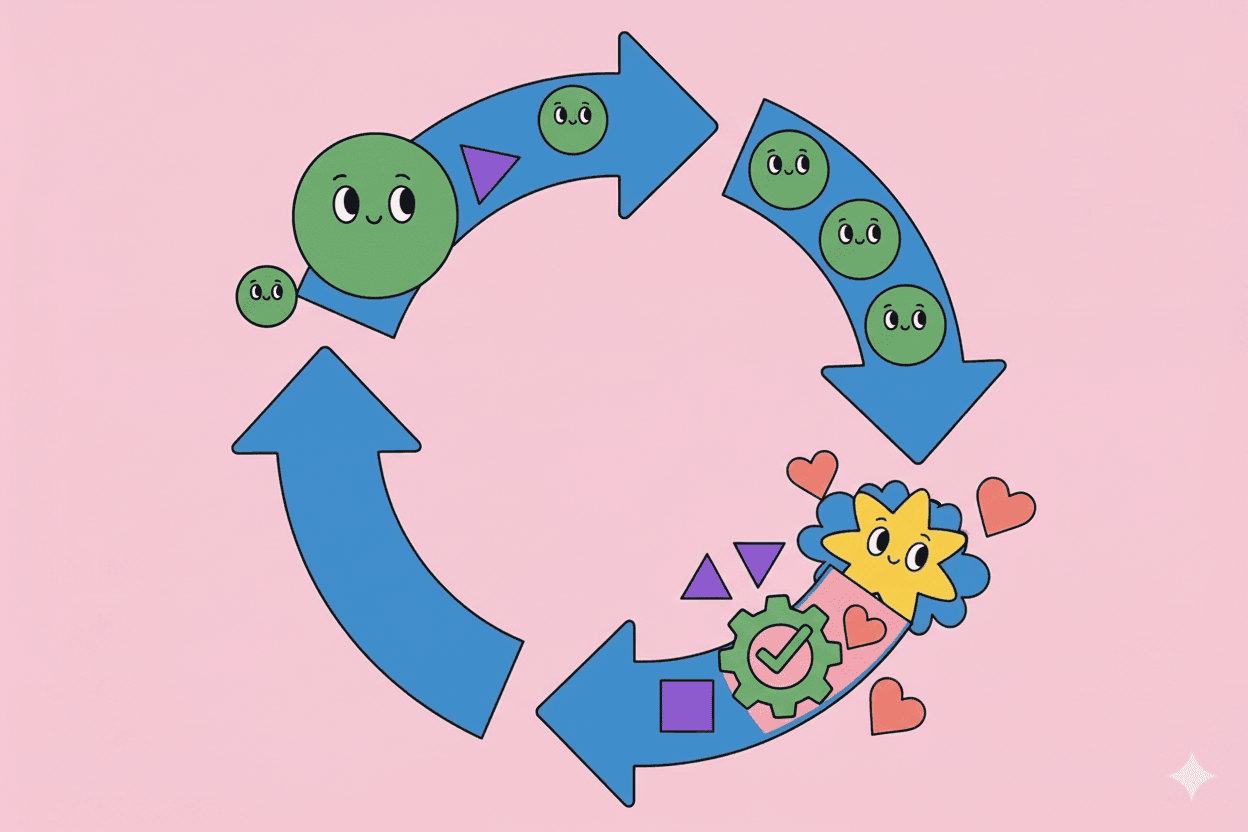
The best marketing is when your product markets itself.
Every time a user invites a teammate, shares output, or collaborates with someone outside their org, they're doing your marketing for you—for free.
Viral loops are built-in product mechanics that turn users into distributors. When designed well, each user brings in more users, creating compounding, organic growth.
The math is simple but powerful: If every user brings in just one more user, your growth is exponential. If they bring in less than one, you need paid acquisition to grow.
This guide covers what viral loops are, how to build them, and tactics from companies that engineered virality into their products.
What Is a Viral Loop?
A viral loop is a self-reinforcing cycle where using the product naturally causes it to spread to new users.
The loop:
- User signs up
- User experiences value
- User's usage exposes the product to others (invite, share, collaborate)
- Those people sign up
- Repeat
Key characteristic: Virality is a byproduct of normal usage, not an artificial "refer a friend" program bolted on.
Examples:
- Slack: Teams invite colleagues to collaborate → more users
- Figma: Designers share files with clients/stakeholders → new users see Figma
- Loom: Users share video links → recipients see "Record your own with Loom"
- Dropbox: Users share folders → recipients need Dropbox to access
Measuring Virality: The Viral Coefficient (K-Factor)
Viral coefficient (K) measures how many new users each existing user brings in.
Formula:
K = (# of invites sent per user) × (% of invites that convert to signups)
Examples:
- If each user sends 5 invites, and 20% sign up → K = 5 × 0.2 = 1.0
- If each user sends 2 invites, and 10% sign up → K = 2 × 0.1 = 0.2
What K means:
- K > 1: Exponential growth (each user brings >1 user)
- K = 0.5-1: Strong organic growth, but needs some paid acquisition
- K < 0.5: Low virality, growth mostly paid
Reality check: Most products have K < 1. Even K = 0.5 is strong. Dropbox at peak was ~0.7. Slack was ~0.5-0.6.
Goal: Maximize K by increasing invites sent and conversion rate.
Types of Viral Loops
1. Collaborative Virality
Users must invite others to get full value from the product.
Example: Slack
- A chat tool for one person is useless
- Value unlocks when teammates join
- Inviting is core to the product, not an add-on
How to build it:
- Make collaboration a core feature (not optional)
- Reduce friction to invite (one-click invite, bulk invites)
- Show value multiplier ("Your team will see 5x faster communication")
2. Exposure Virality (Share Output)
Users share what they create, and the output exposes the product to others.
Example: Figma
- Designers share prototypes with clients/stakeholders
- Recipients see "Made with Figma" + can comment (with Figma account)
- Result: Non-designers discover Figma
How to build it:
- Embed branding in shared outputs (subtle, not obnoxious)
- Make viewing/interacting easy (no signup required at first)
- Offer a CTA to create their own ("Make your own design")
Other examples: Canva (social posts), Loom (video messages), Notion (public pages)
3. Incentive Virality (Referral Programs)
Reward users for referring others.
Example: Dropbox
- "Refer a friend, both get 500MB free storage"
- Referrals drove 35% of signups at peak
- Result: Explosive growth (4M → 100M users in 4 years)
How to build it:
- Offer mutual benefit (both referrer and referee get value)
- Make it easy (share link, no complex forms)
- Tie reward to your product's value metric (storage for Dropbox, credits for Uber)
Caution: Referral programs can feel transactional. Works best when combined with natural usage loops.
4. Network Effects Virality
The product becomes more valuable as more people use it, incentivizing users to invite others.
Example: LinkedIn
- Your network grows → LinkedIn becomes more useful
- You invite colleagues → your network grows
- Result: Reinforcing loop
How to build it:
- Create value from network size (connections, data, collaboration)
- Show what's missing ("5 of your colleagues are on [Product], invite them")
- Reduce value for solo users (push toward network building)
5. Integrations & Ecosystem Virality
Users connect your product to tools their teams use, exposing it to others.
Example: Zapier
- User creates a Zap connecting [App A] to [App B]
- Teammates using [App B] see Zapier in action
- Result: Organic discovery through workflow integration
How to build it:
- Build deep integrations with popular tools (Slack, Google Workspace, CRM)
- Show activity in shared spaces ("New lead added via [Your Product]")
- Make integration easy (OAuth, pre-built templates)
Building Your Viral Loop: Step-by-Step
Step 1: Identify the Natural Sharing Moment
When do users already want to share or collaborate?
Questions to ask:
- Is my product more valuable with teammates? (collaboration)
- Do users create outputs they share publicly? (exposure)
- Do users need others' input/feedback? (collaboration)
- Is there a resource they'd want to share? (content, templates)
Example:
- Notion: "I built a project tracker → let me share it with my team"
- Figma: "I designed a prototype → let me share it with stakeholders"
- Calendly: "I need to schedule a meeting → send my Calendly link"
That natural moment is your viral loop entry point.
Step 2: Reduce Friction to Share/Invite
Make sharing effortless:
Best practices:
- One-click invites: Email addresses → instant invite sent
- Bulk invites: Import from Google, Slack, CSV
- Public links: Shareable URLs (no login required to view)
- Pre-filled messages: "Hey, check out this [thing] I made with [Product]"
Avoid:
- Multi-step invite flows
- Requiring referrers to manually enter emails
- Forcing recipients to sign up before seeing value
Example: Figma
- Share a design → public link generated instantly
- Recipients can view and comment without signing up
- If they want to edit → prompted to create account
Step 3: Optimize the Recipient Experience
When someone receives an invite or shared link, what happens?
Bad experience:
- Paywall before they see content
- Generic landing page ("Sign up for [Product]")
- No context on why they're there
Good experience:
- Show the shared content immediately (no signup wall)
- Provide context ("Sarah invited you to collaborate on this project")
- Clear CTA ("Create your own" or "Join the team")
Example: Loom
- Click video link → video plays instantly (no login)
- Below video: "Record your own free video with Loom" (CTA)
- One-click signup to create
Step 4: Incentivize Sharing (If Appropriate)
Not all products need referral incentives, but when they fit, they can accelerate growth.
When to incentivize:
- Your product has a measurable value metric (storage, credits, seats)
- Sharing isn't already core to the product (needs a nudge)
- Competitors aren't heavily incentivizing (less saturated)
Referral program best practices:
- Mutual benefit: Referrer and referee both get value
- Attainable reward: Easy to earn, meaningful value
- Clear mechanics: "Refer 3 friends → unlock premium for 1 month"
- Track & remind: "You've earned 200MB from 2 referrals. Invite 3 more for 1GB!"
Example: Superhuman
- Referral program: Invite 5 people → $30 credit/month
- High-intent referrals (people already want Superhuman)
- Result: Controlled, high-quality viral growth
Step 5: Track and Optimize
Measure your viral loop:
Metrics to track:
- Invites sent per user (average)
- Invite-to-signup conversion rate (%)
- Viral coefficient (K-factor)
- Time to next invite (viral cycle time)
Segment by:
- User cohort (when did they sign up?)
- Traffic source (organic vs. referred users)
- User type (free vs. paid)
Optimize levers:
- Increase invites sent: Prompt at better moments, reduce friction
- Increase conversion rate: Improve recipient landing experience, show value faster
Example optimization:
- Before: Invite prompt on signup (ignored, K = 0.2)
- After: Invite prompt after first "win" (project created), pre-fill email suggestions from domain → K = 0.5 (2.5x improvement)
Viral Loop Tactics from Top PLG Companies
Dropbox: Referral Program
Tactic: "Refer a friend, both get 500MB free storage"
Why it worked:
- Mutual benefit (both sides win)
- Aligned with product value (storage)
- Simple mechanics (copy link, share)
Result: 35% of signups from referrals, 4M → 100M users in 4 years
Slack: Team Invites
Tactic: Product is useless alone → users must invite teammates
Why it worked:
- Collaboration is core value prop
- Invite flow integrated into onboarding
- Network effects (more teammates = more value)
Result: K ~0.5-0.6, hyper-growth to $27B acquisition
Figma: Public File Sharing
Tactic: Designers share prototypes publicly, recipients see "Made with Figma"
Why it worked:
- Designers naturally share work with clients/stakeholders
- Viewing requires no signup (low friction)
- Commenting requires account (conversion nudge)
Result: Dominated collaborative design, $20B acquisition
Loom: Video Link Sharing
Tactic: Every shared video has "Record your own with Loom" CTA
Why it worked:
- Video is inherently shareable (async communication)
- Recipients see product in action (proof of value)
- One-click signup to create
Result: 10M+ users, largely organic
Calendly: Scheduling Link in Signature
Tactic: Users share Calendly links in emails, signatures, websites
Why it worked:
- Solving a universal pain (scheduling meetings)
- Every booking exposes Calendly to recipient
- No setup required for recipient (just clicks time)
Result: Massive organic adoption, minimal paid marketing
Common Viral Loop Mistakes
Mistake #1: Forcing virality Users hate being nagged to invite friends. Build virality into natural workflows, don't bolt it on.
Mistake #2: Incentivizing too early If users haven't experienced value, they won't refer others. Time incentives after activation.
Mistake #3: High friction invites Multi-step flows kill virality. Make invites one-click.
Mistake #4: Ignoring recipient experience If invitees have a bad signup/onboarding experience, your loop breaks.
Mistake #5: Not measuring You can't optimize what you don't measure. Track K-factor and optimize iteratively.
When Viral Loops Don't Work
Virality isn't a fit for every product:
Low virality products:
- Solo-use tools (personal finance, solo productivity)
- Niche industries (few potential users to refer)
- Products without sharing/collaboration (offline-first, isolated workflows)
In those cases: Focus on other growth levers (SEO, paid acquisition, partnerships). Don't force virality where it doesn't fit.
The Bottom Line
Viral loops turn users into your growth engine. When done right, they create compounding, capital-efficient acquisition—every new user brings in more users.
The best viral loops feel natural, not manipulative. They're built into core product workflows, not awkward "invite a friend" pop-ups.
To build your viral loop:
- Identify natural sharing moments
- Reduce friction to invite/share
- Optimize the recipient experience
- Measure and iterate
Even small improvements compound. A K-factor increase from 0.3 to 0.5 can mean the difference between slow, paid growth and exponential, organic growth.
Your product is your best marketing channel. Build virality in.
Want to understand how users naturally share and refer your product? Pelin.ai analyzes customer conversations and feedback to reveal how users discover, adopt, and recommend your product—helping you identify and amplify natural viral moments.