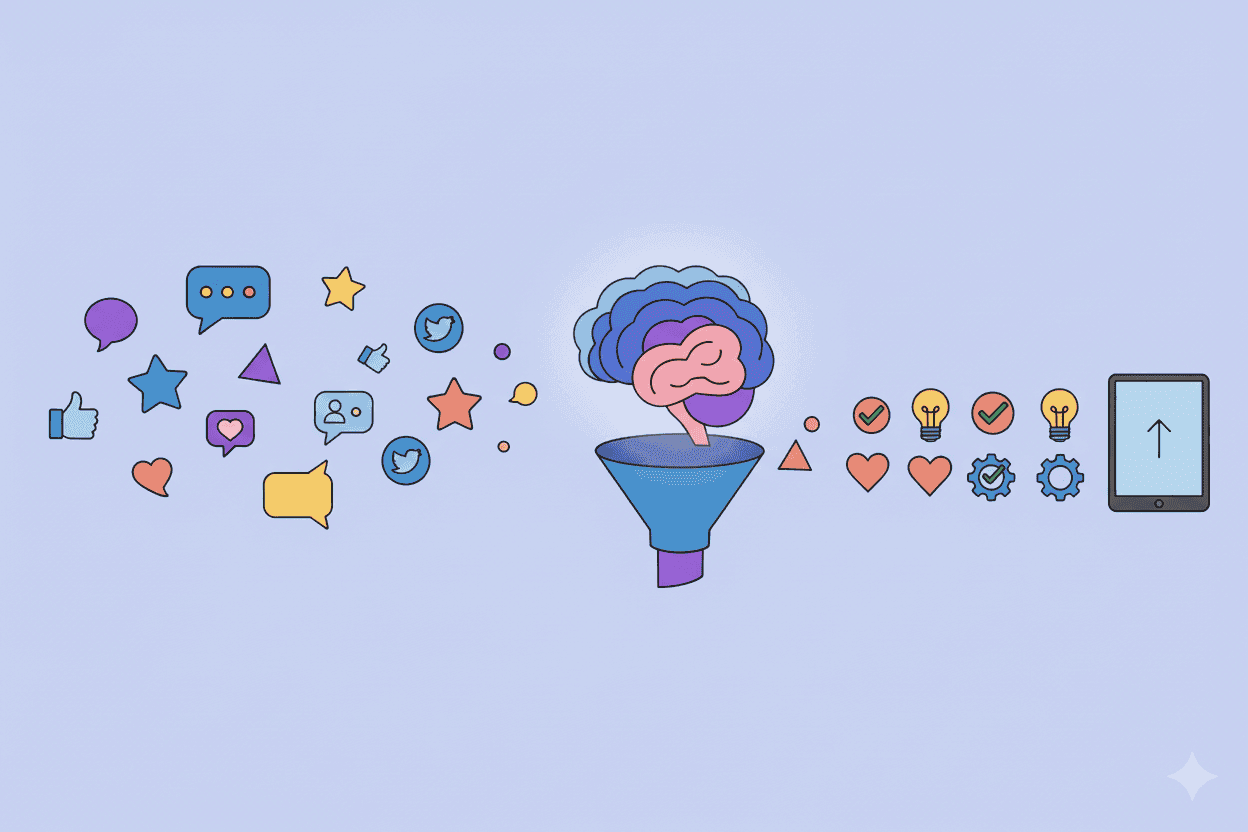
Here's a stat that should keep product leaders up at night: your company is probably sitting on more customer feedback than ever before—and doing almost nothing useful with it.
A recent analysis from CMSWire captures the problem perfectly. As Sprinklr's Chief Product Officer Karthik Suri puts it: "Today's problem isn't data scarcity. It's that feedback has drifted into a transactional, over-analytical exercise. We capture volumes of signals, yet too often lose the human intent and voice we need to act with confidence and speed."
Meanwhile, Forrester research shows that customer-obsessed companies are four times more likely to achieve 10%+ revenue growth. The gap between winners and losers isn't about who collects more data—it's about who actually does something with it.
So why does customer feedback fall flat for most product teams? And what can actually be done about it?
The Feedback Theater Problem
Let's be honest about what customer feedback looks like at most companies: it's theater.
You send a quarterly NPS survey. Maybe you run a few user interviews when launching something new. There's probably a shared inbox somewhere collecting feature requests that nobody's looked at since Q2 of last year.
The feedback is "collected" in the same way that a museum collects artifacts—it goes somewhere, gets catalogued, and sits untouched while the world moves on.
Suri describes this disconnect from the customer's perspective: "If a company asks me for feedback and does nothing about it, it's a rear-view mirror of my experience—something that doesn't motivate me to engage again and may even de-motivate me."
This isn't just bad for customer relationships. It's terrible for product decisions. When feedback becomes a check-the-box activity rather than a genuine input to strategy, teams end up building what they think customers want instead of what customers actually need.
Three Reasons Traditional Feedback Systems Fail
The CMSWire piece identifies three core failures that plague traditional customer feedback management:
1. Feedback is treated as events, not continuous listening
Most companies treat feedback as something that happens at discrete moments—after a support ticket, following a purchase, during annual planning. But customers don't experience your product in discrete moments. They experience it continuously.
When you only capture feedback at scheduled touchpoints, you miss everything that happens in between. The frustration that builds. The workaround someone invented. The competitor they started exploring. By the time your quarterly survey arrives, the context is already lost.
2. Data lives in silos without unified context
Customer feedback is scattered across tools, teams, and formats. There's the NPS data in one tool, support tickets in another, sales call notes in a CRM, social mentions tracked by marketing, and user research somewhere in a Google Drive folder.
Each team sees their own slice. Nobody sees the full picture. And because the data formats are different, connecting insights across sources requires manual effort that rarely happens.
Research from Treasure Data found that 54% of organizations cite fragmented or siloed data as their biggest barrier to leveraging customer insights. It's not that the data doesn't exist—it's that nobody can piece it together.
3. The insight-to-action loop is broken
Even when companies do collect meaningful feedback and manage to analyze it, the path from insight to action is typically broken. By the time feedback makes it from collection to analysis to synthesis to presentation to decision-makers, weeks or months have passed.
At that point, the context has shifted. The urgency has faded. The insight becomes a slide in a deck rather than a driver of real change.
What AI-Native Actually Means (Not Just AI-Washed)
Here's where things get interesting—and where a lot of vendors start hand-waving about "AI-powered insights."
Let's be clear about the distinction: bolting AI onto legacy feedback systems isn't the same as building feedback systems that are AI-native from the ground up.
Traditional systems with AI added on top might help you summarize survey results faster. But they don't fundamentally change the model. You're still stuck with discrete feedback events, siloed data, and slow insight-to-action loops.
AI-native feedback management is different in three critical ways:
Continuous listening across all channels
Instead of waiting for scheduled feedback moments, AI-native systems can continuously monitor and synthesize signals from across every customer touchpoint—support tickets, social mentions, community discussions, product usage patterns, and yes, traditional surveys too.
The key isn't just having access to all these sources. It's having a system that can automatically interpret, contextualize, and connect insights across them in real-time.
Unified understanding of unstructured data
This is where AI genuinely shines. Most valuable customer feedback is unstructured—it's the nuanced explanation in a support email, the frustrated rant on Twitter, the offhand comment in a sales call.
Traditional systems either ignore this unstructured data entirely or require teams to manually tag and categorize it (which means most of it never gets processed). AI-native systems can interpret unstructured feedback at scale, extracting themes, sentiment, and intent automatically.
Compressed insight-to-action latency
Perhaps most importantly, AI-native systems can dramatically compress the time between hearing about an issue and being able to act on it.
When feedback is continuously processed and synthesized, emerging patterns surface in days rather than quarters. Teams can identify and address friction points while they're still developing, rather than discovering them in an end-of-year post-mortem.
What This Means for Product Teams
The Zendesk CX Trends Report for 2026 found that 80% of leaders plan to increase customer service budgets this year, and 72% agree that expanding AI use across the customer experience is important.
The companies winning on customer insight aren't just investing more—they're investing differently. Here's what that looks like in practice:
Stop treating feedback as a project
Customer feedback shouldn't be something that happens during planning cycles. It should be infrastructure that runs continuously in the background, surfacing signals and patterns as they emerge.
This doesn't mean drowning your team in data. It means having systems that can filter noise and highlight what actually matters.
Break down the silos aggressively
The value of customer feedback grows exponentially when it's unified. A support ticket about a confusing feature becomes much more meaningful when you can connect it to the user research that predicted this problem, the sales calls where prospects raised similar concerns, and the product usage data showing exactly where users get stuck.
This requires breaking down organizational silos—but more importantly, it requires tooling that can actually connect insights across sources.
Make the insight-to-action loop a core metric
How long does it take for a customer insight to influence a product decision at your company? If you can't answer that question, you have a problem.
The best teams treat insight-to-action latency as a core performance metric. They track how quickly feedback moves from collection to synthesis to decision. They actively work to compress that timeline.
Embrace continuous discovery, not periodic research
The traditional model of user research—intensive interview sprints before major launches—is fundamentally misaligned with how modern products evolve. Products ship continuously. Learning should too.
This doesn't mean abandoning deep research entirely. It means supplementing it with ongoing automated synthesis that keeps teams connected to customer reality between major research efforts.
The Stakes Are Higher Than You Think
Here's the thing about customer feedback: it's not just about making customers happy. It's about survival.
Gartner research shows that 80% of organizations expect to compete mainly based on customer experience. And Zendesk data confirms that 52% of customers will switch to a competitor after a single negative experience.
In this environment, the companies that can actually hear their customers—continuously, comprehensively, and with speed—have a structural advantage. Those that continue treating feedback as a quarterly checkbox exercise are building on sand.
The gap between "collecting feedback" and "being customer-driven" is massive. AI-native approaches aren't just a nice-to-have efficiency improvement. They're becoming the table stakes for companies that want to build products customers actually love.
At Pelin, we're building AI-native customer insight tools specifically for product teams. We help you continuously synthesize feedback from every channel, surface what matters, and close the loop between insight and action. Learn more about how we work.