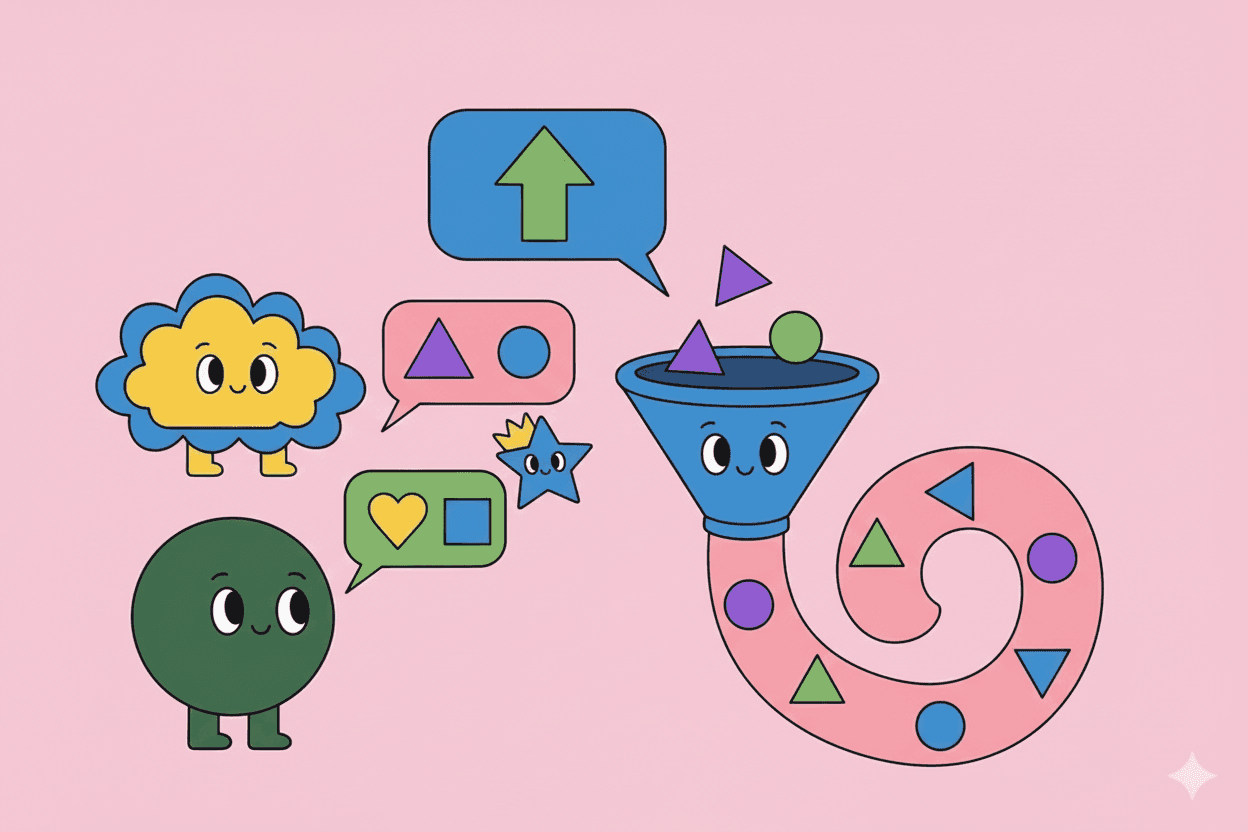
Customer feedback lives everywhere—Zendesk tickets, Intercom conversations, Gong sales calls, NPS surveys, G2 reviews, Twitter mentions, Slack messages, email, community forums. When insights scatter across platforms, patterns hide. You might know support receives complaints about Feature X while missing that sales loses deals for the same reason and reviews criticize it publicly. Feedback aggregation creates a single source of truth, enabling comprehensive analysis that fragmented data can't provide. This is a foundational component of any Voice of Customer program. This guide shows you how to centralize feedback effectively and extract insights from unified data.
Why Aggregation Matters
Pattern recognition: The same issue appearing in support (5 tickets), sales (3 lost deals), and reviews (8 mentions) reveals critical problem. Isolated, each seems minor.
Complete customer picture: Understanding full customer journey requires combining feedback from pre-sales, onboarding, daily use, support, and renewal conversations.
Segment analysis: Comparing feedback across customer types requires centralized data. Is enterprise feedback different than SMB? Aggregation reveals segment patterns.
Priority validation: Is this really your biggest problem or just what landed in your inbox today? Aggregated data shows true prevalence.
Resource efficiency: Teams waste hours manually compiling feedback from scattered sources. Aggregation automates collection.
Feedback Sources to Aggregate
Support channels:
- Zendesk, Intercom, Freshdesk tickets
- Live chat transcripts
- Email support conversations
- Phone call recordings and notes
Sales intelligence:
- Gong, Chorus call recordings
- Salesforce opportunity notes
- Demo feedback
- Win-loss interview insights
Product feedback:
- In-app feedback widgets (Canny, Productboard)
- Feature request submissions
- Beta program input
- User testing sessions
Surveys:
- NPS surveys
- CSAT ratings
- Customer onboarding surveys
- Churn/exit interviews
Reviews and social:
- G2, Capterra, TrustRadius reviews
- App Store / Google Play reviews
- Twitter, LinkedIn, Reddit mentions
- Community forum discussions
Customer success:
- Gainsight, ChurnZero notes
- QBR (Quarterly Business Review) summaries
- Account health indicators
- CS team Slack messages
Analytics and behavior:
- Product usage data (Amplitude, Mixpanel)
- Session recordings (FullStory, Hotjar)
- Feature adoption metrics
- User flow analysis
Aggregation Strategies
Manual Aggregation (Small Scale)
For teams receiving <100 feedback pieces weekly:
Spreadsheet collection: Create master sheet with columns for Source, Date, Customer, Segment, Category, Sentiment, Content.
Weekly compilation: Dedicate time each week to copy feedback from various sources into centralized sheet.
Basic analysis: Use filters and pivot tables to identify patterns.
Limitations: Doesn't scale, prone to human error, time-intensive, delayed insights.
Semi-Automated Aggregation (Medium Scale)
For teams with 100-500 feedback pieces weekly:
Zapier/Make workflows: Create automation rules that copy feedback from various tools into central database (Airtable, Notion, or Google Sheets).
API integrations: Build custom scripts pulling data from platforms offering APIs.
Regular syncing: Schedule automated data pulls (daily or weekly).
Manual categorization: Use AI or manual tagging for analysis.
Limitations: Requires technical setup, maintenance overhead, limited AI analysis.
Platform-Based Aggregation (Enterprise Scale)
For teams with 500+ feedback pieces weekly:
Dedicated platforms: Tools like Pelin.ai, Enterpret, Thematic automatically connect to 20+ sources.
Native integrations: Pre-built connections to major platforms (Zendesk, Intercom, Gong, Salesforce, Linear, Slack, etc.).
Real-time syncing: Feedback flows continuously into centralized system.
AI analysis: Automatic categorization, sentiment analysis, theme detection.
Collaborative access: All stakeholders access same data, preventing information silos. Learn more about democratizing customer insights across your organization.
Advantages: Scalable, comprehensive, real-time, AI-powered insights, minimal maintenance.
Implementation Process
Phase 1: Source Inventory (Week 1)
List all feedback sources: Where does customer input currently live?
Assess volume: How much feedback comes from each source monthly?
Identify owners: Who currently monitors each source?
Evaluate accessibility: Do sources offer APIs, export capabilities, or integration options?
Prioritize sources: Start with highest-volume, highest-value channels.
Phase 2: Tool Selection (Week 2)
Evaluate options:
- Manual (spreadsheets) if <100 pieces weekly
- Semi-automated (Zapier + database) if 100-500 pieces weekly
- Platform (Pelin.ai, Enterpret) if 500+ pieces weekly
Check integrations: Does solution connect to your key sources?
Test capabilities: Most platforms offer trials. Test with real data before committing.
Consider total cost: Include implementation time, ongoing maintenance, and platform fees.
Phase 3: Integration Setup (Weeks 3-4)
Connect high-priority sources first: Start with 2-3 highest-volume channels (typically support and sales).
Validate data flow: Ensure feedback appears complete and accurate in centralized system.
Configure categorization: Set up taxonomy for insight types, product areas, segments (see categorization best practices).
Train AI models: If using ML-powered platforms, provide 100-200 manually tagged examples.
Add remaining sources: Progressively connect additional channels.
Phase 4: Process Establishment (Month 2)
Define review cadence: Weekly for urgent items, monthly for trend analysis, quarterly for strategic patterns.
Assign responsibilities: Who reviews aggregated feedback? Who acts on insights?
Create stakeholder views: Different teams need different perspectives (product sees features, CS sees churn signals, sales sees competitive intel).
Establish workflows: How do insights flow from feedback to roadmap? From detection to action?
Best Practices
Start focused: Connect 2-3 core sources, prove value, then expand. Avoid trying to aggregate everything simultaneously.
Maintain data quality: Ensure source systems capture complete information. AI can't salvage incomplete data.
Standardize formats: When possible, standardize how feedback is captured at sources (custom fields, templates, required information).
Regular audits: Periodically verify integration accuracy. Check that data syncing properly from all sources.
Contextual metadata: Ensure customer segment, account value, tenure, and other context syncs with feedback for segmentation.
Real-time vs. batch: Critical feedback channels (support escalations, churn signals) need real-time monitoring. Historical analysis can batch daily.
Access control: Different stakeholders need different views. Product shouldn't see confidential CS notes. Sales doesn't need engineering technical details.
Feedback loop closure: Aggregation platforms should track not just input but also responses and resolutions. See feedback loops guide.
Common Challenges
Integration limitations: Not all tools offer APIs or easy export. Workaround: Manual periodic exports or web scraping (carefully and legally).
Data inconsistencies: Different sources structure data differently. Solution: Normalization layer that standardizes formats.
Volume overload: Aggregation surfaces more feedback than you can analyze manually. Solution: AI-powered categorization and filtering.
Noise vs. signal: Some sources (social media) contain low-value chatter. Solution: Source-specific filtering rules.
Privacy compliance: Customer data crosses system boundaries. Solution: Ensure aggregation platform meets GDPR, SOC 2, and other requirements.
Technical complexity: Enterprise integrations can require IT involvement. Solution: Choose platforms with pre-built connectors reducing technical lift.
Measuring Success
Coverage: What percentage of feedback gets aggregated vs. stays siloed? Target >95%.
Timeliness: How quickly does feedback flow from source to centralized system? Real-time is ideal, daily is acceptable.
Completeness: Does aggregated data include all necessary context? Or do analysts still need to check source systems?
Utilization: Do stakeholders actually use aggregated data? Or do old habits prevail? Track access and engagement.
Insight quality: Does aggregation reveal patterns that siloed analysis missed? Measure decisions influenced by aggregated insights.
Time savings: How much time previously spent manually compiling feedback is freed for analysis?
For comprehensive feedback analysis frameworks, see customer feedback analysis guide.
Tool Recommendations
Pelin.ai: Best for B2B SaaS product teams. 20+ native integrations, AI categorization, product-focused workflows. Connects support, sales, surveys, and reviews automatically.
Enterpret: Strong AI theme detection. Good for teams prioritizing qualitative analysis. Requires more setup than Pelin.
Thematic: Focuses on text analytics and theme extraction. Good for market research teams alongside product teams.
Zapier + Airtable: Budget-friendly semi-automated option for smaller teams. Requires manual setup and maintenance.
Custom data warehouse: For large enterprises with data teams. Build custom pipelines aggregating into Snowflake, BigQuery, or similar. Most flexible but highest technical overhead.
Getting Started
- List your feedback sources and estimate monthly volume from each
- Choose aggregation approach based on scale and resources
- Select top 2-3 sources to start with (highest volume/value)
- Set up integrations using chosen platform or automation tools
- Validate data flow by checking sample feedback appears complete
- Analyze first patterns that were invisible when data was siloed
- Share insights demonstrating value of aggregation to stakeholders
- Expand coverage by adding remaining sources progressively
- Establish processes for regular analysis and action on aggregated data
Aggregation is foundation for all advanced feedback analysis. Without centralized data, you're building insights on partial information. With comprehensive aggregation, customer voices speak clearly enough to guide confident product decisions.
Related Articles
- Customer Feedback Analysis: Complete Guide - Master the analysis framework
- Voice of Customer Strategy - Build a comprehensive VoC program
- Real-Time Feedback Monitoring - Catch and respond to feedback instantly
- Democratizing Customer Insights - Share insights across your organization
- Customer Feedback Tools Comparison - Evaluate platforms and features
Aggregate Feedback with Pelin
Pelin.ai automatically aggregates feedback from 20+ sources including Intercom, Zendesk, Gong, Slack, Linear, G2, and more. AI-powered analysis categorizes insights, detects patterns, and surfaces what matters most.
Stop losing insights in scattered systems. Start seeing complete customer picture. Request Free Trial.