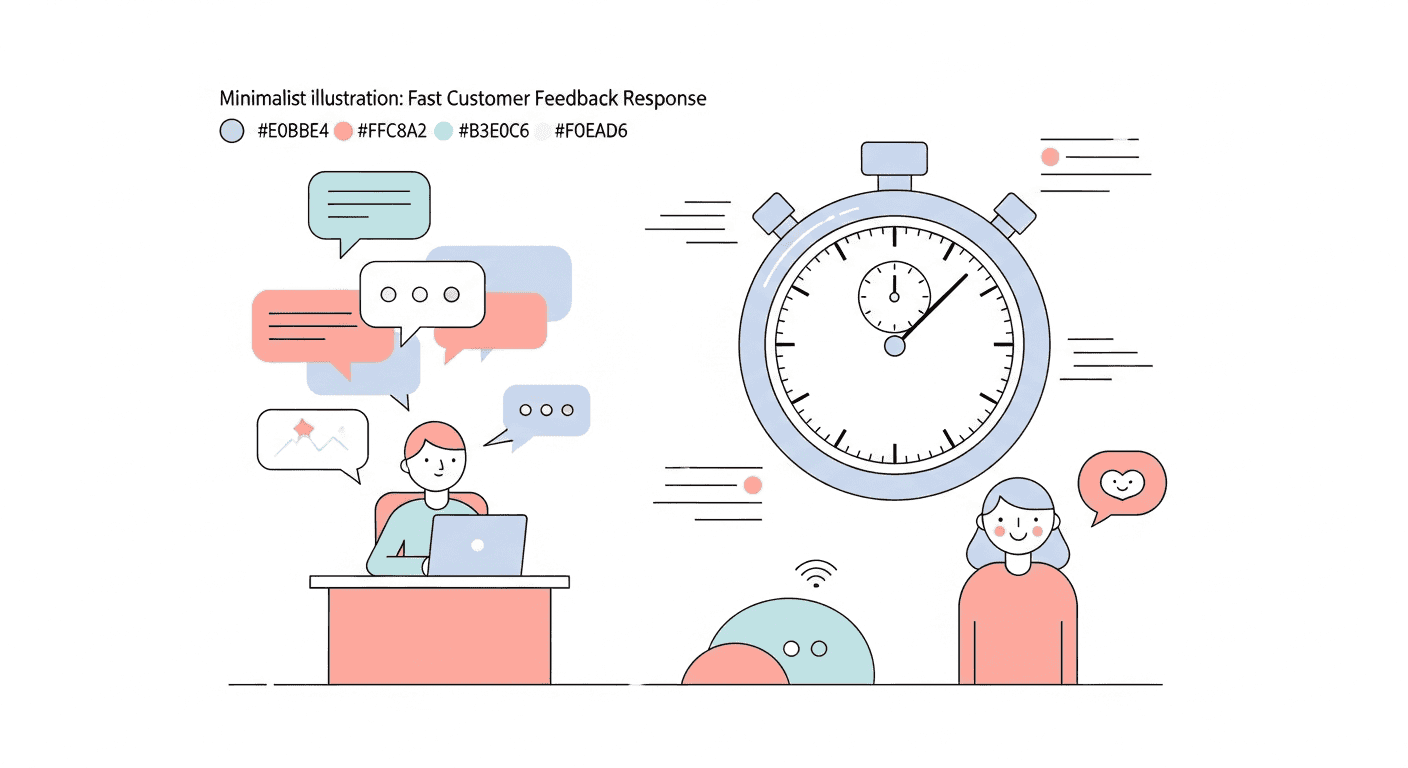
TL;DR: Responding to customer feedback quickly isn't just polite—it directly impacts retention. Research shows closing the loop within 48 hours can increase retention by 12%. Yet most companies take days or weeks to acknowledge feedback, if they respond at all. This guide covers the benchmarks you should aim for, why speed matters so much, and practical ways to respond faster without overwhelming your team.
The Hidden Cost of Slow Feedback Response
Here's an uncomfortable truth: customers who take time to give you feedback are doing you a favor. They're telling you exactly what's wrong (or right) instead of silently churning. And how you respond—or don't—sends a powerful signal about whether you actually care.
Over 50% of consumers now expect brands to respond to inquiries within one hour. That expectation doesn't magically disappear when the inquiry is labeled "feedback" instead of "support ticket."
Yet most product teams treat feedback like a one-way street. They collect it, dump it in a spreadsheet, maybe tag it if someone has time, and then... nothing. The customer never hears back. They have no idea if anyone read their suggestion, let alone acted on it.
This silence is expensive. Companies that don't close the feedback loop see a 2.1% increase in churn—and that's just the measurable impact. The unmeasurable damage to trust and word-of-mouth is likely much larger.
What "Fast" Actually Means for Feedback Response
Let's be clear: responding to feedback isn't the same as resolving it. You're not promising to build every feature request by Friday. You're acknowledging that a human being took time to communicate with you.
Here's a framework for thinking about feedback response tiers:
Tier 1: Immediate Acknowledgment (Within 24 Hours)
This is table stakes. Every piece of feedback should get an automated or manual acknowledgment within a day. Something as simple as:
"Thanks for sharing this—we've logged your feedback and our product team will review it."
This costs almost nothing to implement and immediately differentiates you from the 90% of companies that never respond at all.
Tier 2: Meaningful Response (Within 48-72 Hours)
For feedback that warrants more than a form response—detailed bug reports, thoughtful feature suggestions, critical complaints—aim to respond within 48-72 hours with something substantive:
- Clarifying questions if needed
- Context on whether this is on your radar
- Honest timelines if you have them
Tier 3: Resolution Follow-Up (When Applicable)
When you actually ship something a customer requested, tell them. This is where most companies completely drop the ball. They spend months building a feature that 50 customers asked for, launch it with fanfare... and never email those 50 customers directly.
Companies that successfully close this full loop see retention rates increase by 10%.
Why Speed Creates a Virtuous Cycle
Fast feedback response doesn't just prevent churn—it creates positive momentum:
1. You Get Better Feedback
When customers know you actually read and respond to feedback, they give you more of it. And better quality feedback, too. They'll take time to write detailed descriptions because they trust it won't disappear into a black hole.
2. You Catch Problems Earlier
A customer complaining about a bug on Tuesday is useful. That same customer complaining on Friday after stewing for three days? They're halfway out the door. Fast response means you can often address issues before they compound.
3. You Turn Critics into Advocates
73% of users say if a brand doesn't respond on social media, they'll buy from a competitor. The inverse is also true: customers whose feedback gets acknowledged and addressed become some of your strongest advocates. They feel heard. They feel like partners.
Why Most Teams Are Slow (And How to Fix It)
If fast feedback response is so valuable, why is almost everyone slow at it? Usually, one of these three reasons:
Problem 1: Feedback Is Scattered
Customer feedback lives in Intercom. And Zendesk. And that Google Form. And Slack threads. And sales call notes. And NPS survey results. No one person or team sees the full picture, so no one takes responsibility for responding.
Fix: Consolidate feedback into a single system of record. This doesn't mean forcing all channels into one tool—it means having one place where all feedback flows for triage and response tracking.
Problem 2: No Clear Ownership
Product wants engineering to respond to bug reports. Engineering wants support to handle it. Support thinks it's a product decision. Meanwhile, the customer waits.
Fix: Assign clear ownership for feedback response by category. Bug reports go to Support with a 24-hour SLA. Feature requests go to Product with a 48-hour SLA. Complaints about billing go to Customer Success immediately. Whatever your split, make it explicit.
Problem 3: Manual Response Doesn't Scale
When you have 50 feedback items a week, personal responses work. When you have 500, they don't. Most teams hit this inflection point and just... stop responding entirely.
Fix: Build a tiered response system. Automated acknowledgments for everything. Templated responses for common categories. Personal responses reserved for high-value accounts, detailed submissions, or critical issues.
Building a Fast Feedback Response System
Here's a practical playbook:
Step 1: Set Up Automated Acknowledgment
Every feedback submission should trigger an immediate email or in-app confirmation. Keep it human-sounding but honest:
"We got your feedback! Our product team reviews submissions weekly, and we'll follow up if we have questions or ship something you've asked for."
This takes one afternoon to implement and solves 80% of the "I never heard back" problem.
Step 2: Create Response Templates
Build a library of templates for common scenarios:
- "This is already on our roadmap"
- "We've logged this for future consideration"
- "We need more detail to investigate"
- "We've decided not to pursue this—here's why"
- "We just shipped this!"
Templates aren't impersonal if you customize them slightly for each response. They're efficient.
Step 3: Implement a Triage Workflow
Every piece of feedback needs a quick initial assessment:
- Urgent bugs: Route to engineering immediately
- Churn risks: Route to Customer Success
- Feature requests: Tag and batch for weekly review
- General praise: Respond and archive
The goal is getting each item to the right owner in under 24 hours, not resolving everything instantly.
Step 4: Track Response Time as a Metric
What gets measured gets managed. Start tracking:
- Time to acknowledgment: When did we first respond?
- Time to resolution: When did we close the loop?
- Response rate: What percentage of feedback gets any response?
Set targets. Review them monthly. Improve systematically.
How AI Can Help (Without Replacing Human Connection)
Here's where modern tools actually add value. AI can help you respond faster without making responses feel robotic:
Smart categorization: Instead of manually sorting 500 feedback items, AI can automatically tag and route them. Feature requests go to Product. Bugs go to Engineering. Billing issues go to Finance. This alone can cut triage time by 80%.
Suggested responses: AI can draft initial responses that humans review and send. You maintain quality control while dramatically reducing time-to-response.
Pattern detection: AI can surface when multiple customers are saying the same thing, alerting you to emerging issues before they become crises.
Follow-up tracking: AI can flag customers who gave feedback three months ago about something you just shipped, prompting you to close the loop.
Tools like Pelin are specifically designed for this—ingesting feedback from multiple channels, automatically categorizing it, and helping teams respond faster without losing the human touch. The goal isn't to remove humans from the loop; it's to make humans faster and more consistent.
Response Time Benchmarks by Feedback Type
Different types of feedback warrant different response speeds:
| Feedback Type | Acknowledgment | Substantive Response |
|---|---|---|
| Bug reports | < 4 hours | < 24 hours |
| Churn signals | < 2 hours | < 4 hours |
| Feature requests | < 24 hours | < 1 week |
| General feedback | < 24 hours | As appropriate |
| Praise/testimonials | < 24 hours | Request to share |
The pattern: anything suggesting a customer is at risk gets urgent attention. Everything else gets timely acknowledgment.
Common Objections (And Why They're Wrong)
"We don't have time to respond to everything"
You don't have time not to. Every ignored piece of feedback is a customer you've told, implicitly, that you don't care. The ROI of automated acknowledgment alone is enormous.
"Responding creates expectations we can't meet"
Only if you over-promise. "Thanks for sharing this" doesn't commit you to anything. "We'll build this next quarter" does. Be honest about what feedback means and customers will respect it.
"Our feedback volume is too high for personal responses"
That's exactly why you need a tiered system. Automate the easy stuff so humans can focus on the hard stuff. Personal responses should be reserved for high-impact situations, not burned on routine acknowledgments.
Measuring the Impact of Faster Response
How do you know if your improved feedback response is working? Track these metrics:
Leading indicators:
- Feedback volume (should increase as customers learn you respond)
- Repeat feedback givers (customers who submit multiple times)
- Response time (your core operational metric)
Lagging indicators:
- NPS/CSAT scores from customers who gave feedback
- Retention rate of feedback givers vs. non-givers
- Qualitative feedback about your feedback process (yes, meta)
Most teams see results within 2-3 months of implementing systematic feedback response.
The Competitive Advantage of Speed
In a world where most companies ignore customer feedback entirely, simply acknowledging it puts you ahead. Responding substantively within 48 hours puts you in the top 10%. Actually closing the loop when you ship something? That's rare enough to be remarkable.
Customer feedback response time isn't a nice-to-have metric. It's a direct lever on retention, word-of-mouth, and product-market fit. The companies that figure this out will systematically out-learn and out-retain their competitors.
The question isn't whether you can afford to respond faster. It's whether you can afford not to.
Key Takeaways
- Acknowledge everything within 24 hours—automated is fine, but silence is not
- Close the loop within 48 hours on substantive feedback for a potential 12% retention boost
- Assign clear ownership by feedback type to eliminate response ambiguity
- Build a tiered system: automate routine acknowledgments, save human attention for high-impact responses
- Track response time as a metric and improve it systematically
- Use AI tools like Pelin to categorize, route, and suggest responses faster—without losing the human touch