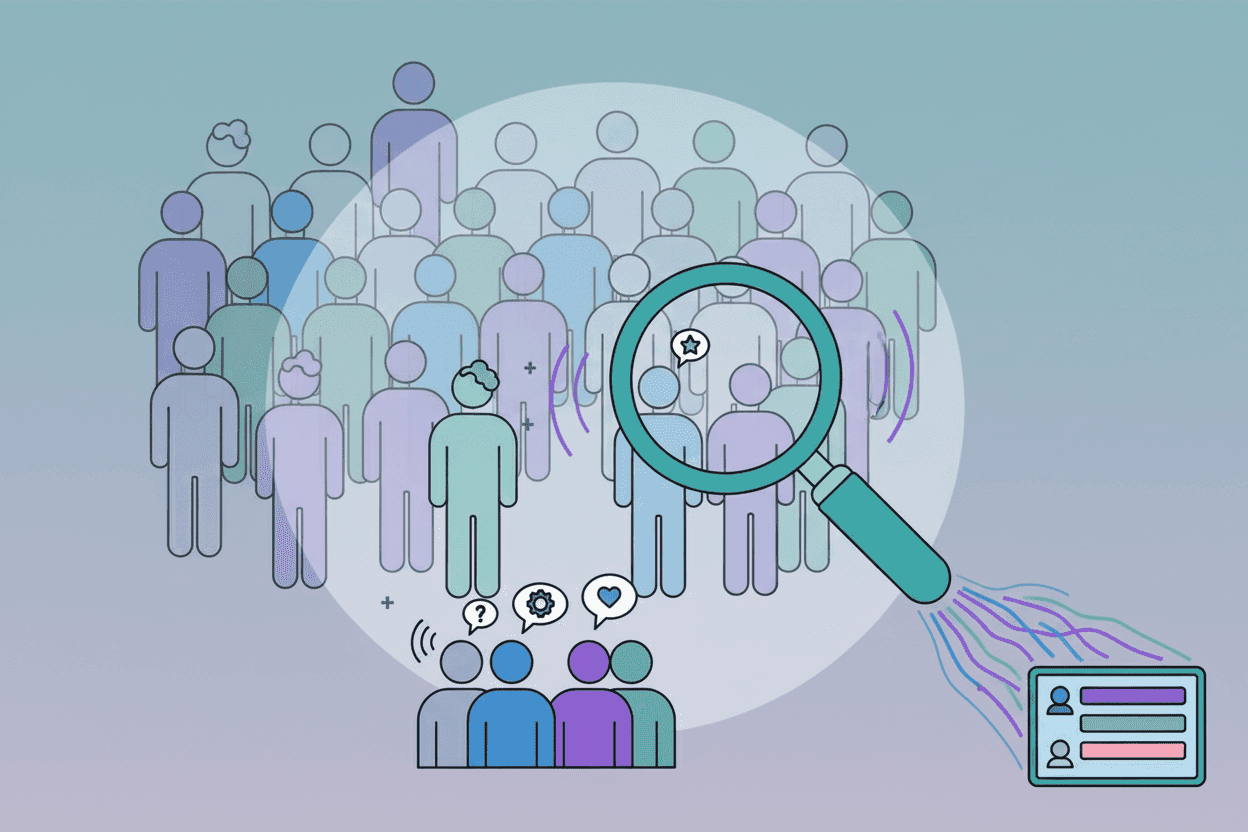
Here's a sobering statistic: 25 out of 26 customers who leave never complain before churning. That's 96% of your churning customers disappearing without a word, taking their revenue—and the reasons why—with them.
These "silent customers" represent both your biggest risk and your greatest opportunity. They won't fill out your surveys. They won't submit support tickets. They'll simply stop logging in, stop engaging, and eventually stop paying.
So how do you hear what they're not saying?
TL;DR: Key Takeaways
- Most churning customers never complain—they just leave silently
- Behavioral signals like declining login frequency and feature abandonment are stronger predictors than explicit feedback
- Passive feedback collection methods (usage analytics, session recordings, in-app micro-surveys) capture insights from non-vocal customers
- AI-powered tools can detect at-risk patterns before customers consciously decide to leave
- Building a "voice of silent customer" program requires combining quantitative signals with qualitative inference
Why Customers Stay Silent (And Why It Matters)
Before diving into solutions, let's understand why customers don't speak up:
The Psychology of Silence
1. Effort vs. Reward Imbalance Providing feedback takes effort. Unless customers believe their feedback will actually change something, the cost-benefit analysis doesn't favor speaking up. Research shows that customers calculate whether their investment of time and energy will yield meaningful results.
2. Conflict Avoidance Many people simply avoid confrontation. Telling a company their product isn't working feels like an unnecessary conflict when canceling is easier.
3. Already Made the Decision By the time a customer is frustrated enough to churn, they've often mentally moved on. Providing feedback feels like investing in a relationship they've already ended.
4. Previous Bad Experiences If feedback has been ignored before—by any company—customers learn that speaking up is futile.
Identifying Silent Customer Signals
The key insight: silent customers aren't actually silent. They're communicating through behavior, not words.
Behavioral Warning Signs
Declining Engagement Patterns
- Login frequency dropping (daily → weekly → monthly)
- Session duration decreasing
- Feature usage contracting to bare minimum
- API calls declining (for developer products)
Usage Trajectory Red Flags
- Stopped exploring new features after initial onboarding
- Never completed key activation milestones
- Reduced team invites or collaboration activity
- Export activity increasing (getting data out before leaving)
Support Behavior Shifts
- Never contacted support (indicating disconnection)
- Sudden stop in support requests (gave up)
- Viewing help docs but not finding resolution
Quantifying the Risk
Recent analysis shows that behavioral metrics predict churn more accurately than satisfaction surveys. A customer who says they're "satisfied" but whose usage is declining is at higher risk than a customer who complains but stays engaged.
Strategies for Capturing Silent Feedback
1. Embedded Micro-Moments
Instead of asking customers to go somewhere to provide feedback, bring feedback collection to them at natural interaction points:
In-Context Single Questions
- After completing a task: "Was this easier or harder than expected?" (2-click response)
- After using a feature: Simple thumbs up/down
- After a session: "Did you accomplish what you came here for?"
Why This Works The friction is nearly zero. Even customers who would never fill out a survey will click a single emoji.
2. Exit Intent Intelligence
When users show signs of leaving (moving to close tab, extended inactivity, navigating to account settings):
- Trigger a non-intrusive prompt: "Before you go—anything we could do better?"
- Use free-text with no required fields
- Make it feel like a conversation, not a form
3. Behavioral Analytics as Feedback
Treat usage data as implicit feedback:
What They Use = What They Value Track which features get adopted and which get ignored. Feature abandonment after initial trial is strong negative feedback.
Where They Struggle = Where You're Failing Rage clicks, repeated back-button usage, and help doc searches reveal friction points better than any survey.
When They Leave = Your Breaking Points Session ending on specific screens or after specific workflows indicates where the experience falls apart.
4. Session Recording Intelligence
Tools that record user sessions (with consent) reveal what customers experience but never verbalize:
- Hesitation patterns before abandoning a workflow
- Workarounds indicating unintuitive design
- Error encounters followed by session end
5. Indirect Feedback Channels
Silent customers still communicate—just not directly to you:
Review Mining Monitor G2, Capterra, TrustPilot for patterns. Customers who won't email you will sometimes vent publicly.
Social Listening Track brand mentions on Twitter, LinkedIn, Reddit. Frustration often surfaces in community discussions.
Community Lurkers Your most silent customers may be reading community forums. Analyze what questions get the most views to understand common pain points.
Building a Silent Customer Early Warning System
Step 1: Define Your Health Metrics
Create a customer health score that doesn't rely on explicit feedback:
- Engagement Score: Login frequency, session depth, feature breadth
- Adoption Score: Progress through key activation milestones
- Trajectory Score: Is engagement trending up, flat, or declining?
- Support Burden: Tickets filed vs. resolved satisfaction
Step 2: Establish Baselines and Thresholds
What does "healthy" look like for your product?
- Segment by customer type, plan level, and use case
- Define warning thresholds for each metric
- Set critical thresholds that trigger immediate intervention
Step 3: Create Automated Triggers
When a customer crosses a warning threshold:
- Add to at-risk segment for outreach
- Trigger in-app re-engagement prompts
- Notify customer success team (for high-value accounts)
- Serve targeted content addressing likely pain points
Step 4: Close the Loop
When you do get a silent customer to speak:
- Acknowledge the feedback immediately
- Report back on actions taken
- Build trust that speaking up matters
How AI Transforms Silent Customer Detection
Modern AI tools have become game-changers for understanding silent customers:
Pattern Recognition at Scale
AI can analyze millions of user sessions to identify behavioral patterns that precede churn—patterns too subtle for human analysts to catch.
Sentiment Without Surveys
Natural language processing can analyze support interactions, in-app chat, and even product usage patterns to infer sentiment without explicit surveys.
Predictive Intervention
Instead of reacting after customers leave, AI models can predict which accounts are trending toward churn weeks or months in advance.
Automated Insight Synthesis
Tools like Pelin aggregate behavioral signals, support conversations, and usage data to surface actionable insights about customer health—including the customers who never explicitly tell you anything.
Practical Implementation Checklist
Immediate Actions (This Week)
- Identify your current silent customer percentage (churners who never contacted support)
- Add one in-context micro-feedback prompt to your highest-traffic screen
- Create a basic health score using your existing analytics
Short-Term (This Month)
- Set up automated alerts for declining engagement patterns
- Implement exit-intent feedback collection
- Start mining public reviews for patterns
Medium-Term (This Quarter)
- Build a comprehensive customer health scoring system
- Create intervention playbooks for different risk segments
- Implement session recording for friction point analysis
Long-Term (This Year)
- Develop predictive churn models using behavioral data
- Build closed-loop systems that connect silent signals to product improvements
- Create a dedicated "voice of silent customer" program
The Bottom Line
Your most dangerous customers are the ones you never hear from. They're not being difficult—they just don't believe their feedback will matter.
The solution isn't to survey harder. It's to listen differently.
By treating behavior as communication, reducing feedback friction to near-zero, and using AI to detect patterns at scale, you can finally hear what your silent customers have been telling you all along.
Because 96% of unhappy customers won't complain—but they will leave. The question is whether you'll understand why before it's too late.
Want to detect silent customer signals automatically? Pelin analyzes behavioral patterns, support interactions, and usage data to surface at-risk customers before they churn—without requiring them to fill out a single survey.