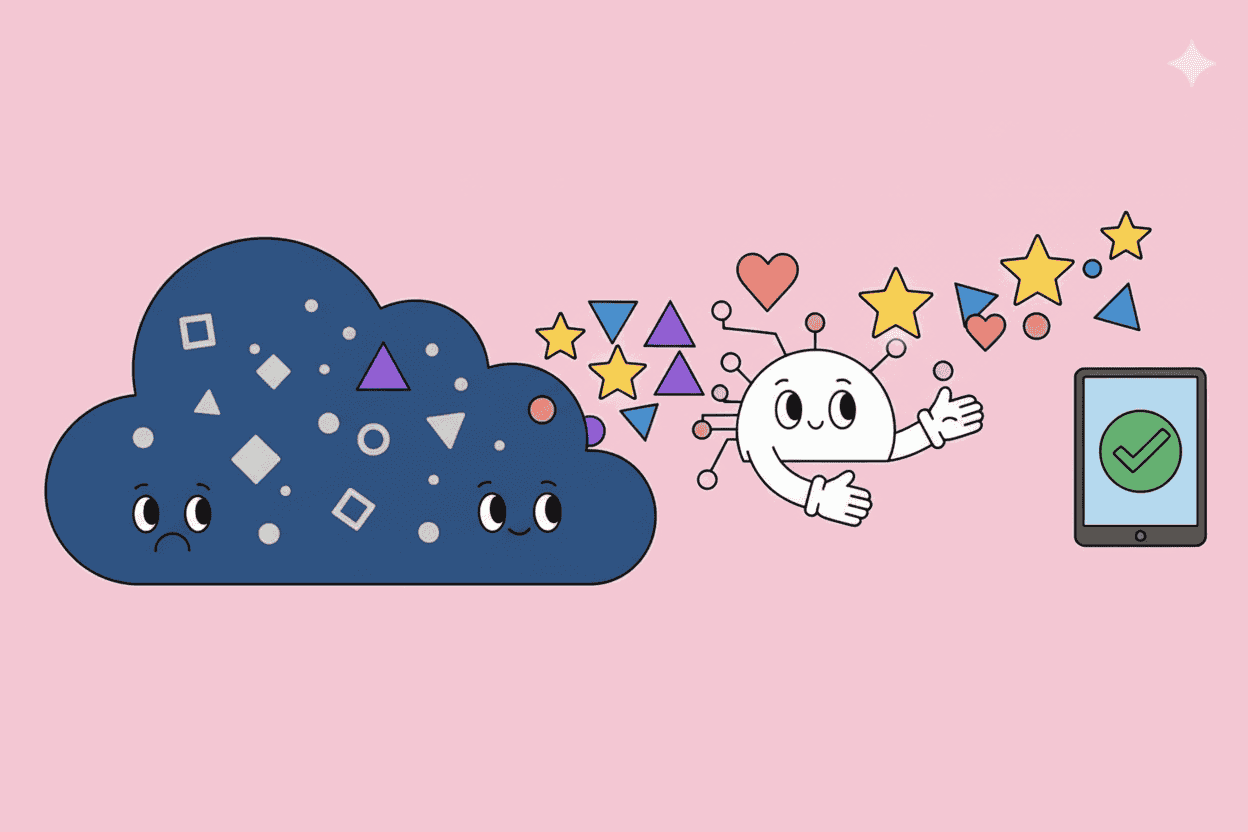
Yesterday, Kustomer announced "AI Signals"—a new AI capability that surfaces customer context, sentiment, and escalation risk directly to support reps before they even respond to a customer. The announcement itself isn't revolutionary. But what it represents is a fundamental shift in how we should think about customer feedback.
The problem Kustomer is solving isn't a lack of data. It's the gap between having visibility and taking action.
Sound familiar?
The Visibility Problem
Most product teams aren't short on customer feedback. They have support tickets, NPS surveys, feature requests, sales call notes, user interviews, social mentions, and app reviews piling up in various tools across the organization.
The issue isn't collection. It's synthesis.
As Kustomer's CEO Brad Birnbaum put it: "CX teams don't need more data—they need the right context at the right moment."
This is exactly the problem that plagues product teams. You have feedback scattered across Intercom, Zendesk, Slack channels, Notion docs, and three different spreadsheets that someone started in 2023. By the time you manually piece together what customers actually want, the market has moved on.
Traditional customer feedback workflows look something like this:
- Collect feedback from multiple sources
- Export to spreadsheet (or worse, try to remember it)
- Manually tag and categorize
- Schedule a "feedback review" meeting
- Debate what patterns mean
- Eventually make a decision
- Realize the decision was based on outdated information
This isn't product management. It's archaeology.
From Reactive to Proactive
What Kustomer understood—and what product teams need to internalize—is that the value isn't in the data itself. It's in surfacing insights at the moment they become actionable.
Their AI Signals does the analysis before a rep has to. It evaluates customer history, recent interactions, purchase behavior, and sentiment, then surfaces a prioritized summary of what matters most. No manual lookup required.
The same principle applies to product management. The best product decisions happen when you have:
- Real-time visibility into customer sentiment across all channels
- Automatic pattern detection that surfaces emerging issues
- Prioritized insights that connect feedback to business outcomes
- Context that helps you understand why customers feel the way they do
Waiting for the weekly sync to review feedback is like checking your email once a day in 2026. You're operating with information that's already stale.
The Cost of Being Late
Here's what reactive product management actually costs you:
Churn you didn't see coming. By the time a customer explicitly tells you they're unhappy, they've usually already decided to leave. Research from Gartner shows that 65% of churned customers had shown warning signs in their behavior patterns months before cancellation. The feedback was there—it just wasn't surfaced.
Features nobody wanted. Without proactive intelligence, product teams build based on the loudest voices rather than the most important problems. The customer who emails you weekly isn't necessarily representative. But without aggregated, weighted insights, you'd never know.
Slower time to market. When every decision requires a manual feedback audit, decisions take weeks instead of hours. Your competitors who have proactive intelligence systems ship faster because they spend less time debating what customers want.
Burned-out PMs. The cognitive load of trying to synthesize feedback manually is exhausting. It's not strategy—it's data entry with a nicer title.
What Proactive Customer Intelligence Actually Looks Like
Let's get specific. Here's what the shift from reactive to proactive looks like in practice:
Old Way: The Feature Request Graveyard
Someone submits a feature request. It goes into a backlog that's never reviewed. Three months later, a different customer asks for the same thing. You don't connect them because they used different words. Eventually, you build something else entirely based on a gut feeling.
New Way: Automated Pattern Detection
AI continuously analyzes all incoming feedback—support tickets, reviews, social mentions, interview transcripts. It automatically clusters similar requests, identifies emerging patterns, and surfaces the signal: "15 enterprise customers have mentioned workflow automation in the past 30 days. This represents $2.1M in ARR. Common use cases include..."
Old Way: The "Let's Review Feedback" Meeting
A monthly ritual where everyone sits in a room, pulls up random feedback, and debates interpretations. Someone says "I think customers want X," someone else disagrees, and you end up splitting the difference with a compromise that satisfies nobody.
New Way: Evidence-Based Prioritization
Before the meeting even starts, the team has access to a prioritized list of customer needs weighted by revenue impact, frequency, and strategic alignment. Disagreements become resolvable because there's actual data, not just opinions.
Old Way: Post-Launch Surprise
You ship a feature. Customers don't use it. Someone says "we should have talked to customers first." Everyone nods. Nothing changes for the next launch.
New Way: Continuous Feedback Loop
Every piece of customer communication is analyzed in real-time. Before you launch, you know which customers are likely to adopt, what objections they might have, and what messaging will resonate—because you've seen those patterns across thousands of similar interactions.
The Technology Shift
What makes this possible now when it wasn't five years ago?
Natural language understanding has matured. Modern language models can understand context, sentiment, and intent across multiple languages and communication styles. A frustrated customer writing "This is fine I guess" gets flagged correctly as negative sentiment.
Integration is easier. APIs and unified data platforms mean you can pull feedback from Intercom, Zendesk, Slack, reviews, and social media into a single analysis layer without building custom connectors.
Real-time processing is affordable. Analyzing thousands of messages per minute no longer requires a dedicated data science team and $500K in infrastructure.
AI can now synthesize, not just sort. The shift from keyword matching to actual understanding means AI can identify that "can't export data," "need CSV functionality," and "why can't I download this?" are all the same feature request.
Practical Steps for Product Teams
You don't need to rip and replace your entire feedback stack overnight. Here's how to start moving toward proactive customer intelligence:
1. Audit your current feedback sources. List every place customer feedback lives. Support tickets, sales calls, user research, reviews, social media, community forums, NPS responses. Most teams find 10+ sources they've been ignoring.
2. Identify your highest-value blind spot. Where are you making decisions without data? Where do surprises come from? That's where proactive intelligence will have the most impact.
3. Start with one channel. Don't try to unify everything at once. Pick your highest-volume feedback source and implement AI analysis there first. Support tickets are often the best starting point—they're structured, high-volume, and directly tied to customer pain.
4. Connect feedback to outcomes. Raw feedback is noise. Feedback connected to revenue, churn risk, and customer segment is signal. Make sure your intelligence layer can weight and prioritize, not just aggregate.
5. Build the habit of checking, not digging. The goal is to shift from "let me go find feedback on this" to "what is the feedback already telling me?" That's the difference between reactive and proactive.
The Future Is Already Here
Kustomer's AI Signals is one example of a broader industry shift. The companies that win in the next decade will be the ones that stop treating customer feedback as a project and start treating it as a continuous intelligence layer.
This isn't about replacing human judgment. It's about making sure humans are judging the right things at the right time.
The alternative is to keep doing archaeology—sifting through the past, hoping you find something useful before it's too late.
Product teams that embrace proactive customer intelligence won't just ship better products. They'll ship faster, with more confidence, and with less burnout.
The question isn't whether this shift will happen. It's whether you'll lead it or be left behind.
At Pelin, we're building the proactive customer intelligence layer that product teams deserve. No more spreadsheets, no more manual synthesis—just real-time insights from every customer conversation, prioritized by what actually matters to your business.