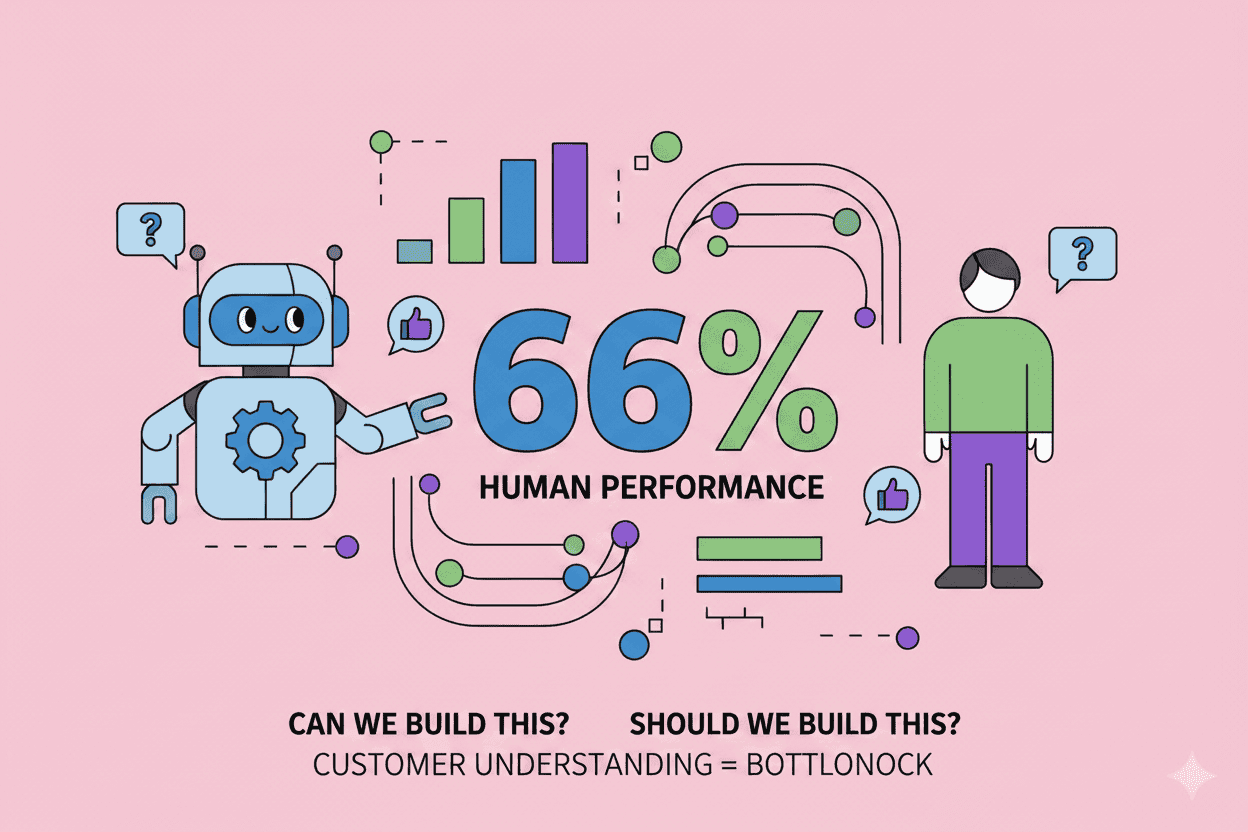
Last week, Stanford's 2026 AI Index Report dropped a number that should make every product team pause: AI agents jumped from 12% to 66.3% task success on the OSWorld benchmark—putting them within 6 percentage points of human performance.
Read that again. In a single year, AI agents went from barely functional to near-human at navigating software, completing multi-step tasks, and working across operating systems.
The capability gap is closing fast. But here's what the Stanford report doesn't tell you: when AI can execute almost anything, the question stops being "can we build this?" and becomes "should we build this?"
And that question? Product teams are still getting it wrong at alarming rates.
The New Bottleneck Isn't Capability
For years, the limiting factor in product development was technical feasibility. Can we build it? How long will it take? Do we have the engineering resources?
Those constraints haven't disappeared—but they're rapidly becoming less relevant. When AI agents can handle 66% of computer tasks at human-level performance, and companies like HubSpot are shifting to results-based AI pricing ($0.50 per resolved conversation, $1 per qualified lead), the cost and complexity of building features is collapsing.
The new bottleneck is knowing what to build in the first place.
According to CB Insights data, 35% of startups fail because there's "no market need." Not because they couldn't build the product—because they built the wrong thing. And that number hasn't budged even as our technical capabilities have exploded.
Think about what that means in the AI agent era. You can now build features faster than ever. Ship updates in days instead of months. Automate entire workflows with near-human accuracy.
But if you're automating the wrong workflows, you're just failing faster.
"Jagged Intelligence" and the Product Discovery Problem
One of the most fascinating findings in Stanford's report is what researchers call "jagged intelligence." Gemini Deep Think can win a gold medal at the International Mathematical Olympiad—but it reads analog clocks correctly only 50.1% of the time compared to 90.1% for humans.
AI is incredibly good at some things and surprisingly bad at others. There's no predictable pattern to its strengths and weaknesses.
This creates a fundamental product discovery problem: you can't just ask AI what to build next, and you can't assume that because AI excels at one task, it'll handle related tasks equally well.
The same principle applies to understanding customers. Your power users might be incredibly vocal on Twitter, while your most valuable segment—the ones driving 80% of revenue—might never fill out a survey. Some customers articulate their needs clearly; others can barely describe what they want.
Product teams that rely on random feedback sampling are essentially hoping they got lucky with who they listened to. In an era where execution is cheap, that kind of randomness is the real risk.
What Actually Matters Now
Here's the uncomfortable truth: most product teams still treat customer feedback like it's 2015.
They collect feedback in 47 different places. Support tickets in Zendesk. Feature requests in Notion. Sales call notes in Google Docs. NPS responses in Delighted. User interviews in a spreadsheet someone created two years ago and forgot about.
Then, once a quarter, someone heroically attempts to "synthesize the insights." They read through hundreds of data points, pattern-match in their head, and present findings that are shaped as much by recency bias and personal assumptions as by actual customer needs.
This worked (barely) when shipping features took months. When execution was the bottleneck, imprecise customer understanding was a tolerable inefficiency. You had time to course-correct.
That buffer is gone.
When you can ship in days, you need to know what to ship in hours. Not "probably this based on my gut feeling from the last sales call," but "definitely this, backed by systematic analysis of every customer signal."
The Voice of Customer Problem Is a Data Problem
The Stanford AI Index also reveals that AI models now achieve 60-90% performance in professional domains like tax, mortgage processing, corporate finance, and legal reasoning. These are complex, high-stakes domains where accuracy matters.
Why does AI perform well in these areas? Because they're structured. There's clear data, defined outcomes, and systematic evaluation criteria.
Now contrast that with how most companies handle customer feedback: unstructured, inconsistent, and scattered across dozens of tools and formats. No wonder product teams struggle to extract actionable insights.
Voice of Customer isn't a listening problem. It's a data problem.
When customer feedback exists as unstructured text in silos, even the best product managers can only process a fraction of it. They end up making decisions based on whichever signals happen to be loudest or most recent—not which signals are most representative or valuable.
Five Shifts Product Teams Need to Make
If AI agents are about to handle 66% of execution, here's where product teams should focus their uniquely human capabilities:
1. Consolidate feedback before you analyze it.
Stop analyzing feedback in isolation. That Zendesk ticket about slow loading times might connect to the NPS comment about "feeling sluggish" and the sales call where a prospect mentioned "we need something faster." Separately, they're three data points. Together, they're a pattern.
2. Weight signals by business impact, not volume.
A hundred free users complaining about a missing feature is different from five enterprise customers threatening to churn over it. Your feedback analysis needs to account for revenue impact, customer segment, and strategic importance—not just count mentions.
3. Make customer insights continuous, not quarterly.
The quarterly product review is dead. If you can ship weekly, you need to understand customers weekly. Build systems that surface customer needs in real-time, not summaries that arrive months after the conversations happened.
4. Document decision context, not just decisions.
When AI can execute your decisions almost as well as humans, the quality of those decisions becomes everything. Document why you chose to build something, what customer evidence supported it, and what you expected to happen. This creates an audit trail that helps you learn and iterate.
5. Get systematic about unknown unknowns.
Your most important customer insights might be hiding in signals you're not currently tracking. Are you analyzing customer behavior patterns, not just their explicit feedback? Are you looking at what customers do, not just what they say?
The Coming Divide
The Stanford AI Index hints at a future that's arriving faster than most teams realize. When four companies are now within 25 Elo points of each other in AI model performance, differentiation shifts away from raw technical capability.
The same pattern will play out in product development. When every team can build fast, the winners will be the ones who know what to build.
That means the real competitive advantage isn't your engineering velocity or your AI agent integration. It's your customer understanding. Your ability to synthesize signals from every touchpoint into a coherent picture of what customers actually need.
Companies that figure this out will iterate faster on the right things. Companies that don't will iterate faster on the wrong things—and wonder why their metrics aren't moving despite shipping constantly.
The Bottom Line
AI agents reaching 66% human performance is impressive. But it's also a warning.
The technology that makes execution easier also makes customer understanding more critical. When building is cheap, building the wrong thing becomes the most expensive mistake you can make.
Product teams have always needed to understand customers. Now, it's basically the whole job.
The teams that thrive in this environment won't be the ones with the most AI agents or the fastest deployment pipelines. They'll be the ones who invested in truly understanding what their customers need—systematically, continuously, and comprehensively.
Because when AI can do almost anything you ask, the only question left is: are you asking the right questions?
Pelin helps product teams turn scattered customer feedback into clear priorities. Instead of heroically synthesizing insights from 47 different sources, get AI-powered analysis that connects every customer signal to business outcomes. Learn more about Pelin.