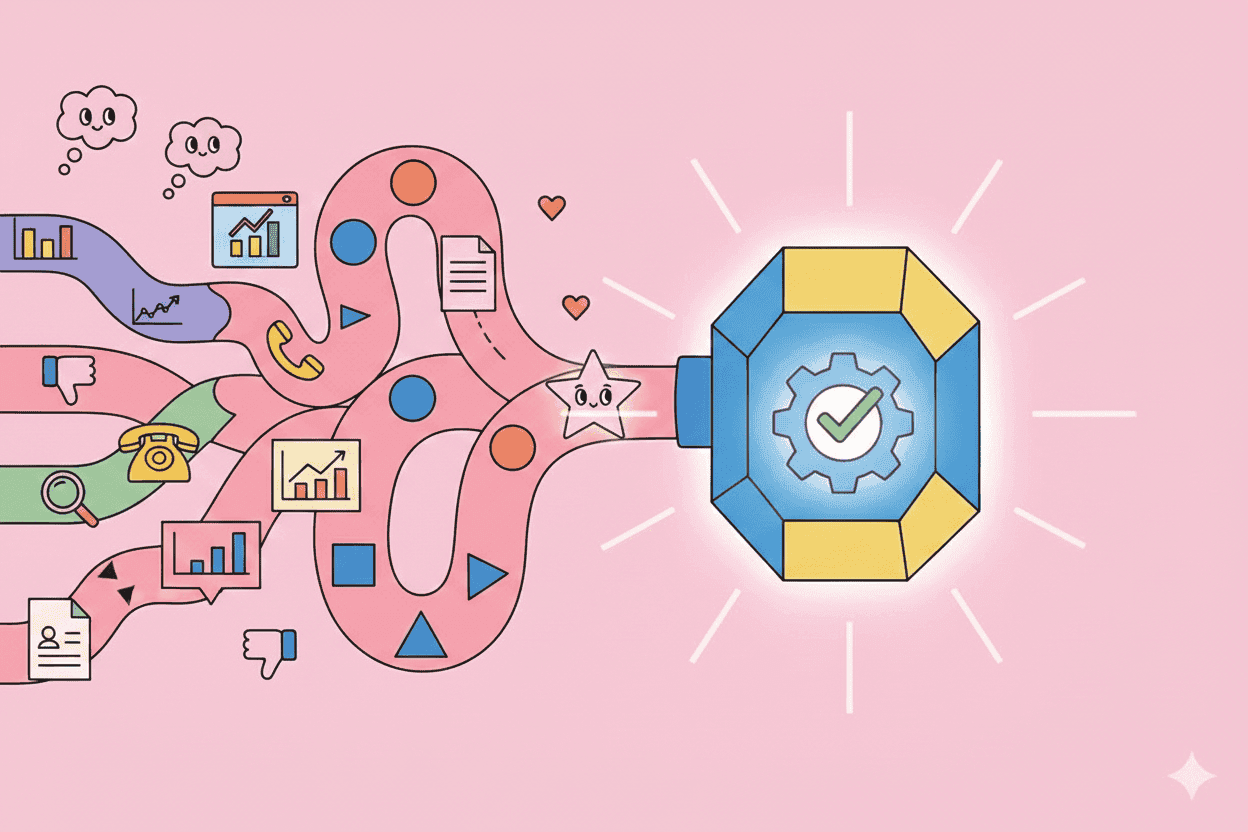
Something interesting is happening in product management. For years, we've watched PMs drown in an ocean of tools—a Notion database here, a Productboard roadmap there, Slack threads everywhere, and that one spreadsheet from 2023 that definitely contains important feedback if anyone could remember where it is.
But the tide is turning.
According to recent research from BuildBetter, over 73% of product managers now use at least one AI-powered tool in their daily workflow—nearly double the 45% adoption rate from just two years ago. And within that surge, one trend stands out above all others: the move toward unified customer intelligence.
The 2026 trend, as the research puts it, is toward "platforms that unify feedback, meeting data, and research into a single intelligence layer. Instead of checking five dashboards, PMs want one place where a support ticket theme, a customer call excerpt, and a Slack discussion all connect."
Welcome to the age of unified customer intelligence. And if you're still toggling between six tabs to understand what your customers actually want, you're already behind.
The Real Cost of Fragmented Feedback
Here's a number that should make every product leader uncomfortable: PMs spend approximately 30% of their time on documentation, meeting notes, and status updates. That's nearly a third of your week—the week where you're supposed to be building product strategy, validating hypotheses, and talking to customers.
Instead, you're copy-pasting snippets from Zoom transcripts into Notion, tagging feature requests in Productboard, cross-referencing support tickets in Zendesk, and trying to remember if that crucial insight came from last Tuesday's customer call or the Slack thread that got buried under 200 messages.
The fragmentation tax is real. And it's not just about time.
When customer signals live in disconnected silos, patterns get missed. That churned customer who mentioned onboarding friction three months ago? Their feedback lived in a support ticket that never made it to the product team. The feature request that 40 customers have mentioned in various forms? It shows up as 40 unrelated data points across four different systems.
The problem isn't that you don't have enough customer feedback. It's that your feedback doesn't talk to itself.
What Unified Intelligence Actually Looks Like
The tools gaining traction in 2026 share a common philosophy: everything connects. A unified customer intelligence platform doesn't just aggregate data—it synthesizes it.
Here's the difference:
Aggregation (the old way): You can see all your support tickets in one dashboard. Great. You can also see all your NPS responses in another dashboard. And your call recordings in a third. Three places, three contexts, zero connections.
Synthesis (the new way): When a customer mentions "confusing pricing" during a sales call, the system automatically links it to the 12 support tickets about pricing confusion, the Slack discussion where your team debated pricing simplification, and the in-app survey where 34% of users said pricing was unclear. One insight, fully contextualized.
This isn't theoretical. Teams using AI-powered feedback synthesis tools report 40-60% reduction in time spent manually synthesizing feedback. That's not incremental improvement—that's a fundamental shift in how product teams operate.
The Four Pillars of Modern Customer Intelligence
If you're evaluating whether your current stack is up to the task, here's what the leading unified intelligence platforms have in common:
1. Multi-Source Data Integration
The best platforms can ingest everything: support tickets, sales calls, user interviews, NPS surveys, in-app feedback widgets, social mentions, Slack conversations, and product usage data. The key word is "ingest"—not just display, but actually process and connect.
This matters because customers don't segment their feedback by your tool categories. A user doesn't think "I'll file my feature request in the official feedback portal and discuss my frustrations on Twitter." They speak wherever it's convenient. Your intelligence layer needs to listen everywhere.
2. Real-Time Processing
Traditional customer research operates on delayed feedback loops. By the time insights are gathered and analyzed, weeks have passed. The market has moved. Customer needs have shifted.
Real-time processing means you can spot emerging patterns as they develop—not three weeks after they've become problems. When five customers mention the same pain point within 48 hours, you know immediately. Not eventually.
3. Contextual Insight Delivery
Modern AI systems don't just generate insights—they deliver them when they're relevant. Instead of overwhelming you with endless reports, intelligent platforms surface the right information at the right moment.
Considering a new feature? The system automatically provides relevant insights about similar past features, user segment preferences, and potential metric impacts. Preparing for a customer call? Here's a summary of everything that customer has ever mentioned, organized by theme.
4. Pattern Recognition at Scale
This is where AI genuinely earns its keep. Identifying patterns in large datasets is simply impossible for humans to do manually at scale. AI can analyze behavior across millions of interactions, spot subtle correlations, and surface insights that would require dedicated data science teams and weeks of work to uncover.
One pattern across 10,000 data points isn't visible. Ten thousand patterns across 10,000 data points is noise. The magic happens when AI finds the meaningful signals hiding in the chaos.
Why Product Teams Are Making the Switch
The shift toward unified intelligence isn't driven by shiny-object syndrome. It's driven by competitive pressure.
Consider this: if your competitor can identify and act on emerging customer needs in days while you're still manually synthesizing feedback over weeks, who wins? The advantage compounds over time. They ship faster, validate faster, course-correct faster.
The teams adopting unified intelligence platforms aren't just saving time on admin work. They're making structurally better decisions because they have structurally better information.
Here's what that looks like in practice:
Before unified intelligence:
"We think users want feature X because several customers mentioned it, but we're not sure if it's a priority. Let's spend a week doing discovery calls to validate."
After unified intelligence:
"47 customers have mentioned variations of feature X across support tickets, sales calls, and feedback forms. The pattern is strongest among Enterprise accounts with more than 50 users. Here are the three most common use cases described, along with similar requests from the past that shipped successfully."
Same question. Vastly different starting point.
The Uncomfortable Truth About Your Current Stack
If you're reading this and thinking "my tools work fine," I'd challenge you with a simple test:
Right now, can you answer this question: What are the top three unmet needs across your customer base, and how confident are you in that ranking?
Not what you think. Not what the loudest customer said. Not what your gut tells you based on recent calls.
The actual answer, derived from synthesized evidence across every customer touchpoint you have.
If that's a hard question to answer—if it would require hours of manual work to even approximate an answer—then your current stack isn't working. It's storing data. But it's not creating intelligence.
Where Pelin Fits
This is exactly the problem we're solving at Pelin. We built a unified customer intelligence platform because we lived the fragmentation problem ourselves—as product people, trying to make good decisions with data scattered across 15 different tools.
Pelin brings all your customer signals together: support tickets, call recordings, feedback forms, NPS surveys, and in-app behavior. Our AI doesn't just collect it—it connects it, surfacing patterns and insights that would be invisible in any single tool.
No more toggling between dashboards. No more manual synthesis. No more gut feelings dressed up as data-driven decisions.
Just a clear picture of what your customers actually need, updated in real time, ready when you are.
The Bottom Line
The 73% of PMs already using AI tools aren't early adopters anymore—they're the new normal. And within that group, the most successful teams are moving beyond point solutions toward unified intelligence.
The question isn't whether to adopt these tools. The question is how quickly you can make the transition—and how much time and competitive advantage you'll leave on the table if you wait.
Your customers are already telling you what they need. The only question is whether you can hear them through the noise.
Ready to see unified customer intelligence in action? Try Pelin free and experience what it's like when all your customer signals finally connect.