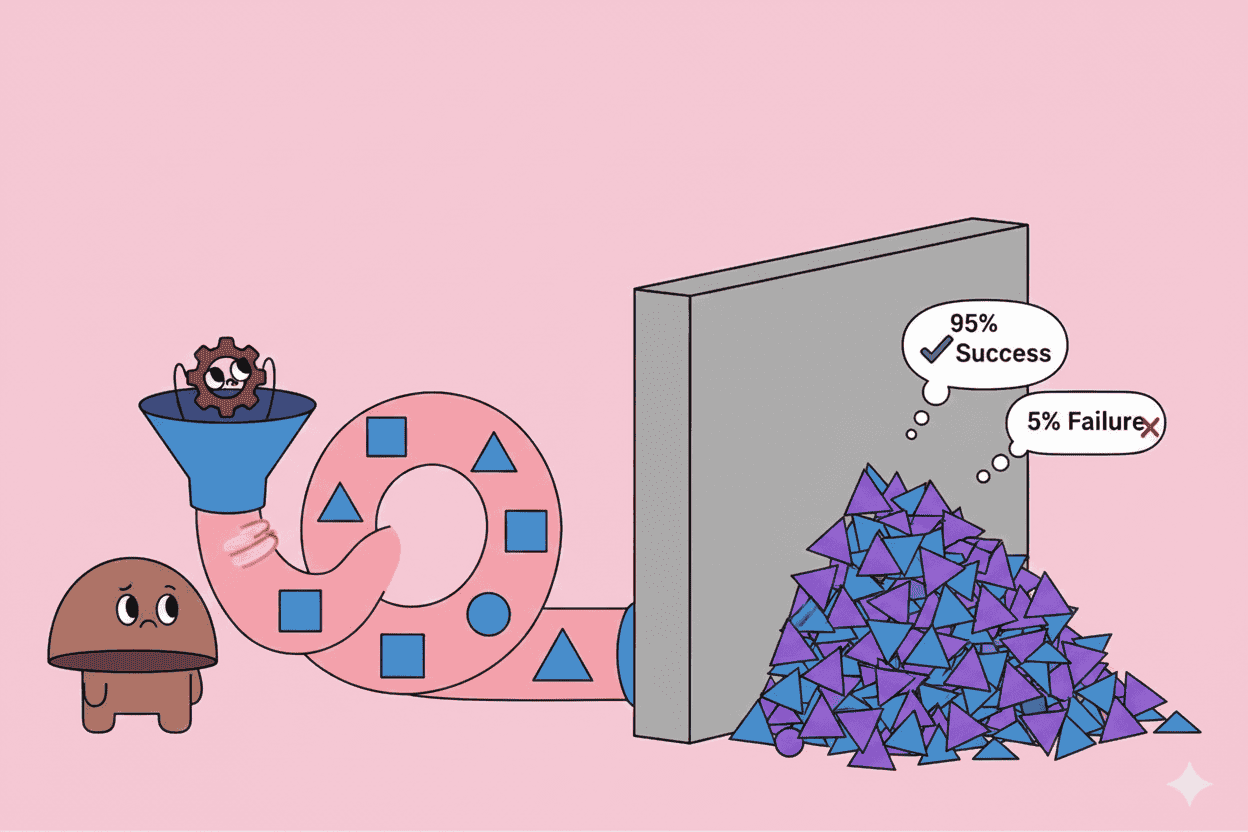
Yesterday, Datadog released their State of AI Engineering 2026 report, and one number should stop every product leader in their tracks: nearly 5% of all AI requests fail in production.
That's not a rounding error. That's 1 in 20 requests breaking—leading to slowdowns, errors, and broken user experiences across AI-powered applications.
And here's the kicker: the failures aren't caused by bad models. According to Datadog, nearly 60% of those failures are caused by capacity limits. The bottleneck isn't intelligence—it's operations.
As Yanbing Li, Chief Product Officer at Datadog, put it: "AI is starting to look a lot like the early days of cloud. The cloud made systems programmable but much more complex to manage. AI is now doing the same thing to the application layer."
The lesson for product teams? Scale without operational control is a recipe for failure. And this doesn't just apply to AI infrastructure—it applies to everything product teams do, including how they gather and act on customer insights.
The Complexity Explosion Is Real
The Datadog report paints a picture of rapidly escalating complexity. 69% of companies now use three or more AI models in production. Agent framework adoption doubled year-over-year. The average number of tokens sent per request more than doubled for typical teams and quadrupled for heavy users.
More models. More agents. More data. More moving parts.
And every additional moving part creates new failure modes.
This isn't a critique of AI adoption—it's a recognition that operational complexity compounds. Each new model you integrate, each new workflow you automate, each new data source you connect adds to the operational burden.
Product teams face the exact same dynamic with customer insights.
The Customer Insights Complexity Problem
Think about how most product teams handle customer feedback today:
- Support tickets live in Zendesk or Intercom
- Feature requests are scattered across Notion, Linear, or Jira
- Sales call notes exist in Google Docs or CRM notes
- NPS responses sit in Delighted or SurveyMonkey
- User interviews are transcribed into random spreadsheets
- Social mentions appear on Twitter, Reddit, and G2
- Usage data lives in product analytics tools
Each source requires its own integration. Each integration requires maintenance. Each piece of data needs to be aggregated, normalized, and analyzed.
Sound familiar? It's the same multi-model, multi-agent complexity that's causing 5% of AI requests to fail in production.
The difference is that when your customer insights infrastructure fails, you don't get error logs. You just make bad product decisions.
Why "More Data" Isn't the Answer
There's a tempting response to the complexity problem: just collect more data and throw AI at it.
But Datadog's findings should give pause. When Vercel CEO Guillermo Rauch says "the next wave of agent failures won't be about what agents can't do but what teams can't observe," he's identifying a fundamental truth: capability without visibility leads to chaos.
Adding more customer feedback sources without a unified system to observe, analyze, and act on them isn't a solution—it's just well-intentioned noise.
Product teams don't need more data. They need operational control over the data they have.
Consider: the average enterprise has customer insights spread across 10+ tools. Each tool has its own tagging system, its own categorization logic, its own export format. Trying to build a unified view manually is like trying to run AI models in production without observability—technically possible, but practically unmanageable at scale.
The Operational Control Imperative
The Datadog report highlights a crucial shift in mindset: "The companies that win won't just build better models—they'll build operational control around them."
For product teams, the parallel is clear: the teams that win won't just collect more feedback—they'll build operational control around customer insights.
What does operational control mean in practice?
1. Single Source of Truth
Just as AI teams need unified observability across models, product teams need unified visibility across all customer feedback channels. Not 47 tabs in your browser—one place where support tickets, feature requests, sales calls, and user interviews converge.
When everything lives in one system, patterns emerge that you'd never spot when switching between tools. The feature request from three enterprise customers suddenly connects to the support ticket trend from last month and the churn reason from last quarter.
2. Automated Signal Detection
Agent framework adoption doubled in 2026 because automation removes manual bottlenecks. The same principle applies to customer insights: the signal should surface automatically, not require hours of manual tagging and categorization.
The best customer insight systems don't just store feedback—they identify themes, detect sentiment shifts, and surface anomalies before they become crises. Like AI observability tools that catch capacity limits before requests fail, good customer insight tools catch emerging patterns before they impact churn.
3. Real-Time Visibility
The Datadog report emphasizes "real-time visibility across the entire stack." Why? Because by the time you discover a problem in batch analysis, you've already lost time (and customers).
Product teams typically operate on monthly or quarterly feedback review cycles. But customer needs don't follow your roadmap cadence. The feature that was "nice to have" last month might be causing churn today.
Real-time customer insight visibility means you're never surprised by feedback. You know what customers are asking for right now, not what they asked for when you last had time to read through your backlog.
The Hidden Cost of Operational Complexity
Here's what product leaders often miss: operational complexity has a compounding cost.
Every hour spent manually aggregating feedback from multiple sources is an hour not spent actually talking to customers. Every week spent building internal dashboards to track feature requests is a week not spent shipping improvements. Every quarter spent reconciling conflicting data from different tools is a quarter of delayed decisions.
According to research from McKinsey, organizations that effectively leverage customer data see 23% higher revenue growth. But "effectively" is the key word. Data that sits in silos, requires manual effort to analyze, or takes weeks to synthesize isn't effective—it's just overhead.
The Datadog report notes that token volumes quadrupled for heavy AI users. But the teams that succeeded weren't just processing more data—they were processing it with operational control. The same is true for customer insights: it's not about volume, it's about having systems that can handle the volume reliably.
What Product Teams Should Do Next
If the Datadog report is a warning about AI infrastructure, it's equally a warning about any system that scales without operational rigor. Here's how to apply those lessons to customer insights:
Audit Your Current Stack
Count how many tools contain customer feedback. If the number is higher than five, you have a complexity problem. Each integration point is a potential failure mode—a place where data can be lost, delayed, or misinterpreted.
Identify Manual Bottlenecks
Where does someone have to manually export, tag, or aggregate data? Those manual steps are your equivalent of the "capacity limits" causing 60% of AI failures. They don't scale, and they fail silently.
Measure Time-to-Insight
How long does it take from a customer saying something important to your product team knowing about it? Days? Weeks? In an era where AI agents can complete complex tasks at near-human performance, waiting weeks to understand what customers want is inexcusable.
Build for the Scale You'll Need
Datadog's customers learned that operational problems emerge at scale, not during pilots. Don't wait until you have 10,000 customers to fix your feedback infrastructure. Build the operational control now.
The Bottom Line
The State of AI Engineering 2026 reveals an uncomfortable truth: technical capability without operational control leads to failure. 5% request failure rates. Broken user experiences. Teams that can't observe what they've built.
Product teams face the same challenge with customer insights. The capability to collect feedback has never been greater—but without operational control, that feedback becomes noise instead of signal.
The companies that win in 2026 won't be the ones with the most customer feedback. They'll be the ones who can reliably turn that feedback into action.
As the Datadog report concludes: "How you operate AI may matter more than the models you choose."
The same is true for customer insights: how you operate your feedback system may matter more than how much feedback you collect.
Ready to build operational control around your customer insights? See how Pelin helps product teams unify feedback and surface signals automatically.