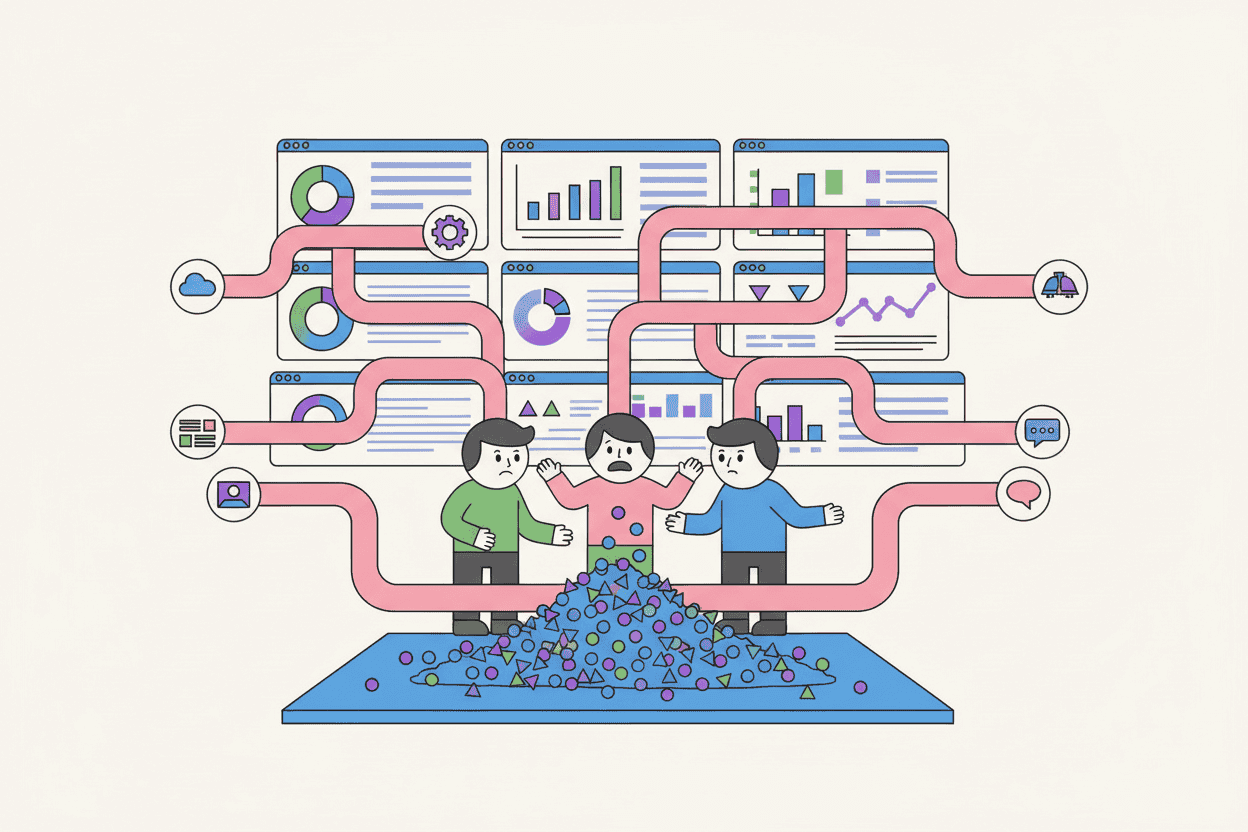
Here's an uncomfortable statistic: according to Medallia's 2026 State of CX report, 66% of CX professionals believe customer experience has improved at their organization. But when you ask customers? Only 17% agree.
That's not a gap. That's a canyon.
What's causing this massive disconnect? CX Today's recent analysis puts it bluntly: 30-40% of departments simply aren't acting on feedback. They have the data. They have the dashboards. They have access to more customer signals than ever before.
They just don't do anything with it.
The Dashboard Delusion
We've all seen it. The sprawling Notion database. The meticulously tagged feedback spreadsheet. The quarterly "Voice of Customer" report that gets presented once and then forgotten.
Product teams spend hours collecting feedback—from support tickets, NPS surveys, user interviews, sales calls, social media, and product analytics. Then they spend more hours categorizing it, scoring it, and visualizing it.
And then... nothing happens.
The problem isn't data collection. It's what CX Today calls the "measurement trap": organizations mistake reporting for progress. They build beautiful dashboards and think the job is done. But as their analysis notes, "real-time intelligence isn't faster reporting. Real-time does not mean a prettier dashboard that refreshes more often."
The Execution Loop That Actually Works
The difference between teams that improve and teams that just measure comes down to a simple loop:
- Detect what changed
- Diagnose why it changed
- Assign an owner
- Act inside the workflow
- Measure impact and repeat
Most organizations break down at step three. They can see problems. They might even understand root causes. But ownership gets fuzzy, priorities get muddled, and the insight dies in committee.
According to the CX Today research, "if a platform cannot support that loop, it is helping you report on problems, not solve them."
Why "More Data" Isn't the Answer
Here's what most product teams don't realize: you probably have enough data already. What you lack is the system to turn that data into action.
Consider the typical feedback journey at most companies:
- Customer mentions a pain point in a support ticket
- It gets tagged and categorized
- It shows up in a monthly report
- A PM sees it alongside 50 other issues
- It goes into a backlog
- It competes with feature requests from the sales team
- Six months later, nothing has changed
Now multiply this by hundreds of touchpoints across your customer base. Every channel—support, social, reviews, surveys—generates more signal. But more signal without better synthesis just means more noise.
This is where traditional analytics falls short. As one industry analysis notes, the real gap is "interpretation, prioritization, and follow-through."
The Shift to Customer Intelligence
The distinction between analytics and intelligence matters more than most teams realize.
Analytics tells you: "Average handle time increased today."
Intelligence tells you: "Average handle time increased because billing questions spiked and agents are searching for answers. Update knowledge content and route those intents to trained specialists."
One gives you a metric. The other gives you a next step.
This shift—from passive measurement to active intelligence—is why AI-powered tools are finally delivering on the promise of customer-centric product development. Not because they collect more data, but because they can synthesize across sources, identify patterns humans would miss, and surface actionable recommendations in real time.
Practical Steps for Product Teams
If you're stuck in the measurement trap, here's how to climb out:
1. Shrink Your Dashboard
Seriously. The best teams track fewer metrics, not more. Focus on indicators that directly connect to customer outcomes: resolution rate, effort scores, retention signals. If a metric doesn't change what you do tomorrow, remove it from your real-time view.
2. Assign Owners, Not Committees
Every customer problem needs one human accountable for its resolution. Not a "cross-functional team." Not a "working group." One person who will be asked next week: "Did you fix this?"
3. Close the Loop in Days, Not Quarters
The lag between insight and action is where most improvements die. If you're seeing feedback in January and acting on it in April, you're not doing customer intelligence—you're doing historical research.
4. Connect Channels, Not Just Data
Customers don't live in channels. They mention something on social, follow up with support, and then complain in a review. Intelligence means connecting these signals into a single customer story, not fragmenting them across separate dashboards.
5. Measure What Changed
After you act, go back to the data. Did the intervention work? Did handle times drop? Did repeat contacts decrease? The teams that improve fastest are obsessive about closing the feedback loop on their own actions.
What AI Actually Solves
Let's be clear about what AI-powered customer intelligence tools can and can't do.
They can:
- Synthesize signals across dozens of channels simultaneously
- Detect patterns across thousands of conversations that humans would miss
- Predict which issues will escalate before they become crises
- Recommend specific next actions based on what's worked before
- Route insights to the right owner automatically
They can't:
- Make your organization care about customers
- Force action on insights that get ignored
- Replace human judgment about what matters
- Fix broken processes with better reporting
The technology is a multiplier. If your team genuinely wants to improve customer experience, AI tools can compress months of analysis into minutes. But if your culture treats feedback as a checkbox exercise, no amount of sophisticated analytics will help.
The Real Question
The challenge for product teams in 2026 isn't access to customer signals. AI-powered tools have made it possible to capture, synthesize, and act on feedback at a scale that would have been impossible five years ago.
The question is simpler and harder: Will you actually do something with what you learn?
Because right now, most organizations won't. They'll keep building dashboards, keep generating reports, and keep wondering why their customers don't feel heard.
The teams that win will be the ones who figure out that customer intelligence isn't about measurement. It's about action. Every insight has a half-life. Wait too long, and the moment passes.
Your customers are telling you exactly what they need. The only remaining question is whether you're listening—and whether you'll move fast enough to matter.
Pelin helps product teams stop drowning in feedback and start building what customers actually need. Our AI synthesizes customer signals from every channel, identifies what matters most, and tells you exactly what to do next. No more dashboard archaeology. No more quarterly reports that arrive too late to matter. Just clear priorities, backed by every customer conversation you've ever had.