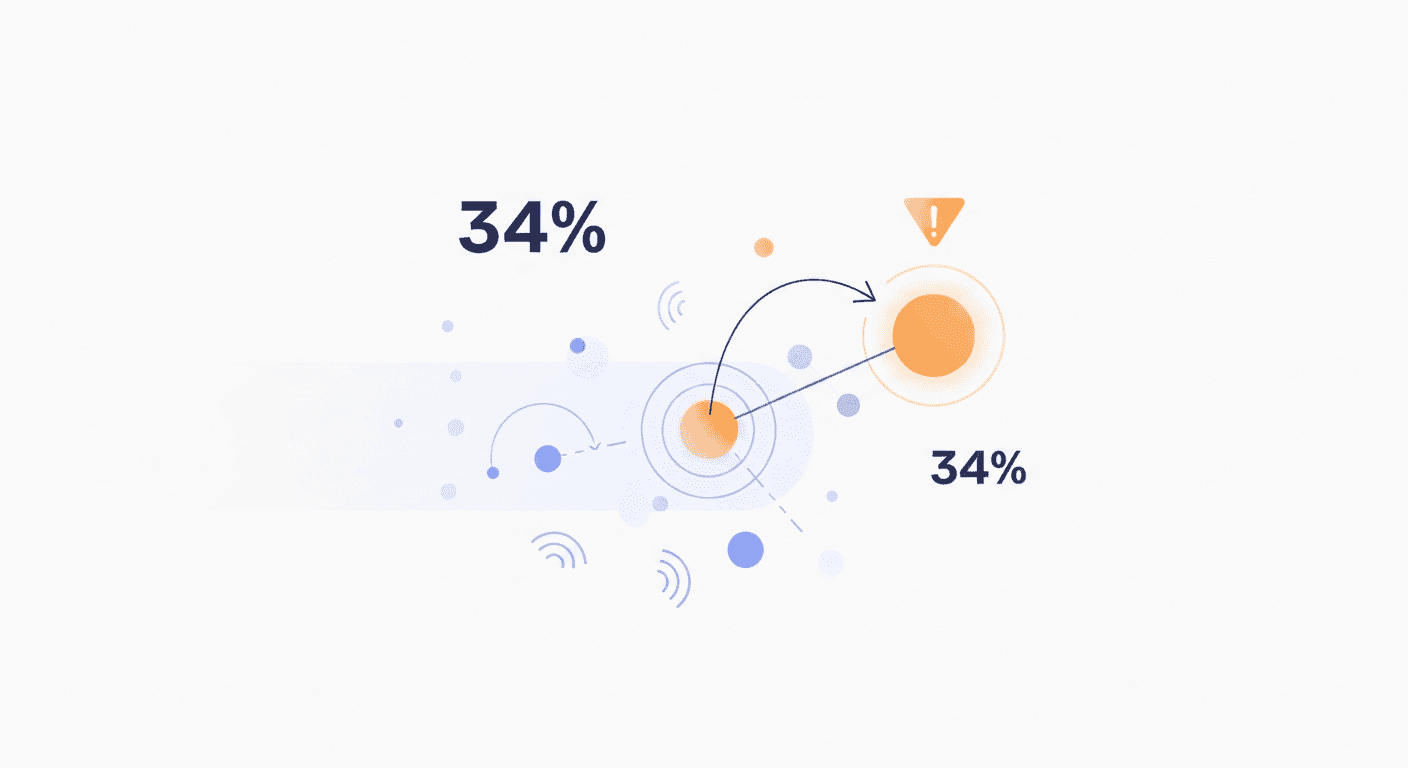
A new Forrester Research study just dropped some numbers that should make every product manager sit up: companies using AI-powered customer success platforms are seeing their annual churn rates drop by an average of 34%.
That's not a marginal improvement. That's the difference between a SaaS business that's growing and one that's stuck on a treadmill, acquiring customers just to watch them leave.
But here's what caught our attention: the study found that AI health scores can predict churn with 87% accuracy — 60 days before cancellation. Sixty days. That's not just impressive technology. That's a two-month window where product teams could actually do something about it.
The question is: are they?
The Retention Gap Product Teams Keep Missing
Let's be honest about how most companies handle churn. A customer cancels. Someone in customer success marks them as churned in the CRM. Maybe there's a quarterly review where leadership looks at aggregate numbers and asks "why are we losing so many customers in segment X?"
By then, it's too late. The customer is gone. The feedback is stale. And the product team is left guessing about what went wrong.
According to the Harvard Business Review, acquiring a new customer costs anywhere from 5 to 25 times more than retaining an existing one. And Bain & Company's research shows that a 5% increase in customer retention can boost profits by 25% to 95%.
Those aren't small numbers. Yet most product teams still spend the majority of their strategic energy on acquisition-focused features — the flashy new capabilities that might attract new users — rather than the retention-focused improvements that keep existing customers from walking out the door.
This is the gap AI is starting to close. Not by replacing product judgment, but by surfacing the signals product teams are currently blind to.
What AI Actually Sees That Humans Don't
The Forrester study examined platforms like Gainsight, Totango, ChurnZero, and Vitally. What makes these tools different from traditional analytics isn't just that they're faster — it's that they're looking at patterns humans can't easily spot.
A typical churn model analyzes 15 to 25 behavioral signals simultaneously. Things like:
- Usage trajectory, not just "did they log in" but "are they logging in less than last month?"
- Feature adoption depth — are they using the features that correlate with long-term retention?
- Support sentiment — is frustration building across multiple tickets?
- Onboarding completion — did they ever reach their "aha moment"?
According to Artisan Strategies, 60-70% of churn happens within the first 90 days. Companies that help users reach their first meaningful result within 7 days see 50% lower churn rates.
That's not a customer success problem. That's a product problem. It's about whether your onboarding flow actually gets people to value quickly. It's about whether your core features are discoverable. It's about whether your product delivers on the promise your marketing made.
AI doesn't fix these problems directly. But it does make them visible in time to act.
The Real ROI: It's Not Just About Retention
The Forrester study found that companies deploying AI customer success tools report an average ROI of 340% within the first year. Most of that comes from retained revenue that would otherwise have been lost.
But there's a second-order effect that's equally important for product teams: expansion revenue increases by 28% when AI identifies optimal upsell timing.
Think about what that means. The same signals that predict churn can also predict when a customer is ready to grow. When they're using the product heavily. When they've hit the limits of their current plan. When they're showing buying intent through behavior rather than explicit requests.
Netflix is the canonical example here. Their recommendation engine drives 75-80% of all viewing hours, and it maintains industry-leading retention — their churn sits between 1.85% and 2.5%, while competitors average 3-5%.
Netflix isn't just using AI to recommend content. They're using it to prevent the moment where a subscriber opens the app, can't find anything to watch, and starts wondering if they really need another streaming service.
That's retention built into the product experience itself.
What This Means for Product Teams
Here's where we need to be direct: most product teams aren't set up to use this intelligence effectively.
Customer success might have access to churn prediction scores, but product doesn't see them. The insights stay siloed in CS dashboards while product teams prioritize based on stakeholder requests and gut feel.
This is backwards.
If 87% of churning customers can be identified 60 days early, product teams should be asking: What are the common patterns in what these at-risk customers requested, struggled with, or complained about?
That's not a CS question. That's a prioritization question. It's the difference between building features that sound good in roadmap presentations and building features that actually keep customers.
Here's a practical framework for connecting churn intelligence to product decisions:
1. Segment your feedback by retention risk
Don't treat all customer feedback equally. A feature request from a healthy, expanding account is different from the same request from an account showing churn signals. Both matter, but they matter differently.
If you're hearing the same friction point from multiple at-risk accounts, that's not just feedback — that's a retention emergency masquerading as a feature request.
2. Build "time to value" into your product metrics
Most product dashboards track activation rates and feature adoption. Fewer track speed to activation. But that speed matters enormously.
If AI can identify that users who don't complete onboarding within 72 hours have a 3x higher churn rate, then "reduce time to first value" becomes a concrete, measurable product goal — not just a vague aspiration.
3. Close the loop between churn analysis and roadmap planning
When customers do churn, make sure the reasons make it back to product. Not just "they said it was too expensive" (which is often a proxy for "they didn't see enough value"), but the specific features they requested, the support tickets they filed, the onboarding steps they skipped.
This isn't about blame. It's about learning. Every churned customer is data about what your product failed to deliver.
The Bigger Shift: From Reactive to Predictive Product Management
The Forrester findings point to something larger than just churn reduction. They signal a shift in how product decisions can be made.
Traditional product management is largely reactive. Customers complain, competitors ship something, stakeholders request features, and PMs triangulate between conflicting inputs to build something that hopefully addresses the most important needs.
Predictive product management — powered by AI that can see patterns across thousands of customer behaviors — flips this model. You're not waiting for customers to tell you they're unhappy. You're seeing the behavioral fingerprints of dissatisfaction before it crystallizes into a cancellation.
Companies using AI for churn prevention are typically seeing 15-20% improvements in retention rates. That's not because they're doing reactive outreach better. It's because they're catching problems earlier, when the problems are still fixable.
For product teams, this means the voice of the customer isn't just what customers say — it's what their behavior reveals about what they need but haven't articulated yet.
What We're Building Toward
At Pelin, this is exactly the problem we're obsessed with: helping product teams understand what customers actually need, not just what they say.
When you aggregate customer feedback across support tickets, sales calls, user interviews, and product analytics, patterns emerge that no single data source would reveal. The same frustration showing up in churn signals, support escalations, and competitor mentions isn't a coincidence — it's a prioritization signal.
The companies that will win the next decade aren't the ones with the most features. They're the ones that ship the right features — the ones that address what's actually causing customers to leave or stay.
AI makes this possible at scale. The Forrester study is early evidence. The 34% churn reduction is real. The 340% ROI is real.
The question for product teams is whether they'll use this intelligence, or keep building based on who shouted loudest in the last stakeholder meeting.
Pelin helps product teams turn scattered customer feedback into clear priorities. See patterns across support tickets, sales calls, and user research to understand what customers actually need — before they churn.