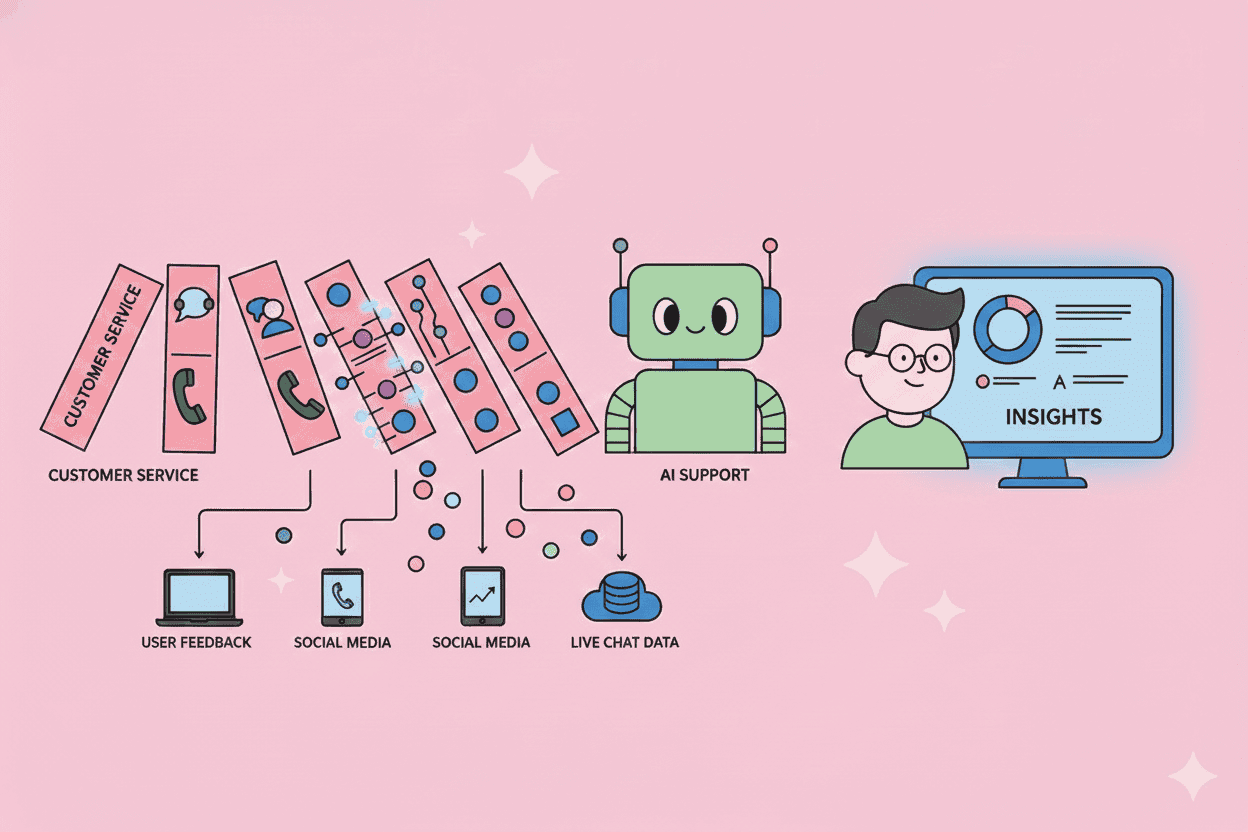
The customer service department just became ground zero for the AI revolution. And if you're a product manager, you should be paying very close attention—because what happens in support is going to reshape how you build products.
The Survey That Should Worry Every SaaS Incumbent
Redpoint's latest survey of 141 CIOs dropped this week, and one number jumped off the page: 26% of CIOs have seriously considered replacing their customer service vendor in the last twelve months. That's the highest of any software category surveyed.
Customer service isn't just on the edge of disruption. It's in the middle of it.
The survey paints a stark picture. Customer service management topped the list of categories where CIOs are actively evaluating alternatives, ahead of finance ops (21%), project management (20%), and salesforce automation (19%). At the other end of the spectrum, general productivity tools like Microsoft 365 and Google Workspace showed just 2% replacement consideration.
But here's the number that really hammers it home: A separate Gartner survey of 321 customer service leaders found that 91% are under pressure to implement AI in 2026, with nearly 80% planning to transition at least some frontline agents into new roles.
This isn't a prediction. It's happening right now.
What This Means for Product Teams
If you're thinking "I'm in product, not support—why should I care?", you're missing the bigger picture.
Customer service has always been the canary in the coal mine for product issues. Support tickets are where bad UX decisions come home to roost. They're where missing features generate friction. They're where your product's rough edges create real human frustration, day after day.
When AI takes over the front lines of customer support, something fundamental changes in how product teams get feedback.
The Feedback Loop Is About to Break
Here's the uncomfortable truth: most product teams rely on customer support as a de facto feedback mechanism. CSMs flag recurring issues. Support managers escalate patterns. Engineers get pulled into tickets that reveal underlying problems.
When AI agents handle 80% of customer interactions (which is where we're heading), that informal feedback loop goes dark. The AI will resolve issues, but will it surface the patterns that matter for product decisions?
This is the hidden cost of the customer service AI revolution: the same efficiency gains that reduce support costs can also reduce product intelligence.
The Volume Problem Gets Worse, Not Better
Here's the paradox. As AI handles routine support, the remaining human-to-human interactions become more complex, more nuanced, and more valuable for product insights. But there are also fewer of them to learn from.
Meanwhile, customer feedback doesn't stop arriving in all the other channels: in-app surveys, NPS scores, G2 reviews, Reddit threads, sales call transcripts, churn interviews, feature requests in Intercom, and complaints on Twitter.
The Gartner survey noted that companies are seeing AI adoption pressure from leadership while simultaneously dealing with an explosion in unstructured feedback data. Product teams are drowning in signal without a way to synthesize it.
Why Smart Product Teams Are Inverting Their Feedback Strategy
The savviest product leaders are responding to this shift with a counterintuitive move: instead of passively waiting for support to surface issues, they're actively mining customer feedback across every touchpoint.
The logic is simple. If AI is going to absorb the support function, you need a different source of truth for understanding what customers actually want.
The New Voice of Customer Stack
What does modern customer insight infrastructure look like? It's not a single tool—it's a capability.
Real-time feedback aggregation. Instead of checking in quarterly with your support team, you need continuous ingestion of customer signals from every channel. That means pulling from support tickets (while they still exist in their current form), reviews, surveys, social mentions, sales notes, and product usage data.
Automatic pattern detection. No human team can read every piece of feedback. You need AI that identifies emerging themes, clusters related issues, and flags anomalies before they become crises.
Prioritization that connects to business impact. Not all feedback is equal. The best product teams are linking customer complaints directly to churn risk, expansion potential, and revenue impact. Recent data shows that companies with Net Revenue Retention above 130% trade at 15-20x forward revenue, while those below 100% struggle at 3-5x. Customer feedback that prevents churn isn't just product intel—it's valuation defense.
The First 90 Days Matter Most
Here's a stat that should shape how you think about customer feedback: 60-70% of SaaS churn happens in the first 90 days. That means the feedback you collect during onboarding is disproportionately valuable.
If someone struggles with your product in week one and doesn't tell you about it directly, they're just going to leave. They won't submit a support ticket. They won't write a review. They'll just silently cancel and move on.
This is why passive feedback collection—waiting for customers to come to you—is a losing strategy. The most valuable feedback is proactive, triggered at key moments, and captured before frustration turns into churn.
The Consolidation Factor
There's another dimension to the Redpoint survey that matters for product teams: 54% of CIOs are actively pursuing vendor consolidation.
That means your customers aren't just evaluating whether to replace individual tools with AI. They're evaluating whether they need your tool at all when they can consolidate functionality into fewer platforms.
The implications for product strategy are significant:
-
Depth beats breadth. Point solutions that don't integrate deeply into workflows are vulnerable. Products that become essential to daily operations are stickier.
-
Customer intelligence is a differentiator. When every platform can add "AI features," the companies that truly understand their customers' problems will build the right features faster.
-
Speed of insight matters. The survey found that 45% of AI budgets are replacing existing software budgets, not adding to them. If you're the vendor being cut, you'll want as much warning as possible. Customer feedback analysis that identifies at-risk accounts before they announce they're leaving is now a survival skill.
What This Looks Like in Practice
Let's get concrete. What does a product team do with this information?
Audit Your Feedback Sources
Start by mapping every place customer feedback currently arrives:
- Support tickets and chat logs
- Product reviews (G2, Capterra, App Store)
- NPS and satisfaction surveys
- Sales call recordings and CRM notes
- Social media mentions
- Community forums and Slack groups
- Feature request boards
- Churn interview transcripts
Now ask: what percentage of this are we actually analyzing? If the answer is "support reads the tickets and tells us when something's urgent," you have a problem. That informal channel is about to disappear.
Shift from Reactive to Predictive
The old model: wait for customers to complain, then fix the problem.
The new model: identify friction before customers even articulate it. Use product usage data to spot confusion. Use sentiment analysis to catch frustration early. Use churn prediction to prioritize fixes based on retention impact.
AI-powered customer success tools are already showing results—Chargebee has reported churn reductions up to 25% in AI-driven setups, and Velaris users have seen 15% drops in churn by embedding AI insights into daily operations.
The same technology that's displacing customer service agents can help product teams understand customers better than ever before.
Build Feedback Into the Product
If customers aren't going to talk to human support agents, make it easy for them to talk to you directly.
This means in-app feedback widgets that appear at moments of friction. It means micro-surveys that take 10 seconds to complete. It means analyzing user behavior to identify confusion without requiring customers to explicitly complain.
The goal is to capture the insights that would have surfaced through support—before AI agents resolve them into statistical noise.
The Bottom Line
Customer service AI isn't just a cost reduction play. It's a fundamental shift in how companies understand their customers.
The 26% of CIOs actively looking to replace their customer service vendors aren't just chasing efficiency. They're betting that AI can handle the transactional parts of customer relationships. That bet is probably right.
But the strategic parts—understanding what customers want, anticipating their needs, building products they'll love—those require a different kind of intelligence. And that intelligence is about to become much harder to collect passively.
Product teams that rely on support escalations as their early warning system are about to fly blind. Product teams that build proactive feedback systems will have an advantage their competitors can't easily replicate.
The customer service domino is falling. The question is whether you'll be ready when the ripples reach your product roadmap.
Pelin helps product teams turn scattered customer feedback into prioritized insights. When support can't tell you what's wrong, your data still can.