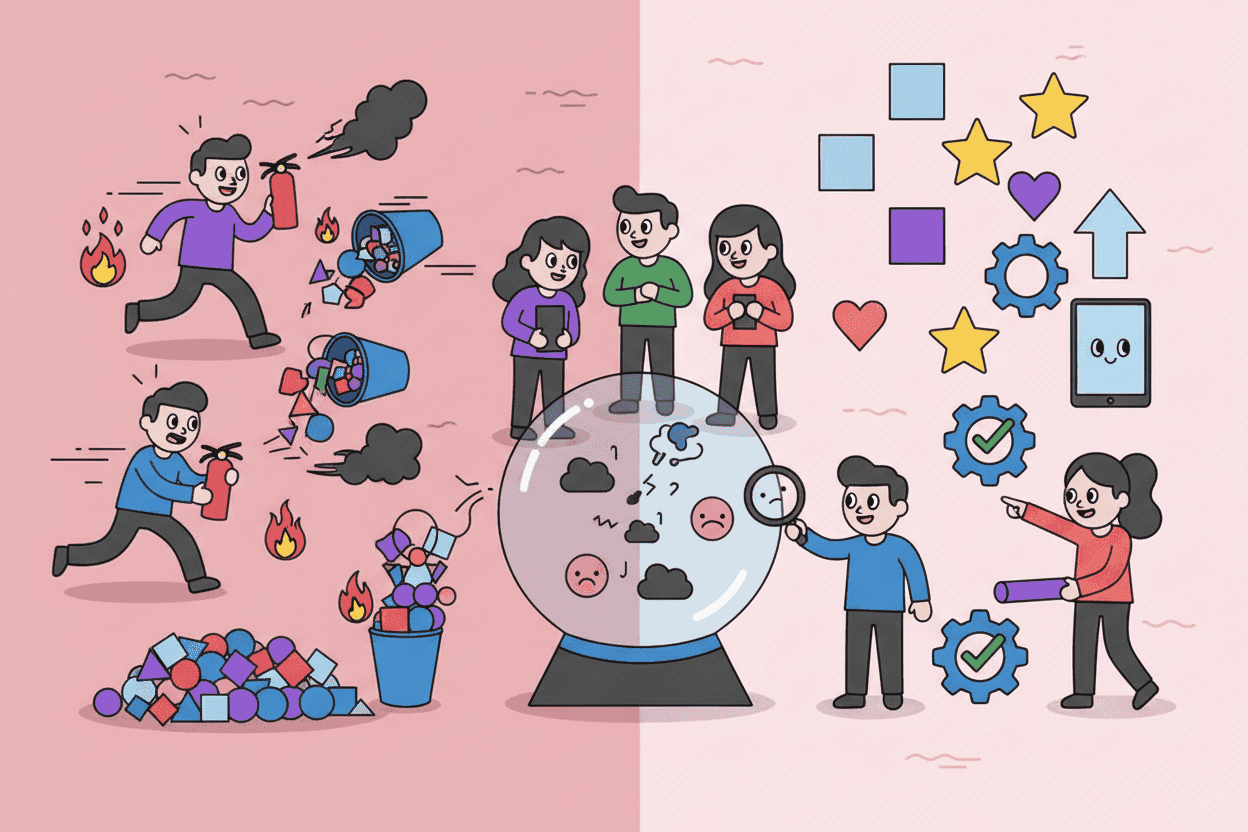
There's a moment every product manager knows too well. You're reviewing support tickets, and there it is—a pattern you should have caught weeks ago. Dozens of users hitting the same friction point. A feature that's confusing everyone. A workflow that's driving people straight to your competitors.
By the time you notice, it's already too late. The damage is done.
But what if you could see these patterns before they became problems?
The Shift from Reactive to Proactive
According to recent industry analysis from CX Today, 2026 is the year proactive customer experience moved from buzzword to business imperative. The concept is simple: instead of waiting for customers to complain, predict issues and solve them before they escalate.
The shift isn't just about better customer service—it's fundamentally changing how product teams operate.
Traditional product management looks like this:
- Customer complains
- Support ticket gets created
- Pattern eventually emerges (if you're lucky)
- PM prioritizes fix (eventually)
- Feature ships (weeks or months later)
- Repeat
Proactive product management flips the script:
- AI detects behavioral anomaly
- PM sees insight before complaint
- Team ships fix
- Customer never experiences the problem
That's not a marginal improvement. That's a different game entirely.
Why Churn Prediction Changes Everything
The most compelling use case for proactive CX is churn prediction. Modern AI systems can detect subtle indicators of customer dissatisfaction long before a cancellation email lands in your inbox:
- Reduced product usage over time
- Increased complaint frequency
- Negative sentiment in support interactions
- Changes in buying or engagement behavior
Here's what makes this powerful for product teams: churn signals aren't just warning lights—they're product insights.
When you see a cohort of users showing disengagement patterns, you're not just looking at retention risk. You're looking at a roadmap. Those patterns tell you exactly which features are underperforming, which workflows are broken, and which promises your product isn't keeping.
The AI Journal reports that reinforcement learning is now moving into live commerce environments, enabling AI systems to learn directly from customer behavior and revenue outcomes. This means your customer intelligence doesn't just detect problems—it gets better at detecting them over time.
From Customer Support to Product Intelligence
The traditional separation between "support" and "product" is starting to look arbitrary. Every support ticket is product feedback. Every churn signal is a feature request. Every customer complaint is a prioritization input.
Proactive CX tools are collapsing these silos. Instead of support teams manually tagging issues and hoping product teams read the reports, AI systems are surfacing patterns in real-time:
Journey orchestration tracks customer behavior across touchpoints. When someone abandons a workflow, the system doesn't just log it—it identifies why and routes that insight to the right team.
Sentiment analysis monitors every customer interaction. Not just support tickets, but reviews, social mentions, sales calls, and product usage patterns. The system spots frustration before it becomes a support ticket.
Behavioral analytics identifies at-risk users based on engagement patterns. But more importantly, it clusters them by cause—showing you which product issues are driving different segments toward the exit.
The Competitive Edge Isn't Speed—It's Anticipation
Here's a counterintuitive truth: the companies winning at product aren't necessarily shipping faster. They're just shipping the right things.
When you're constantly firefighting, you're always one step behind. You're building features to solve yesterday's problems. You're prioritizing based on who complained loudest, not what actually matters.
Proactive CX flips this dynamic. When you can see problems before they fully emerge, you can:
-
Prioritize with confidence. No more guessing which issues are most urgent. The data shows you.
-
Prevent churn instead of recovering from it. It's 5-25x more expensive to acquire a new customer than retain an existing one. Catching dissatisfaction early changes your unit economics.
-
Build ahead of demand. When you understand behavioral patterns, you can anticipate what customers will need—not just what they're asking for now.
-
Reduce support load. Every problem you prevent is a ticket that never gets created. That's compounding cost savings.
What This Means for Product Teams
If you're a PM still running quarterly customer research cycles and hoping the insights hold up, you're already behind. The teams setting the pace are operating in near-real-time.
This doesn't mean abandoning deep research. It means augmenting it. Qualitative insights tell you why things happen. AI-powered analytics tell you what is happening—right now, across your entire user base.
The practical shift looks like this:
Old model: Run quarterly surveys → Analyze results → Update roadmap → Ship features → Hope for improvement
New model: Continuous AI monitoring → Real-time pattern detection → Immediate prioritization signals → Rapid iteration → Measured impact
The teams who figure this out first don't just ship better products. They build compounding advantages. Every insight makes their model smarter. Every early intervention builds customer trust. Every prevented churn event improves their economics.
Making It Practical
So how do you actually implement proactive CX without a massive infrastructure overhaul?
Start with your feedback channels. Most product teams are sitting on goldmines of unstructured customer data—support tickets, sales calls, reviews, NPS comments, user interviews. The friction isn't collecting feedback; it's synthesizing it at scale.
AI-powered customer intelligence tools can now process thousands of feedback data points and surface the patterns that matter. Instead of reading 500 support tickets to find themes, you get synthesized insights in minutes.
The key is treating this as a continuous process, not a project. Set up systems that constantly monitor sentiment and behavior. Build alerts for anomaly detection. Create workflows that route insights directly to the teams who can act on them.
And most importantly: close the loop. The value of proactive CX isn't just detecting problems—it's proving that you fixed them. Track whether your interventions actually moved the needle. Use that data to train your systems and refine your processes.
The Bottom Line
Customer experience isn't a department anymore. It's a dataset. And the companies treating it that way—using AI to continuously monitor, predict, and prevent issues—are playing a different game than the ones still waiting for complaints.
The shift from reactive to proactive isn't just about better tools. It's about a different relationship with your customers. One where you're solving problems they haven't articulated yet. Where you're building features they didn't know they needed. Where you're earning loyalty through anticipation, not just reaction.
The firefighting PM is becoming obsolete. The future belongs to the ones who see the smoke before there's a fire.
Building products that actually serve your customers means understanding them deeply. Pelin helps product teams synthesize customer feedback at scale—turning scattered insights into clear priorities. See how it works →