A striking prediction landed this week: 75% of customer interactions will be AI-powered by the end of 2026. Not a feature update. Not incremental adoption. A fundamental restructuring of how businesses relate to their customers.
The quote comes from Abhinandan Jain, speaking to CXOToday about the rise of AI-native customer experience. His observation cuts deeper than the headline: "The companies winning right now are not integrating AI into their CX stack. They are rebuilding the stack around AI from the ground up."
For product teams, this creates an uncomfortable question: If three out of four customer touchpoints will soon be AI-mediated, how do you even know what your customers actually think?
The Signal Problem Gets Worse Before It Gets Better
Here's the paradox. AI is generating more customer interaction data than ever—chat logs, support tickets, in-app behaviors, survey responses. Meanwhile, product teams are drowning in noise and starving for signal.
The traditional feedback loop looked something like this: Customer complains → Support tickets it → PM reads ticket three weeks later → Maybe gets prioritized next quarter. Slow, but at least you knew a human felt strongly enough to complain.
Now picture the AI-native version: Customer chats with AI → AI resolves issue → Interaction logged somewhere → PM never sees it because it was "resolved."
The irony is brutal. Companies are getting better at handling customer problems in real-time while simultaneously getting worse at understanding the underlying patterns. The firefighting improves. The prevention disappears.
What "AI-Native" Actually Means for Product Discovery
Let's be precise about what's changing. AI-native CX isn't about chatbots. It's about systems that learn from every interaction, anticipate needs before they surface, and resolve issues without human intervention.
That sounds great for customer support. It's terrifying for product teams who rely on support escalations as a proxy for "things customers care about."
Consider the old workflow:
- High ticket volume on Feature X → PM notices pattern → Feature X gets attention
- Customer calls angry about missing capability → Sales escalates → PM prioritizes
Now consider the AI-native workflow:
- AI handles most inquiries about Feature X → Volume never spikes → PM sees nothing
- Customer asks AI about missing capability → AI deflects politely → Customer shrugs and moves on
The problems don't disappear. They become invisible.
The New Data Layer: Reading Signals That Never Reach Humans
The smartest product teams are recognizing that AI-mediated interactions contain valuable signal—you just need new tools to extract it.
Think about what an AI support agent actually captures:
- The exact language customers use to describe their problems
- The sequence of questions that lead to frustration
- The workarounds customers mention ("I've been exporting to Excel because...")
- The moments where AI fails to resolve and the customer gives up
This is goldmine information. It's sitting in conversation logs that no human will ever read. The volume is simply too high for traditional analysis.
According to Harvard Business Review, AI is now enabling companies to conduct rich, adaptive conversations with thousands of participants—capturing not just what customers think but why they think it, including emotional nuance that surveys miss entirely.
The catch? You need AI to analyze what AI is collecting. Human-scale review is no longer possible.
Three Shifts Every Product Team Needs to Make
1. From Ticket Counting to Conversation Mining
Stop measuring feedback volume. Start measuring feedback meaning.
The old metric was simple: "We got 47 tickets about onboarding this month, up from 32 last month. Prioritize onboarding."
The new metric is harder: "Across 3,400 AI-handled conversations, 23% mentioned friction during setup. The specific pain point clusters around connecting third-party integrations. Customers who mention this have 40% lower activation rates."
Same underlying problem. Completely different level of actionable insight.
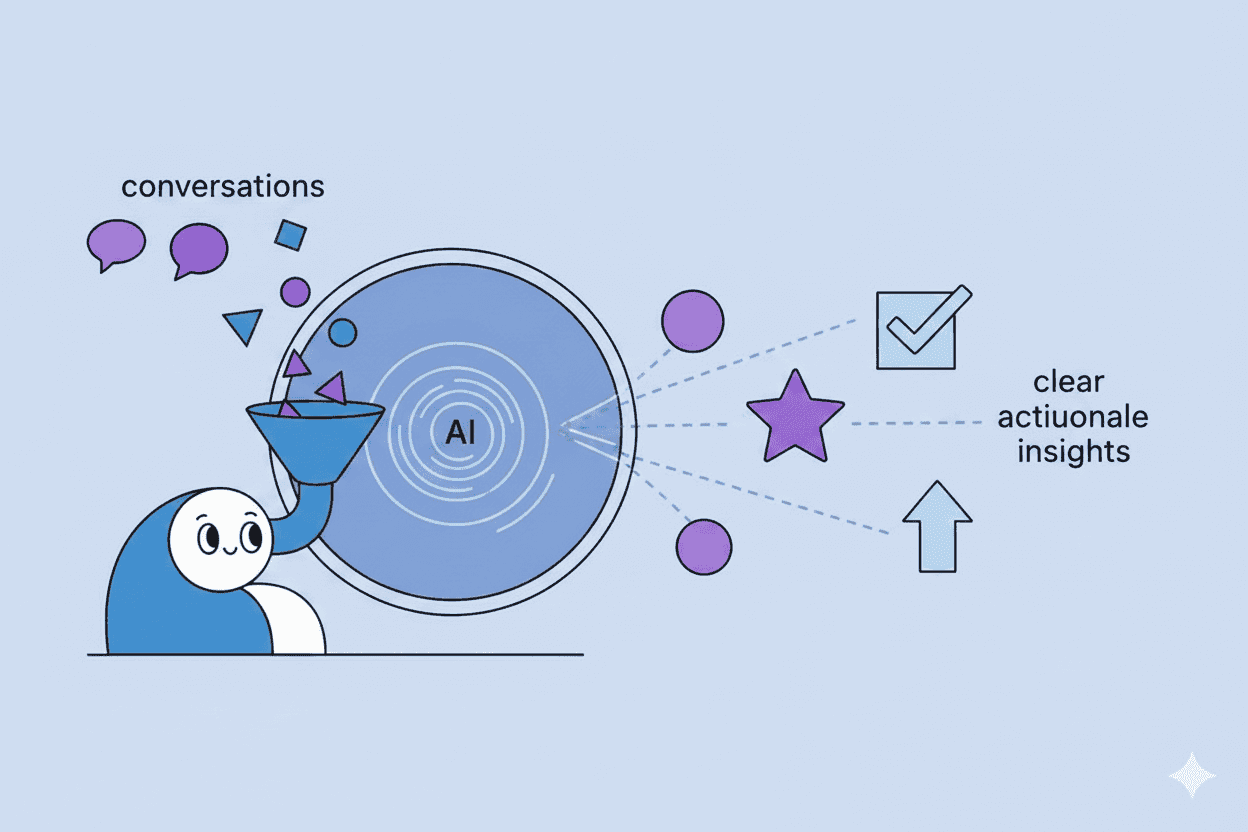
Tools like Pelin exist specifically for this—taking the firehose of customer conversations, support interactions, and feedback channels and synthesizing them into patterns a product team can actually act on. The key is semantic analysis, not keyword matching. Understanding what customers mean, not just what they say.
2. From Reactive Research to Continuous Learning
Traditional user research has a cadence: quarterly discovery sprints, annual surveys, occasional interviews. That cadence made sense when research was expensive and time-consuming.
In an AI-native world, research should be continuous. Every customer interaction is a data point. Every support conversation contains insight. The question isn't "when should we do research?" but "what did we learn today?"
This requires treating customer feedback infrastructure as a first-class product concern. Not a support team problem. Not a "nice to have." Core infrastructure.
The organizations getting this right build feedback loops directly into their product development cycle. Customer insight flows to product decisions flows to shipped features flows to new customer interactions. A closed loop that compounds.
3. From Anecdote to Evidence
"The customer said" is no longer enough.
When a sales rep escalates a feature request, the natural question was "how many customers have asked for this?" Now the question needs to be "across all channels—human and AI-mediated—what's the actual signal strength on this need?"
Evidence-based prioritization means connecting customer sentiment to business outcomes. Not just "customers want X" but "customers who mention wanting X have 3x higher churn probability" or "companies that activate Feature Y within 14 days have 50% higher expansion rates."
This is the difference between listening to customers and understanding customers.
The Governance Question Nobody's Asking
Here's something buried in the CXOToday interview that deserves more attention: AI governance is becoming mission-critical for customer experience.
"We have moved from AI as a recommendation engine to AI as a decision-maker. That changes liability. It changes ethics. It changes trust at the institutional level."
For product teams, this translates to a specific question: Who is accountable when AI-mediated interactions create customer outcomes?
If your AI support agent consistently fails to escalate a specific type of issue, and customers churn as a result, who owns that? Support? Product? Engineering?
The answer increasingly is: everyone needs visibility.
Product teams can't afford to be downstream from AI systems they don't understand. They need insight into what those systems are handling, how they're handling it, and where they're failing—even when "failing" means "resolving without flagging underlying product issues."
What This Looks Like in Practice
Let me paint a concrete picture.
Company A has traditional product feedback processes. They check NPS quarterly, read support escalations weekly, and do user interviews during discovery phases. Their AI handles 70% of customer support. Product decisions are based on a shrinking slice of total customer interaction.
Company B has AI-native product feedback. Every customer interaction—AI-handled or human—feeds into a unified insight layer. Semantic analysis extracts themes automatically. Product teams see real-time dashboards showing emerging issues before they become ticket spikes. Discovery is continuous, pulling from thousands of conversations rather than dozens of interviews.
Company B catches the churn signal three weeks earlier. Ships the fix two sprints faster. Retains the revenue.
That's the gap AI-native product teams need to close.
The Uncomfortable Truth
Here's the thing nobody wants to say: Most product teams are already behind.
The shift to AI-native CX isn't coming. It's here. The 75% prediction isn't about some distant future—it's about the end of this calendar year.
If you're still relying on manual ticket review, quarterly surveys, and occasional user interviews as your primary insight sources, you're making decisions based on a shrinking minority of actual customer interactions.
The path forward isn't complicated conceptually. It's challenging operationally:
- Get visibility into what your AI systems are handling
- Build infrastructure to analyze AI-mediated conversations at scale
- Create feedback loops that turn continuous interaction data into continuous product insight
- Establish governance so you know when AI-customer interactions reveal product problems
The companies rebuilding their stack around AI will own the next decade. The ones retrofitting will be paying to catch up.
Which side of that divide is your product team on?
Pelin helps product teams turn customer conversations into actionable insights—across support, sales, and every feedback channel. Because understanding what customers actually mean shouldn't require reading 3,400 transcripts.