There's a strange paradox happening in product and marketing teams right now.
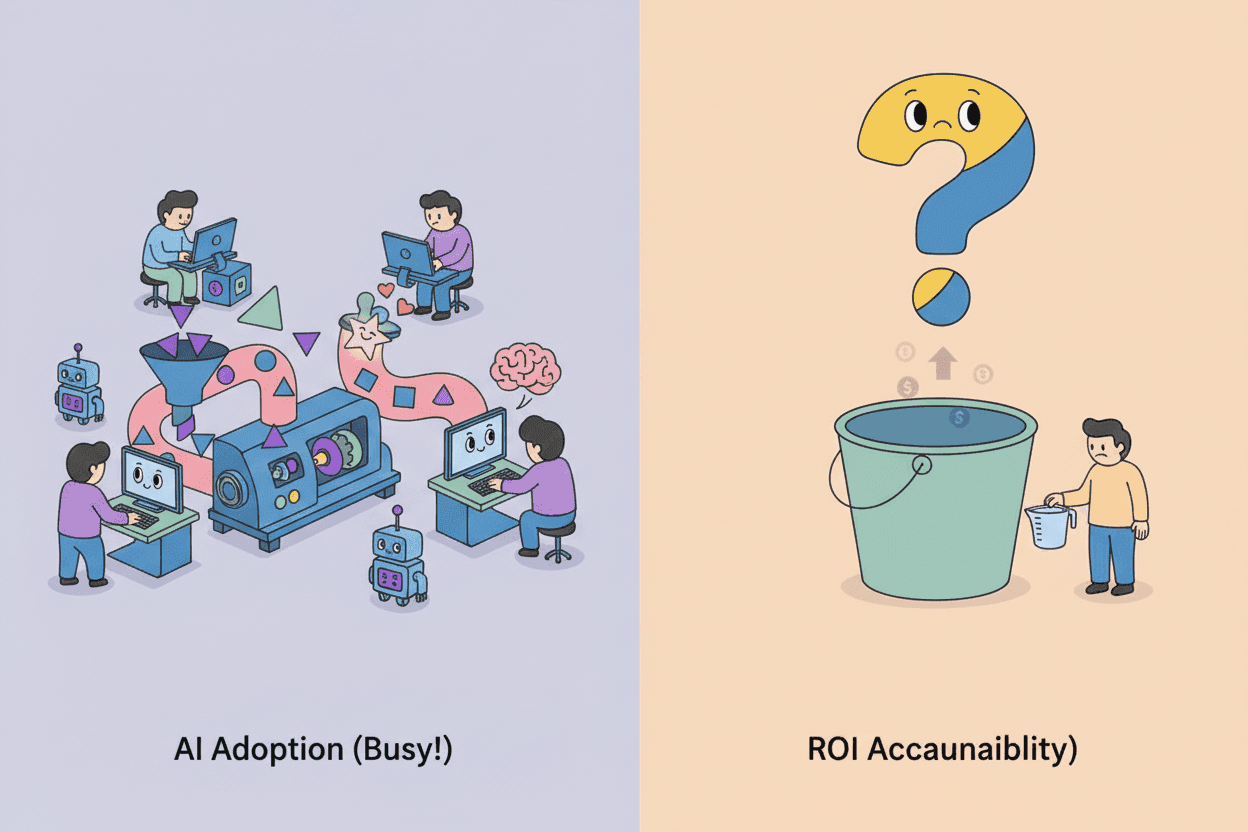
According to Jasper's State of AI in Marketing 2026 report, a survey of 1,400 marketers, 91% of teams now actively use AI in their work. That's up from 63% just a year ago. AI has officially crossed from "experimental" to "expected."
But here's the twist: the share of teams who can actually prove their AI is delivering ROI dropped from 49% to 41%.
More adoption. Less proof.
Welcome to what the industry is calling the "AI accountability era." And it has massive implications for product teams.
The Productivity Trap
Let's be honest about what's happening. Teams bought AI tools. They generated more content, automated more workflows, and saved more hours. The dashboards showed activity metrics going up.
But when leadership asked "What did all this AI actually do for us?"—crickets.
The problem isn't that AI doesn't work. It's that teams are measuring the wrong things.
"Hours saved" sounds great in a vendor pitch. But your CFO doesn't care about hours saved. They care about outcomes: Did we ship faster? Did customers buy more? Did churn go down? Did revenue increase?
Most teams can't answer those questions because they never connected their AI usage to customer impact.
Why Customer Insights Are the Missing Link
Here's the uncomfortable truth: you can automate everything and still build the wrong thing.
AI can generate 50 landing page variants in an afternoon. But if you don't know which customer pain points actually matter, you're just A/B testing your way through mediocrity.
AI can summarize 1,000 support tickets. But if you're not extracting the insights that drive product decisions, you've got a really expensive summary.
The teams that report 2-3× returns on AI investment aren't just using AI—they're connecting it to what customers actually want. They've built feedback loops that tie AI-assisted work to real outcomes.
And that starts with understanding your customers at scale.
The Three Gaps Killing Your AI ROI
After talking to hundreds of product teams, we see the same patterns over and over. There are three gaps that prevent teams from proving AI ROI:
Gap 1: The Insight Gap
You have customer feedback scattered across Zendesk, Intercom, Gong calls, NPS surveys, and that one Notion doc someone made last quarter. AI tools are generating outputs, but nobody knows if those outputs align with what customers actually need.
Without centralized, structured customer insights, AI is just making guesses faster.
Gap 2: The Prioritization Gap
Product teams are drowning in feature requests. AI can help categorize them, sure. But categorization isn't prioritization.
Real prioritization requires understanding which customer segments are asking for what, how requests connect to revenue and churn, and what problems actually matter versus what's just noise.
Most AI tools don't give you that. They give you tags.
Gap 3: The Measurement Gap
This is where things really fall apart. Teams ship features that AI helped create, but they have no systematic way to measure if those features addressed customer needs.
Did that onboarding flow you AI-generated actually reduce time-to-value? Did that feature you prioritized based on AI summaries actually reduce churn in the segment that requested it?
Without closing the loop, you can't prove anything.
How to Actually Prove AI ROI
The Jasper report notes that 65% of marketing teams now have designated AI roles. That's good. But roles aren't enough.
Here's what actually moves the needle:
1. Start With Customer Problems, Not AI Capabilities
Before you automate anything, get clear on your highest-value customer problems. What are the top five reasons customers churn? What are the top three requests from your highest-LTV segment?
If you can't answer those questions, more AI won't help. You need better customer intelligence first.
2. Build Your Customer Insight Layer
Your AI tools are only as good as the data they work with. Most teams have feedback silos that prevent AI from seeing the full picture.
You need a system that pulls insights from every customer touchpoint—support tickets, sales calls, NPS surveys, product analytics, cancellation reasons—and synthesizes them into actionable intelligence.
This isn't about more dashboards. It's about connecting the dots between what customers say, what they do, and what you should build next.
3. Connect Every AI Output to a Customer Insight
Here's the discipline that separates high-performing teams: every AI-assisted deliverable should trace back to a customer insight.
That landing page variant? It addresses pain point X, identified in analysis of Q1 support tickets.
That feature prioritization? It's based on aggregated feedback from the segment with highest expansion potential.
That churn-reduction campaign? It directly addresses the top three cancellation reasons.
When you can make these connections explicit, you can finally prove ROI.
4. Measure Outcomes, Not Outputs
Stop counting how many things AI generated. Start measuring what changed:
- Time-to-value: Did customers activate faster after AI-informed onboarding changes?
- Feature adoption: Did the features you prioritized based on customer insights actually get used?
- Churn impact: Did addressing specific pain points reduce cancellation rates?
- Revenue influence: Can you tie product changes to expansion or retention revenue?
These are the metrics leadership cares about. And they're only possible when your AI work is grounded in customer insights.
The Real Competitive Moat
The Jasper report makes a crucial point: "Your competitive advantage won't be which model you used. It will be the system you built around it."
We'd add: the system that wins is the one that connects AI to customers.
Every team has access to the same AI models. GPT-4, Claude, Gemini—they're commodities. The differentiator is context. The teams that win are the ones who give AI the richest possible understanding of their customers.
That means:
- Centralizing feedback from every source
- Extracting insights automatically, not manually
- Connecting insights to prioritization decisions
- Measuring outcomes, not just activity
This is the infrastructure that turns AI from a cost center into a competitive advantage.
What This Means for Your Roadmap
If you're a product leader reading this, here's the uncomfortable question: Can you prove that your current roadmap is based on what customers actually need?
Not what stakeholders think customers need. Not what got the most upvotes in your feedback portal. What customers actually need—synthesized from real conversations, real support tickets, real cancellation reasons.
The 41% of teams that can't prove AI ROI are often the same teams that can't answer that question.
The Path Forward
The AI adoption wave already happened. What comes next is the accountability wave.
Teams will need to justify their AI investments with real outcomes. Product leaders will need to show that their roadmaps are grounded in customer reality, not assumptions.
The winners will be teams that use AI not just to do more, but to understand more. To connect the dots between what customers say and what they build. To prove, with actual data, that their product decisions drove customer outcomes.
That's not a technology problem. It's a customer intelligence problem.
And it's exactly the problem we built Pelin to solve.
Pelin helps product teams turn scattered customer feedback into prioritized insights. From support tickets to sales calls, we synthesize what customers actually need—so your AI investments (and your roadmap) actually pay off. See how it works →