Yesterday, Salesforce announced its definitive agreement to acquire Momentum, an AI-powered revenue orchestration platform. The deal is expected to close in Q1 of Salesforce's fiscal year 2027.
On the surface, it looks like another enterprise acquisition. Dig deeper, and you'll find a very clear signal: the world's largest CRM company is admitting they have a customer insights problem. And they're willing to pay handsomely to fix it.
Here's what caught our attention from Momentum's CEO Santiago Suarez Ordoñez: "We founded Momentum to bridge the gap between unstructured conversation and structured action."
That single sentence captures the biggest challenge facing product teams today. And it explains why this acquisition matters far beyond Salesforce's quarterly earnings.
The Unstructured Data Problem Nobody Talks About
Your customers are talking to you constantly. Support tickets. Sales calls. Customer success check-ins. NPS responses. Slack messages. Feature requests buried in email threads.
The problem isn't that you don't have customer feedback. The problem is that 80% of it is completely unstructured, sitting in systems that don't talk to each other, waiting for someone with superhuman patience to extract insights manually.
Here's what typically happens: A PM gets assigned to "understand customer needs" for a new initiative. They pull up a spreadsheet. Maybe run some SQL queries. Schedule a few customer calls. Then spend two weeks reading through old support tickets, trying to piece together what customers actually want.
By the time they've done the analysis, the data is already stale. The roadmap meeting happened without them. And the feature that shipped? It missed the mark because nobody could process customer feedback fast enough to inform the decision.
Salesforce clearly sees this gap. As Steve Fisher, Salesforce's President and Chief Product Officer, put it: "To deliver on the promise of agents, we need visibility and context from every meaningful interaction."
Why Agentic AI Changes Everything
We're witnessing a fundamental shift in how AI works with business data. According to a recent analysis by digital marketing agency JabJab, 2026 marks the transition from static chatbots to autonomous AI agents that "search, choose, book, buy and make business decisions on their own."
But here's the part that matters for product teams: these agentic systems can now process unstructured data at scale and turn it into structured insights.
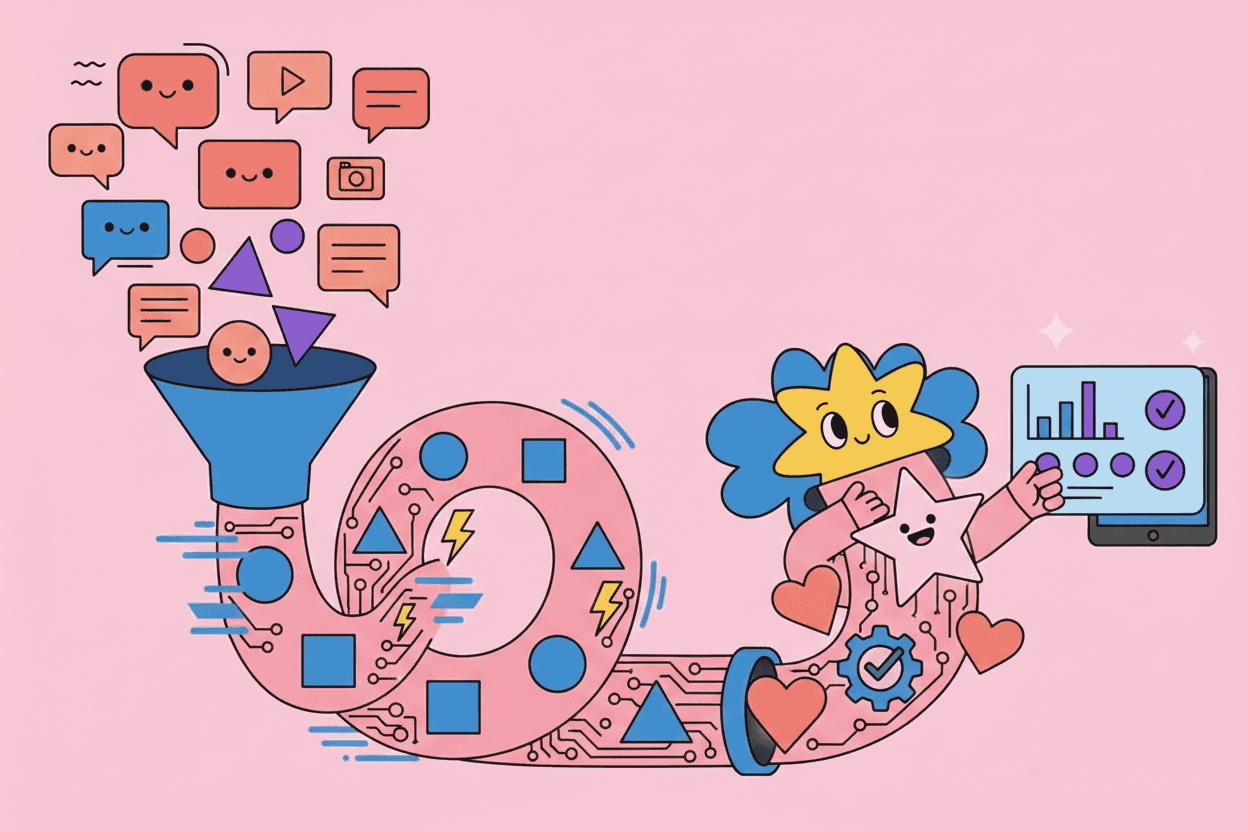
Momentum's "universal ingestion engine" can analyze customer interactions across video calls, emails, and other channels—then feed those insights directly into workflows. That's not just automation. That's turning the voice of the customer into something product teams can actually use.
The old workflow looked like this:
- Customer says something important on a call
- Sales rep maybe takes a note
- Note sits in CRM, never tagged properly
- PM never sees it
- Feature ships without critical context
- Customer churns
The new workflow:
- Customer says something important on a call
- AI captures it automatically
- Insight flows into product intelligence system
- PM sees aggregated patterns across all customers
- Feature ships with customer context baked in
- Customer stays
That's the promise. And that's why Salesforce is willing to integrate Momentum into Agentforce 360 and Slackbot to "incorporate the true voice of the customer to drive complex, multi-step workflows."
The Speed Advantage
Here's a stat that should make every product leader nervous: According to analysis cited by eWeek's coverage of agentic AI trends, "advantage in the age of intelligence arises from converting data into decisions more swiftly than competitors can process the same information."
Let that sink in. Your competitive advantage isn't just about having customer data. It's about how fast you can turn that data into product decisions.
The companies that figured this out early are already seeing the results. They're shipping features that customers actually want. They're catching churn signals before they become cancellations. They're prioritizing their roadmaps based on real customer evidence, not HiPPO (Highest Paid Person's Opinion).
The companies that haven't? They're still running monthly "Voice of Customer" meetings where they review the same stale feedback deck they've been recycling for six months.
What This Means for Product Teams
The Salesforce-Momentum deal isn't just enterprise news. It's a signal that customer insight automation has officially moved from "nice to have" to "strategic imperative."
If you're a product manager, here's what you should be thinking about:
1. Your feedback loop is probably too slow
How long does it take for a customer insight to reach your roadmap? If the answer is "weeks" or "I'm not sure," you have a problem. Modern product teams need feedback loops measured in hours, not months.
2. Structured data isn't enough
Most product analytics tools are great at telling you what customers did. But they're terrible at telling you why. The "why" lives in unstructured conversations—and if you're not capturing it systematically, you're flying blind.
3. Manual synthesis doesn't scale
You can hire more researchers. You can do more customer calls. But there's a ceiling on what humans can process manually. The companies winning at customer insight have figured out how to augment human judgment with AI-powered synthesis.
4. Integration matters more than tools
The Momentum acquisition is specifically about bringing customer conversation intelligence into Salesforce's existing workflows. That's the key insight: the best customer data is useless if it doesn't flow into your actual decision-making process.
Practical Steps to Get Ahead
You don't need to wait for Salesforce to close this acquisition to start improving your customer insight workflow. Here's what you can do this week:
Audit your feedback sources
Make a list of everywhere customer feedback lives: support tickets, sales call recordings, NPS surveys, in-app feedback, social media, community forums. How many of these actually make it into product decisions? For most teams, the answer is "maybe two or three."
Identify your insight bottlenecks
Where does customer feedback get stuck? Is it the initial capture? The tagging and categorization? The synthesis and analysis? The delivery to decision-makers? You can't fix a bottleneck you can't see.
Calculate your feedback latency
Pick a recent customer insight that made it into a shipped feature. How long did it take from when the customer said it to when it influenced a product decision? That number is your feedback latency. Competitive teams are measuring this in days, not quarters.
Look for AI-assisted solutions
The Salesforce acquisition is just one example of a broader trend. Tools like Pelin are specifically designed to help product teams turn customer conversations into actionable insights—without the weeks of manual synthesis.
The Bottom Line
Salesforce didn't acquire Momentum because they wanted another bullet point for their feature list. They acquired it because they recognized a fundamental shift in what customers expect and how competitive advantage works.
The era of static customer data is ending. The era of real-time, AI-synthesized customer intelligence is here.
Product teams that adapt will ship better products, faster. They'll catch issues before they become fires. They'll build roadmaps that actually reflect what customers need.
The teams that don't? They'll keep running on stale insights, shipping features nobody asked for, and wondering why their churn metrics keep climbing.
The good news: you don't need a billion-dollar acquisition to solve this problem. You just need to start treating customer insight velocity as the strategic advantage it is.
Your customers are already telling you what they need. The only question is whether you're listening fast enough.