This week, another AI-powered churn prediction tool launched on Product Hunt. Flywheel.cx promises to "automatically prevent churn and upsell users" before they even think about leaving. It's the latest in a wave of predictive customer intelligence platforms flooding the market in 2026.
And it raises a question every product leader should be asking: Why are we still waiting for customers to tell us what's wrong?
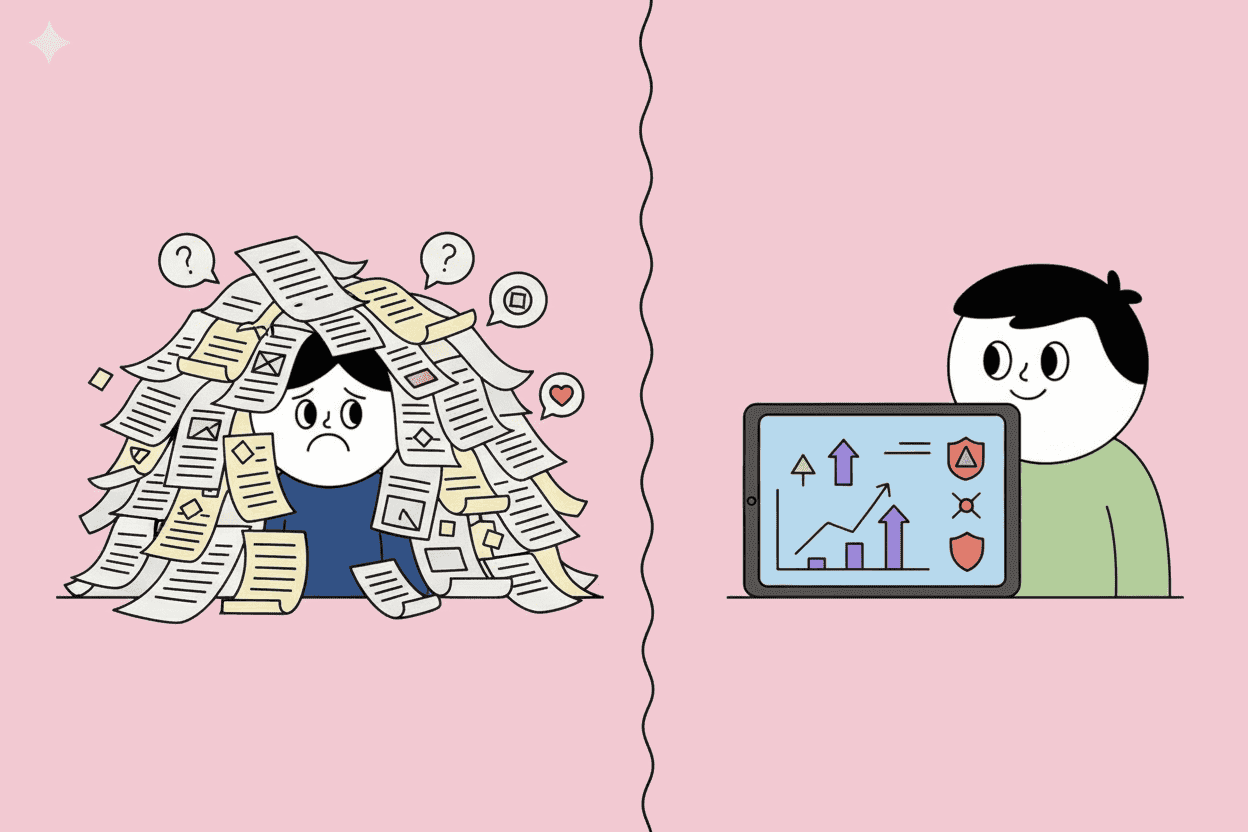
The answer, for most teams, is that they don't realize they're doing it. They've built feedback systems that feel comprehensive—NPS surveys, support tickets, feature request boards, quarterly business reviews. But these systems share a fatal flaw: they only capture what customers choose to tell you, after they've already experienced the problem.
That's not customer intelligence. That's customer archaeology.
The Feedback Lag Problem
Here's a scenario that plays out daily in B2B SaaS companies:
A customer starts using your product less. Login frequency drops. They stop exploring new features. They skip your latest webinar. Their support tickets shift from "how do I do X?" to "why doesn't X work?"
By the time they respond to your NPS survey with a 6 and leave a comment about "considering alternatives," you're already losing. The decision has been made. Your "feedback loop" captured the symptom, not the cause.
Research from ChurnZero suggests that AI models in 2026 can now predict renewal and expansion outcomes months ahead by analyzing historical churn, usage patterns, and engagement signals. That's not a incremental improvement over surveys—it's a fundamentally different approach to understanding customers.
The gap between what traditional feedback tells you and what behavioral intelligence reveals is what we call the feedback lag problem. And it's costing SaaS companies more than they realize.
Why Traditional Feedback Systems Fail
Traditional customer feedback operates on a simple model: ask customers what they think, collect responses, analyze patterns, act on insights. It sounds reasonable. It's also deeply flawed.
Problem 1: Selection bias
The customers who respond to surveys are not representative of your user base. They're either very happy (evangelists) or very unhappy (about to churn). The silent middle—the customers quietly drifting away—rarely speak up.
Problem 2: Articulation gaps
Customers often can't articulate what they actually need. Henry Ford's (possibly apocryphal) quote about faster horses captures something real: people describe solutions within their existing mental models. They'll tell you they want "better reporting" when what they actually need is a completely different workflow.
Problem 3: Timing failures
Feedback collected quarterly (or even monthly) is already stale. Product decisions made on last quarter's NPS scores are optimizing for a customer base that may have already shifted.
Problem 4: The politeness filter
In B2B relationships, customers often soften negative feedback to maintain the relationship. They'll say things are "fine" in a QBR while privately researching competitors. By the time they're honest, they've already decided to leave.
According to a recent analysis of B2B SaaS retention strategies, AI-driven usage monitoring can predict 70% of churn risks by analyzing login frequency, feature usage, and support ticket patterns. Traditional feedback methods catch maybe 20% of at-risk accounts—and usually too late to intervene effectively.
The Shift to Predictive Customer Intelligence
What's changing in 2026 isn't just the technology—it's the fundamental model of how product teams understand their customers.
The old model: Collect feedback → Analyze feedback → Make decisions → Ship features → Collect more feedback
The new model: Monitor behavior continuously → Detect signals automatically → Predict outcomes → Intervene proactively → Validate with targeted feedback
This isn't about replacing human insight with algorithms. It's about changing what you're paying attention to.
Consider feature adoption. Traditional feedback might tell you that customers "want" a particular feature. Behavioral intelligence tells you that 40% of users who don't adopt Feature X within their first 30 days churn within 6 months. That's actionable in a way that survey responses aren't.
Industry data suggests that feature adoption rates above 60% correlate with 10% higher net revenue retention. But you can't optimize for adoption if you're only measuring satisfaction.
What the Best Product Teams Do Differently
The product teams winning at retention in 2026 share a few common practices:
1. They instrument everything
They don't just track whether customers use their product—they track how they use it. Time-to-value metrics. Feature discovery patterns. Workflow completion rates. Support interaction sentiment. The goal isn't surveillance; it's building a complete picture of the customer experience as it actually happens.
2. They build leading indicators, not lagging ones
NPS is a lagging indicator—by the time it drops, the damage is done. Leading indicators are predictive: usage velocity changes, support ticket sentiment shifts, engagement pattern anomalies. The best teams build dashboards around signals that predict outcomes, not signals that report them.
3. They close the loop faster
Modern customer success frameworks emphasize "time-to-intervention" as a critical KPI—measuring not just whether you caught an at-risk account, but how quickly you responded. The target has shifted from weeks to hours.
4. They use feedback strategically, not comprehensively
Instead of surveying everyone about everything, they use targeted feedback to validate behavioral hypotheses. "We noticed you stopped using Feature X—can you tell us why?" is more valuable than "How likely are you to recommend us?"
5. They integrate customer intelligence into product development
Customer insights don't live in a CS silo—they feed directly into product roadmap decisions. The prioritization framework isn't just "what do customers say they want?" but "what behaviors predict the outcomes we're optimizing for?"
The Role of AI in Modern Customer Intelligence
Let's be specific about what AI actually enables here.
Pattern detection at scale: Humans can't manually review usage data for thousands of accounts. AI can surface the patterns that predict outcomes—even patterns humans wouldn't think to look for.
Continuous monitoring: AI doesn't take weekends off. It can flag at-risk accounts the moment behavioral signals change, not whenever someone gets around to reviewing the dashboard.
Sentiment analysis across channels: Support tickets, sales calls, community posts, social mentions—AI can aggregate sentiment signals from multiple sources and detect shifts before they become explicit complaints.
Predictive accuracy: Modern churn prediction models using Random Forest and Gradient Boosting algorithms achieve 71% prevention accuracy when combined with human insights. That's not perfect, but it's dramatically better than waiting for customers to tell you they're unhappy.
The key phrase there is "combined with human insights." AI isn't replacing product judgment—it's augmenting it with data that humans couldn't process alone.
What This Means for Your Product Team
If you're still relying primarily on surveys and feature request boards to understand your customers, you're operating on delayed information. Here's how to start shifting:
Start with the signals you already have. You're probably collecting usage data, support tickets, and engagement metrics. Before adding new tools, ask: what are these signals actually telling us? Can you identify behavioral patterns that correlate with churn or expansion?
Define leading indicators for your specific business. What behaviors in your product predict long-term retention? What patterns precede churn? These will be different for every product—there's no universal playbook.
Build intervention playbooks. Detecting an at-risk account is only valuable if you can act on it. What does proactive outreach look like for your team? What can you automate versus what requires human touch?
Integrate customer intelligence into product planning. Stop treating feedback as something the CS team handles. Build regular reviews of behavioral data into your product planning process.
Use feedback to validate, not discover. Surveys still have value—but for confirming hypotheses, not generating them. "We think users are struggling with X—let's ask" is more valuable than "let's ask users what they think about everything."
The Uncomfortable Truth
The rise of predictive customer intelligence exposes an uncomfortable truth: most product teams don't actually know their customers as well as they think they do.
They know what customers say. They know what customers complain about. They know what customers ask for.
But they often don't know what customers actually do. They don't know which behaviors predict success. They don't know which experiences cause silent churn.
The tools to change this exist. The data exists. The question is whether product teams are willing to move beyond the comfortable fiction that customer feedback equals customer understanding.
Because in 2026, the teams that win won't be the ones who are best at collecting feedback. They'll be the ones who understand customer behavior before customers even know there's something to talk about.
Pelin helps product teams transform scattered customer signals into prioritized insights. Instead of drowning in feedback, you get clarity on what actually matters—automatically. See how it works