Something remarkable happened this month. Salesforce, the company that essentially invented cloud SaaS, watched its stock crater 30% year-to-date amid fears that AI would destroy its entire business model.
But the really interesting part isn't the stock price. It's why their AI is struggling.
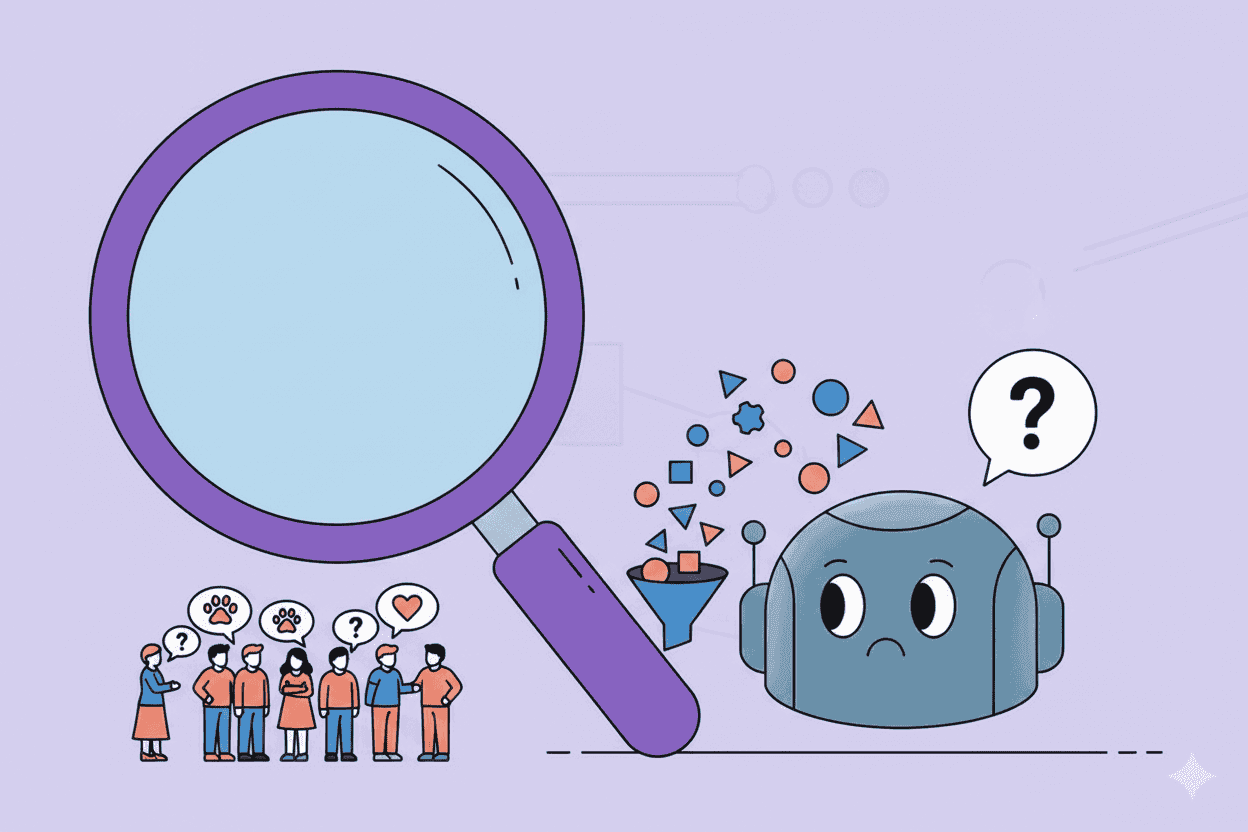
Pandora's chief digital officer revealed that Salesforce's Agentforce AI struggles with vague or complex customer requests — like recommending jewelry when a customer says "my wife likes dogs."
Read that again. A company with over $300 million invested in Anthropic still can't figure out what a customer actually wants when they speak like, well, a normal human.
This isn't a Salesforce problem. This is the problem. And it's one that every product team building with AI needs to understand deeply.
The Gap Between Data and Understanding
Salesforce has more customer data than almost any company on Earth. They've processed 2.4 billion "Agentic Work Units" in a single quarter — up 57% from the previous quarter. They have 150,000 enterprise customers feeding data into their systems.
And yet their AI can't connect "my wife likes dogs" to "dog-themed jewelry might be a good gift."
Why? Because there's a massive difference between having customer data and actually understanding customers.
Customer feedback isn't just information to be processed. It's signal wrapped in context, emotion, unstated assumptions, and cultural nuance. When someone says "my wife likes dogs," they're not giving you a product requirement. They're giving you a window into a relationship, a preference pattern, a gift-giving context.
Traditional analytics sees: wife + dogs = ???
Real understanding sees: This person is trying to do something thoughtful for someone they care about, and they're sharing a meaningful detail about what brings that person joy.
Why More Data Won't Fix This
Here's what's counterintuitive: Salesforce's problem isn't that they need more data. It's that they're drowning in it.
Early customer feedback about Agentforce flagged the time spent preparing data before the AI could even use it. Companies were spending more time wrangling information than actually getting insights from it.
This is the trap that most enterprise AI falls into. The assumption is: collect everything → process it all → understanding emerges automatically.
But understanding doesn't scale linearly with data volume. In fact, it often scales inversely. The more data you have, the harder it becomes to find the signal that matters.
Think about your own product team. You probably have:
- Thousands of support tickets
- Hundreds of feature requests
- Dozens of NPS responses
- Customer interviews scattered across Google Drive
- Slack threads with sales about what customers are saying
- A Notion database someone started and abandoned
You have plenty of customer data. What you don't have is a coherent picture of what customers actually need and why.
The Real Lesson from Salesforce's Struggles
Marc Benioff isn't wrong when he says "the opportunity has never been greater." AI absolutely can transform how companies understand and serve customers.
But only if you solve the right problem first.
The companies winning with AI right now aren't the ones with the most data or the most sophisticated models. They're the ones who've figured out how to turn messy, unstructured, human customer feedback into actionable understanding.
Look at where Agentforce actually works: Pearson increased their resolution rate by 40% for straightforward queries — order status, refunds, access codes. PenFed Credit Union cut IT tickets by 40% for password resets and account unlocks.
Notice the pattern? It works for structured problems with clear answers. It fails for anything requiring actual understanding of human intent.
What This Means for Product Teams
If Salesforce, with hundreds of millions in AI investment and decades of CRM expertise, can't automatically translate customer data into customer understanding — what makes you think your product team can?
This isn't meant to be discouraging. It's meant to be clarifying.
The path forward isn't to throw more AI at raw data and hope understanding emerges. The path forward is to build systems that help humans develop real customer understanding, with AI as an accelerant rather than a replacement.
Here's what that looks like in practice:
1. Stop Treating Feedback as Data Points
Every piece of customer feedback is a story fragment. A support ticket isn't just a bug report — it's a frustrated human trying to accomplish something that matters to them. A feature request isn't just a product spec — it's a signal about an unmet need.
When you process feedback as isolated data points, you lose the connecting tissue that makes them meaningful. The goal isn't to categorize and count. It's to synthesize and understand.
2. Connect Feedback to Context
"My wife likes dogs" only makes sense as a jewelry recommendation signal if you understand the context: gift shopping, personal relationship, seeking to please someone else.
Your customer feedback needs the same contextual grounding. What was the customer trying to do? What was their emotional state? What do we know about their history with the product? What's happening in their business or life that shapes this interaction?
This context often lives outside your formal feedback channels — in sales conversations, in onboarding calls, in the questions they ask before the complaints they file.
3. Look for Patterns Humans Can Validate
AI is excellent at finding patterns. Humans are excellent at determining which patterns actually matter.
The mistake is letting AI decide both. Use AI to surface potential patterns across your feedback, but keep humans in the loop to validate whether those patterns reflect real customer needs or just statistical noise.
When 50 customers all complain about the same thing using slightly different words, AI can help you see that's actually one issue, not 50. But a human needs to decide whether that issue is a fundamental product problem or a documentation gap.
4. Build Understanding Incrementally
You're not going to suddenly "understand your customers" through one big AI implementation. Understanding builds over time, through consistent attention and systematic synthesis.
Create rituals around customer understanding. Weekly reviews of feedback themes. Monthly deep-dives into specific customer segments. Quarterly synthesis of what you've learned and what's changed.
AI can make each of these faster and more comprehensive. But it can't replace the human judgment that turns information into insight.
The Competitive Advantage No One's Talking About
Here's the thing about Salesforce's current crisis: it's temporary. They'll figure out better ways to handle nuanced requests. Agent Albert will launch. The AI will improve.
But the companies that win in the meantime aren't the ones waiting for perfect AI. They're the ones building customer understanding as a core competency right now.
Because customer understanding isn't just an input to product decisions. It's a competitive moat.
Companies that truly understand their customers:
- Build features that solve real problems, not imagined ones
- Prioritize roadmaps based on actual impact, not loudest voices
- Reduce churn by addressing root causes, not symptoms
- Create products that feel like they were built just for their users
This isn't something you can buy or implement. It's something you have to develop. And the teams that start now — while others are waiting for AI to magically solve it — will have years of compounding advantage.
Moving Forward
Salesforce's stock will recover. The SaaS model isn't dying — it's evolving. AI will get better at understanding nuanced human communication.
But none of that changes the fundamental truth exposed by their current struggles: understanding customers is hard. Really hard. And no amount of data or AI sophistication will make it automatic.
The question for your product team isn't whether to use AI for customer understanding. It's how to use AI to augment genuine human insight rather than try to replace it.
Start with what you have. Your customers are already telling you what they need — in support tickets, in feature requests, in the questions they ask and the workarounds they create. The signal is there.
You just need a way to hear it clearly.
Building products that genuinely serve customers requires moving beyond data collection to true understanding. That's exactly what Pelin helps product teams achieve — turning scattered customer feedback into coherent insights that drive better decisions. Because the future belongs to teams who actually understand their customers, not just those who have the most data about them.