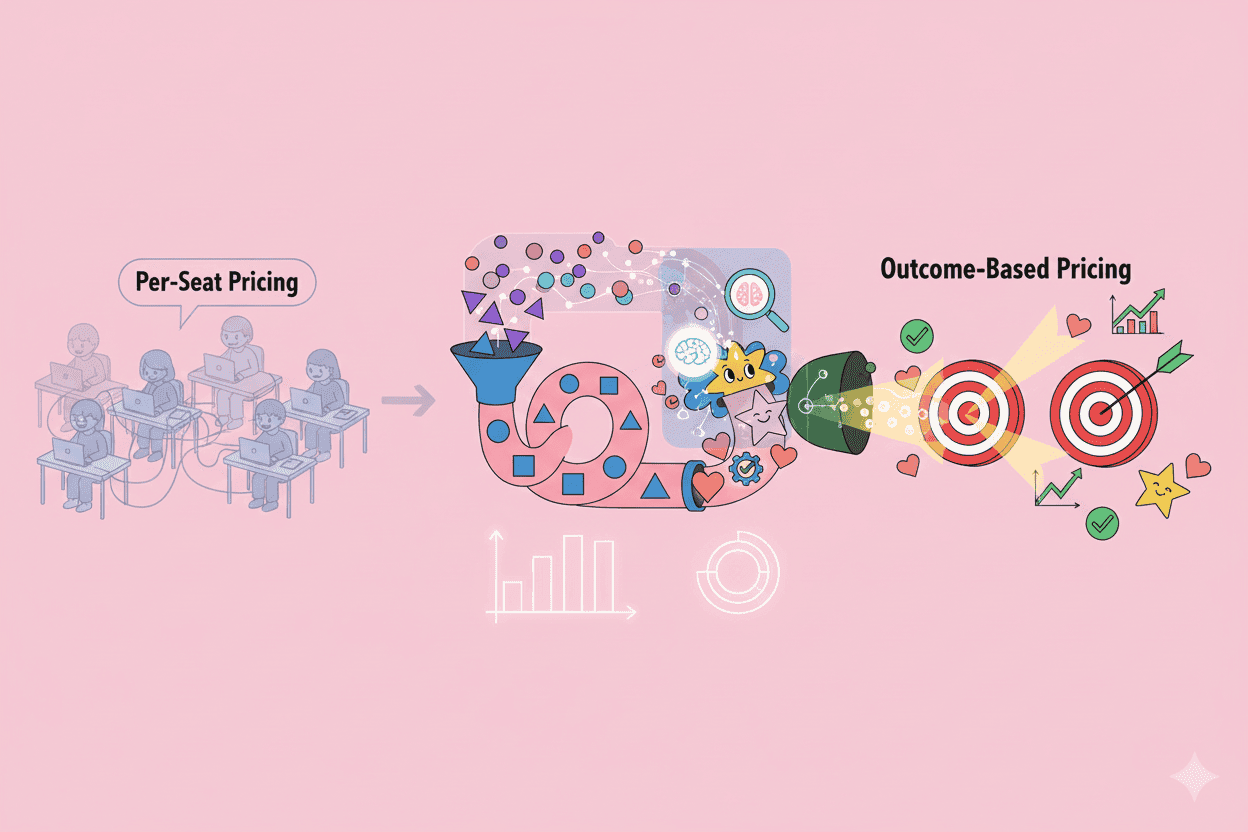
Something profound is happening in enterprise software, and it's going to fundamentally change how product teams operate.
This week, Gartner data revealed that 40% of enterprise SaaS contracts now include "outcome-based" elements—up from just 15% two years ago. Instead of charging for seats, companies are charging for automated customer resolutions, processed workflows, or achieved results.
The B2B software sector has been slammed with a 25% valuation compression this quarter alone, as investors wake up to a brutal reality: AI agents are cannibalizing the per-seat licensing model that funded two decades of SaaS growth.
For product managers and product teams, this isn't just a financial story. It's an existential shift in what your job actually means.
The End of "Ship Features, Charge Per Seat"
For twenty years, the SaaS playbook was beautifully simple: build features, acquire users, charge per seat, expand within accounts. Success meant user growth. Product metrics centered on adoption, engagement, and retention.
That model assumed humans would do the work inside your software.
But here's what's changed: surveys of CIOs show that 40% of IT budgets are now being reallocated from traditional SaaS subscriptions toward "agentic" platforms—systems where AI does the work, not humans clicking through interfaces.
The data is stark: for every AI agent deployed, human software seat requirements are dropping at a ratio of roughly 1:5.
What does this mean for product teams?
If you're still optimizing for "time in app" or "feature adoption," you're measuring the wrong things. The market is telling us that value no longer lives in how many people use your software—it lives in what outcomes your software actually produces.
Why This Changes Everything for Product Discovery
Here's the uncomfortable truth: most product teams don't actually know what outcomes their customers are trying to achieve.
They know which features get used. They know NPS scores. They might even have some qualitative feedback from sales calls. But ask them to map customer problems to measurable business outcomes with confidence, and watch the room go quiet.
This was fine when pricing was decoupled from outcomes. You shipped features, customers figured out how to get value, and everyone pretended the connection was obvious.
Outcome-based pricing removes that comfortable ambiguity.
When your revenue is literally tied to customer results—resolved support tickets, successful onboardings, completed workflows—you need to understand those outcomes with surgical precision. You need to know:
- Which customer problems, when solved, drive measurable business value?
- What does "success" actually look like for different customer segments?
- Where are customers failing to achieve outcomes, and why?
- Which product capabilities directly contribute to customer results?
This is exactly what voice of customer (VoC) research and continuous product discovery are supposed to provide. But too many teams treat customer feedback as a compliance exercise rather than a strategic asset.
The Three Types of Teams That Will Win (and Lose)
As this transition unfolds, product teams are splitting into three camps:
Teams That Will Fail: The Feature Factories
These teams ship what stakeholders ask for, conduct occasional user interviews, and measure success by release velocity. They have a backlog full of feature requests but no systematic way to connect those features to customer outcomes.
In an outcome-based pricing world, these teams will ship features that don't move the metrics that matter—and they'll wonder why revenue isn't following.
Teams That Will Struggle: The Data Collectors
These teams actually gather customer feedback. They have surveys, NPS scores, support tickets, and maybe even some interview transcripts. But the data sits in silos—Notion pages nobody reads, Slack threads that disappear, spreadsheets last updated in 2024.
They have the raw material but lack the synthesis. When asked "what should we build to improve customer outcomes," they can't answer quickly or confidently.
Teams That Will Win: The Insight-Driven
These teams treat customer intelligence as infrastructure, not an afterthought. They have systems that continuously aggregate feedback from every touchpoint—support, sales, interviews, reviews, usage data. More importantly, they have ways to synthesize that feedback into actionable patterns.
When the CEO asks "how do we tie our pricing to outcomes," these teams can answer: "Here are the top five outcomes our customers care about, rank-ordered by frequency and revenue impact. Here's the evidence. Here's what we should build."
What Insight-Driven Actually Looks Like
Let's get specific. In the old world, a product manager might review customer feedback once a month, pull out some themes, and use those to inform roadmap discussions.
In the outcome-based world, you need:
Continuous synthesis: Customer feedback from support, sales, product analytics, and direct research needs to flow into a single source of truth—automatically, not manually. You can't wait for quarterly reviews when pricing is tied to weekly outcomes.
Outcome mapping: Every piece of feedback needs to connect to a customer outcome. "I want feature X" is useless. "I couldn't complete Y task, which prevented me from achieving Z result" is gold.
Evidence-based prioritization: When you decide what to build, you need receipts. Not opinions, not HiPPO (highest paid person's opinion), but actual evidence that building X will improve outcome Y for customers who represent Z revenue.
Feedback loops: When you ship something, you need to know whether it actually improved the outcome you were targeting. Fast. Not in three months when the NPS survey comes around.
This is exactly what modern product discovery tools are designed to enable. The question is whether teams are actually using them this way—or just checking a box.
The AI Angle: Research at Scale
Here's where it gets interesting. The same AI capabilities disrupting SaaS pricing can also help product teams solve the customer insight problem.
Salesforce AI Research recently highlighted "ambient intelligence" as a major trend: AI that sifts through overwhelming volumes of data to surface exactly the information needed in real-time.
This describes precisely what product teams need. Imagine an AI that:
- Reads every support ticket, sales call transcript, and product review
- Automatically extracts customer problems and maps them to outcomes
- Identifies patterns across thousands of data points that humans would miss
- Surfaces insights exactly when you need them—during planning, during standups, during roadmap reviews
This isn't science fiction. It's what modern VoC and product discovery platforms are building right now. The teams that adopt these tools—and actually use them to drive decisions—will have an enormous advantage.
Five Actions for Product Teams This Quarter
If you're reading this and feeling a slight panic, good. That means you're taking it seriously. Here's where to start:
1. Audit Your Feedback Infrastructure
Where does customer feedback actually live in your organization? How fragmented is it? How stale? If you can't answer "what are our customers' top three unsolved problems" in under five minutes, you have infrastructure work to do.
2. Map Features to Outcomes
Take your current roadmap and try to connect each item to a measurable customer outcome. If you can't make that connection clearly—backed by evidence—flag it. In an outcome-based world, building things that don't tie to outcomes is waste.
3. Define Success Metrics That Matter
Stop measuring feature adoption and start measuring outcome achievement. What does "success" look like for your customers? How would you know if they achieved it? These metrics should drive product decisions.
4. Invest in Synthesis, Not Just Collection
If you're already gathering feedback but it's sitting unused, your problem isn't data—it's synthesis. Look at tools that use AI to automatically aggregate and pattern-match across feedback sources. The insight is in the connections.
5. Create Feedback Loops
When you ship something, close the loop. Did it improve the targeted outcome? Set up instrumentation to know. If you're only measuring whether people used the feature, you're measuring the wrong thing.
The Bigger Picture
The shift to outcome-based pricing is part of a larger transformation in how software creates and captures value. As one analysis put it, "the value moves from the tool to the result."
For product teams, this is actually great news—if you're prepared. It means product work becomes more strategic, more directly tied to business outcomes, more clearly valuable.
But it requires a fundamental shift in how teams operate. The gap between teams who deeply understand customer outcomes and teams who don't is about to become a chasm.
The companies that thrive in this new world will be the ones that treat customer insights not as a nice-to-have, but as the foundation of everything they build. The evidence, after all, is now directly tied to the revenue.
The question is simple: when your pricing depends on customer outcomes, do you actually know what those outcomes are?
At Pelin, we're building AI that helps product teams turn scattered feedback into actionable insights—automatically. Because in an outcome-based world, understanding your customers isn't optional anymore.