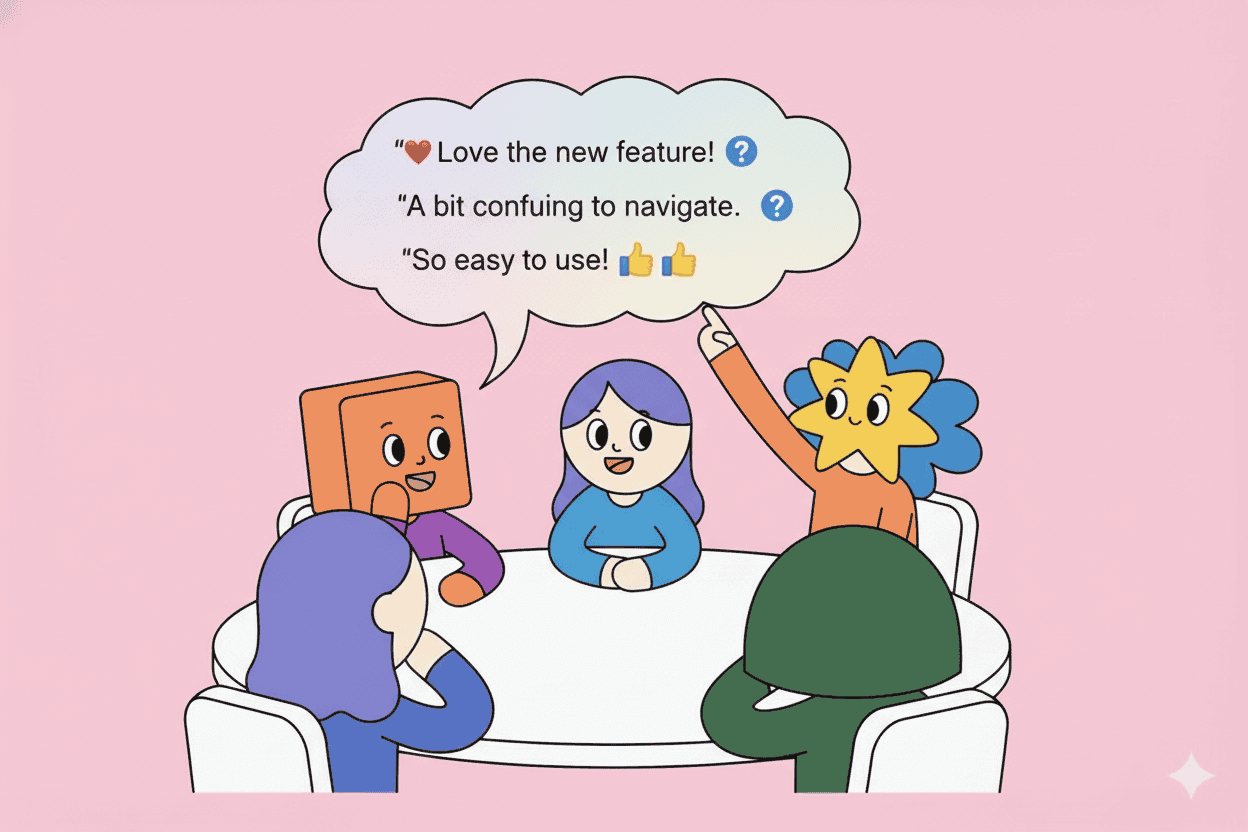
Your sprint retrospectives are probably missing the most important voice in the room: your customers.
Most retros follow the same tired script. What went well? What didn't? What should we improve? The team discusses blockers, velocity, and maybe some interpersonal friction. Then everyone goes back to building features that may or may not matter to actual users.
Here's the problem: organizations with a cross-team approach centered on customers are nearly twice as likely to exceed their business goals. Yet most product teams treat retrospectives as purely internal affairs.
It's time to fix that.
TL;DR
- Sprint retrospectives should include customer feedback as a standing agenda item
- Designate a "customer voice" role to surface relevant feedback each sprint
- Connect team process improvements to customer outcomes
- Use a simple framework: What did customers love? What frustrated them? What are they asking for?
- Track customer satisfaction trends alongside sprint metrics
Why Customer Feedback Belongs in Retrospectives
The sprint retrospective is the only recurring ceremony explicitly designed for improvement. Everything else—standup, planning, review—focuses on delivery. The retro is where teams step back and ask: "How can we do better?"
But "better" at what?
Most teams optimize for internal efficiency. Ship faster. Reduce bugs. Clear blockers. These matter, but they're proxies for what actually matters: delivering value to customers.
Research from Accenture shows companies that involve their service organization in product development achieve 10x higher revenue growth. The service organization knows what customers actually experience. Your retrospective should tap into that knowledge.
The Disconnection Problem
Here's what typically happens:
- Product builds features based on roadmap priorities
- Customers use (or don't use) those features
- Support and CS teams hear customer reactions
- That feedback sits in Zendesk, Intercom, or Slack
- Engineering keeps optimizing internal processes
- The cycle repeats
The retrospective is the perfect intervention point. It's already a dedicated time for reflection. It already involves the whole team. It just needs customer data injected into the conversation.
A Framework for Customer-Centric Retrospectives
Replace (or augment) your standard retro format with a customer-focused structure:
The "Customer Voice" Retrospective Format
Part 1: Customer Wins (10 minutes)
- What shipped last sprint that customers loved?
- Any positive feedback, testimonials, or NPS improvements?
- Support tickets that got resolved particularly well?
Part 2: Customer Friction (10 minutes)
- What frustrated customers this sprint?
- Common support tickets or complaints?
- Features that aren't landing as expected?
Part 3: Customer Asks (10 minutes)
- What are customers requesting that we're not building?
- Patterns in feature requests?
- Competitive gaps customers mention?
Part 4: Team Process Review (15 minutes)
- Now do your standard "what went well / what didn't" discussion
- But frame improvements through customer impact
- Ask: "Will this process change help us serve customers better?"
Part 5: Action Items (10 minutes)
- Prioritize actions that directly impact customer experience
- Assign owners and deadlines
- Connect each action to a customer outcome
Here's the uncomfortable truth: research shows only 40-50% of retrospective action items ever get completed. Tying actions to real customer problems increases follow-through because the stakes feel tangible.
Designate a "Customer Voice" Role
Someone needs to own bringing customer feedback into the retro. This shouldn't be extra work—it should be a rotating responsibility that takes 15-20 minutes of prep.
The Customer Voice's Prep Checklist
Before each retrospective, the designated person should:
- Pull NPS/CSAT data for the sprint period
- Scan support tickets for patterns and outliers
- Check sales call notes for objections or requests
- Review any customer interviews conducted that sprint
- Summarize in 3-5 bullet points to present
This role can rotate weekly, giving everyone exposure to customer feedback. It's particularly valuable for engineers who rarely interact with customers directly.
Who Should Be Customer Voice?
Consider rotating among:
- Product managers (obviously, but they shouldn't always own it)
- Engineers (builds empathy and context)
- Designers (grounds UX decisions in real feedback)
- QA/Support liaisons (closest to daily customer issues)
The key is rotation. When the same person always presents customer feedback, it becomes "their thing." When everyone takes turns, customer-centricity becomes a team trait.
Connecting Process Improvements to Customer Outcomes
The standard retro question "What should we improve?" typically generates answers like:
- "Better code reviews"
- "Cleaner standups"
- "More accurate estimates"
These are fine, but they're internally focused. Try reframing every improvement through a customer lens:
| Internal Improvement | Customer-Centric Reframe |
|---|---|
| Better code reviews | Fewer bugs reaching customers |
| Cleaner standups | Faster response to customer blockers |
| More accurate estimates | More reliable release dates we can share with customers |
| Less meeting time | More time to address customer feedback |
When you connect internal improvements to customer outcomes, two things happen:
-
Prioritization becomes clearer. "Better code reviews" might feel optional. "Fewer bugs frustrating customers" feels urgent.
-
Buy-in increases. People work harder on improvements that help real humans, not just process checkboxes.
Practical Templates to Get Started
Template 1: The Customer Feedback Brief
Have the Customer Voice complete this before each retro:
Sprint X Customer Feedback Brief

NPS/CSAT this sprint: ___
Change from last sprint: ___

Top 3 things customers loved:
1.
2.
3.

Top 3 pain points surfaced:
1.
2.
3.

Most requested feature/change:


Quote of the sprint (positive or constructive):


One thing we should discuss as a team:
Template 2: Customer-Impact Action Item Format
When creating action items, use this structure:
ACTION: [What we'll do]
OWNER: [Who's responsible]
DUE: [When it'll be done]
CUSTOMER IMPACT: [How this helps customers]
SUCCESS METRIC: [How we'll know it worked]
Example:
ACTION: Add automated test coverage for checkout flow
OWNER: Sarah
DUE: End of next sprint
CUSTOMER IMPACT: Reduces checkout failures that cause abandoned purchases
SUCCESS METRIC: Checkout error rate drops below 0.5%
Template 3: Monthly Customer Retrospective
Once per month, run a deeper customer-focused retro that includes:
- Customer journey review: Walk through a recent customer's experience end-to-end
- Churn analysis: What do we know about customers who left this month?
- Feature adoption check: Are recent releases actually being used?
- Competitive pulse: What are customers saying about alternatives?
This monthly session supplements the weekly sprint retro with deeper strategic thinking.
How AI Can Accelerate This Process
Manually synthesizing customer feedback from multiple sources is tedious. This is exactly where AI tools excel.
Modern customer insight platforms like Pelin can:
- Aggregate feedback automatically from support tickets, calls, surveys, and reviews
- Surface patterns across hundreds of data points
- Generate sprint-ready summaries of what customers are saying
- Track sentiment trends over time
Instead of the Customer Voice spending 20 minutes pulling data manually, they can spend 5 minutes reviewing an AI-generated summary and 15 minutes adding context and nuance.
The goal isn't to replace human judgment—it's to ensure no team member skips their Customer Voice prep because "it took too long." When feedback synthesis is automated, customer-centric retros become sustainable.
Common Objections (and How to Address Them)
"We don't have time—retros already run long."
Cut something else. If your retro is 60 minutes, spend 15 on customer feedback and 45 on team process. Customer feedback should be at least 25% of retro time.
"We don't have access to customer feedback."
Start simple. Ask your support team to send you the top 5 tickets from the sprint. Ask sales for one customer quote. Ask CS for their gut feeling. Perfect data isn't required—any signal is better than no signal.
"That's the PM's job, not the team's."
Customer-centricity is everyone's job. Engineers make hundreds of micro-decisions that affect user experience. Designers need to know what's working and what's not. The whole team benefits from customer context.
"Customer feedback is too negative—it'll demoralize the team."
Balance criticism with praise. The Customer Voice should always include wins alongside friction. Hearing "customers loved X" is motivating. And knowing about problems means you can fix them, which is ultimately more empowering than ignorance.
Measuring Success
How do you know if customer-centric retros are working?
Leading indicators:
- Percentage of action items tied to customer outcomes
- Team participation in customer voice prep
- Increase in customer feedback sources accessed
Lagging indicators:
- NPS/CSAT trends over quarters
- Feature adoption rates
- Customer retention
- Support ticket volume
Track these metrics quarterly. If you're consistently bringing customer feedback into retros, you should see improvements within 2-3 quarters.
Start Small, Build the Habit
You don't need to overhaul your retros overnight. Start with one change:
This sprint: Ask someone to bring one customer quote or support ticket summary to the retro.
Next sprint: Designate a Customer Voice and use a simple template.
Following sprint: Track one customer metric alongside your sprint metrics.
Within a month: You'll have a customer-centric retro habit that feels natural.
The teams that consistently connect their internal processes to customer outcomes are the teams that build products people actually want. Your retrospective is where that connection happens—or doesn't.
Make sure it does.