You just wrapped a great customer interview. The recording is saved, notes are in a doc somewhere, and... that's it. Two weeks later, nobody remembers what was said. Sound familiar?
According to UserTesting's 2024 research operations report, only 34% of product teams have a formal process for synthesizing customer research. The rest? They're sitting on goldmines of insight that never make it into product decisions.
The missing piece isn't more interviews. It's what happens immediately after.
TL;DR: Key Takeaways
- Debrief within 24 hours while the conversation is fresh
- Include cross-functional observers (engineering, design, CS) — not just the interviewer
- Use structured templates to capture insights, not just quotes
- Separate observations from interpretations to reduce bias
- Create atomic insights that can be tagged, tracked, and referenced later
- Assign follow-up owners so insights drive action, not just documentation
What Is a Customer Interview Debrief?
A customer interview debrief is a structured team meeting held immediately after a customer conversation. Its purpose is to capture, discuss, and synthesize raw observations before memory fades and bias creeps in.
It's not:
- A readout of your notes
- A chance to debate whether the customer was "right"
- A decision-making meeting
It is:
- A collaborative sense-making session
- A way to surface multiple perspectives on the same conversation
- The bridge between raw data and actionable insight
Research from the Nielsen Norman Group shows that involving multiple observers in research synthesis improves insight quality and reduces individual interpretation bias by up to 40%.
Why Most Teams Skip Debriefs (And Why That's Expensive)
The "I'll Just Share My Notes" Trap
Sending interview notes to Slack feels productive. It isn't. Studies on organizational knowledge sharing show that async documentation has a 15-20% retention rate among recipients. Most of your team will skim it, nod, and forget.
The Interpretation Gap
When one person conducts an interview and writes up findings, they're unconsciously filtering through their own assumptions. A debrief forces multiple perspectives to collide — the designer noticed body language, the engineer caught a technical workaround, CS recognized a support pattern.
The "Someday" Synthesis Problem
Without immediate debriefs, teams accumulate piles of interview recordings that "someone will analyze eventually." That someday rarely comes. ProductPlan's 2024 PM survey found that 67% of product managers feel overwhelmed by unprocessed customer feedback.
The Customer Interview Debrief Template
Here's a practical template you can use in your next debrief:
Pre-Debrief Setup (5 minutes before)
Attendees: Interview facilitator + all observers + optional stakeholders Time: 30-45 minutes (max) Materials: Interview notes, recording (optional), whiteboard or shared doc
Part 1: Individual Capture (5 minutes — silent)
Before any discussion, each person independently writes down:
- 3-5 key observations (what the customer said or did — factual, no interpretation)
- 1-2 surprising moments (things that challenged your assumptions)
- Questions raised (what do you now want to learn more about?)
This prevents groupthink and ensures quieter team members contribute equally.
Part 2: Share Observations (10 minutes)
Go around the room. Each person shares their observations without interpretation.
Good: "The customer mentioned checking competitor pricing weekly" Bad: "The customer is price-sensitive" (that's interpretation)
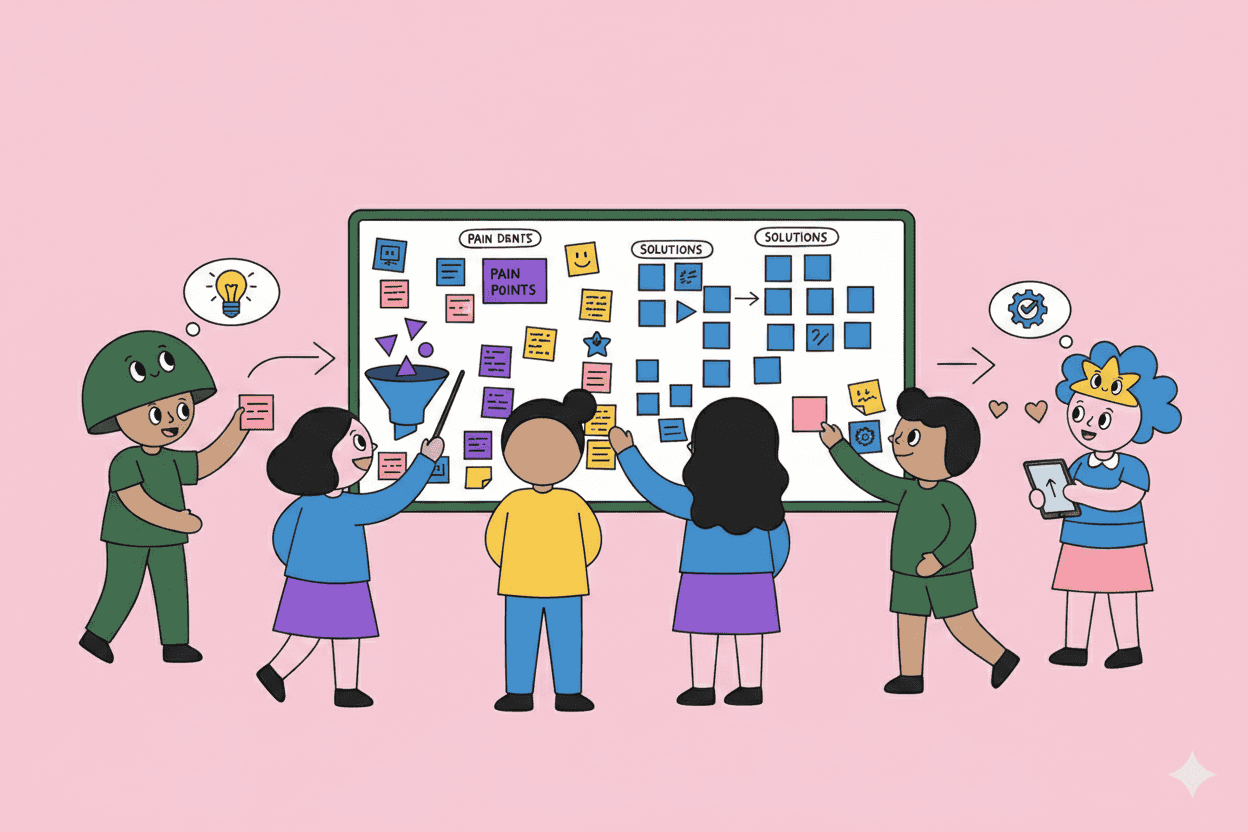
Capture all observations on a shared board.
Part 3: Identify Patterns and Themes (10 minutes)
Now discuss as a group:
- What observations cluster together?
- Do we see patterns across previous interviews?
- What contradictions emerged?
Use affinity mapping to group related observations. Tag themes that recur.
Part 4: Generate Insights (10 minutes)
An insight is an observation + interpretation + implication. Format them as:
"We observed [observation]. This suggests [interpretation]. This matters because [product implication]."
Example: "We observed Sarah spends 30 minutes weekly exporting data to spreadsheets. This suggests our native analytics don't meet her reporting needs. This matters because she's a power user we're at risk of losing to competitors with better reporting."
Part 5: Define Next Steps (5 minutes)
- What follow-up research do we need?
- Which insights should go into our research repository?
- Who owns actioning specific insights?
- Should this inform our current sprint priorities?
Facilitation Tips That Actually Work
Use a Dedicated Facilitator
The interview facilitator often has the strongest opinions. Designate someone else to run the debrief so the interviewer can participate as an equal voice.
Time-Box Ruthlessly
Debriefs expand to fill available time. Set a 45-minute hard stop. Unfinished discussions can continue async or in a follow-up session.
Separate Facts from Feelings
It's tempting to jump to "I think the customer wants X." Force the team to ground interpretations in specific observations. "What did they actually say or do that led you to that conclusion?"
Capture Dissent
When team members disagree on interpretation, that's valuable data. Document both perspectives and what would help resolve the disagreement (more interviews? Usage data? Prototype testing?).
Make It Safe to Say "I Don't Know"
Good debriefs surface uncertainty. If a debrief produces only confident conclusions, you're probably missing something. Encourage questions like "What else could explain this behavior?"
Scaling Debriefs Without Burning Out Your Team
Running full debriefs after every single interview isn't sustainable at scale. Here's how to adapt:
The Batch Debrief Model
Conduct 3-5 interviews in a week, then hold one longer synthesis session. This works well when researching a specific feature or problem space.
The Async-First Hybrid
For remote teams: Each observer submits observations to a shared doc within 24 hours. A 20-minute sync call reviews themes and generates insights. Works well for geographically distributed teams.
The Rotational Observer Model
Not everyone needs to attend every debrief. Rotate observers across interviews so the full team participates over time without every meeting becoming a 10-person committee.
From Debrief to Action: Closing the Loop
The best debrief process is worthless if insights disappear into a doc graveyard.
Tag and Categorize Insights
Use consistent tags: problem area, customer segment, product area, confidence level. This makes insights searchable and patterns visible across multiple debriefs.
Connect to Existing Work
Does this insight validate or challenge something on your roadmap? Does it relate to a recent support trend? Link insights to relevant initiatives so they're discovered in context.
Create Insight Digests
Send a weekly summary of key customer insights to stakeholders who don't attend debriefs. Keep it to 3-5 bullet points with links to detail. Research on executive attention shows that curated summaries drive 3x more action than comprehensive reports.
Review Insights in Planning
During sprint planning or roadmap reviews, explicitly reference recent customer insights. Make it a habit, not an afterthought.
Tools That Support Debrief Workflows
You don't need specialized software to run good debriefs, but some tools help:
For Collaborative Capture:
- Miro or FigJam for visual affinity mapping
- Notion or Confluence for structured templates
- Dovetail or Condens for research repositories
For Recording and Playback:
- Grain, Otter, or Fathom for timestamped transcripts
- Loom for sharing interview highlights async
For Pattern Recognition at Scale: Modern AI tools can help surface patterns across many interviews — identifying recurring themes, sentiment shifts, and emerging topics that humans might miss in the volume. Platforms like Pelin automatically aggregate and analyze customer conversations, surfacing insights that would take hours of manual synthesis to uncover.
Common Debrief Anti-Patterns to Avoid
The "Let's Fix It Now" Meeting
Debriefs aren't solution sessions. When someone jumps to "we should just build X," redirect: "Let's capture that as a hypothesis to validate. What else did we learn?"
The Loudest Voice Wins
Without structured turn-taking, the most senior or most opinionated person dominates. Use the silent capture phase religiously and give everyone equal airtime.
Observation Inflation
One customer said it, so it must be a universal truth. Counter this by tracking how many customers have mentioned similar themes and at what confidence level.
Debrief Theater
Going through the motions without changing anything. If your debriefs never influence roadmap decisions or spawn follow-up research, something's broken. Track insight-to-action rate as a health metric.
Measuring Debrief Effectiveness
How do you know your debriefs are working?
Leading Indicators:
- Attendance consistency (are people showing up?)
- Observer diversity (are multiple functions represented?)
- Insight output rate (are you producing actionable insights?)
Lagging Indicators:
- Features shipped that reference customer insights
- Reduced rework or pivots due to early discovery
- Faster decision-making in planning sessions
- Improved customer satisfaction scores on released features
Set a quarterly review to assess your research synthesis process and iterate.
Getting Started: Your First Debrief
Don't overengineer it. For your next customer interview:
- Invite 2-3 observers from different functions
- Book 30 minutes immediately after the interview
- Use the template above — adapt as you learn
- Capture insights in whatever system you already use
- Assign one follow-up action with an owner
You can refine your process over time. The important thing is starting.
The Compound Effect of Consistent Debriefs
Teams that run regular debriefs build what Teresa Torres calls "continuous discovery habits". Each interview builds on the last. Patterns emerge across weeks and months. The team develops shared customer intuition that accelerates decision-making.
That's the real value — not any single insight, but the cumulative understanding that compounds over time.
Your customers are talking. Make sure your team is actually listening — together.
Need help making sense of customer conversations at scale? Pelin uses AI to surface patterns across all your customer feedback — interviews, support tickets, sales calls, and more — so your team can focus on the insights that matter.