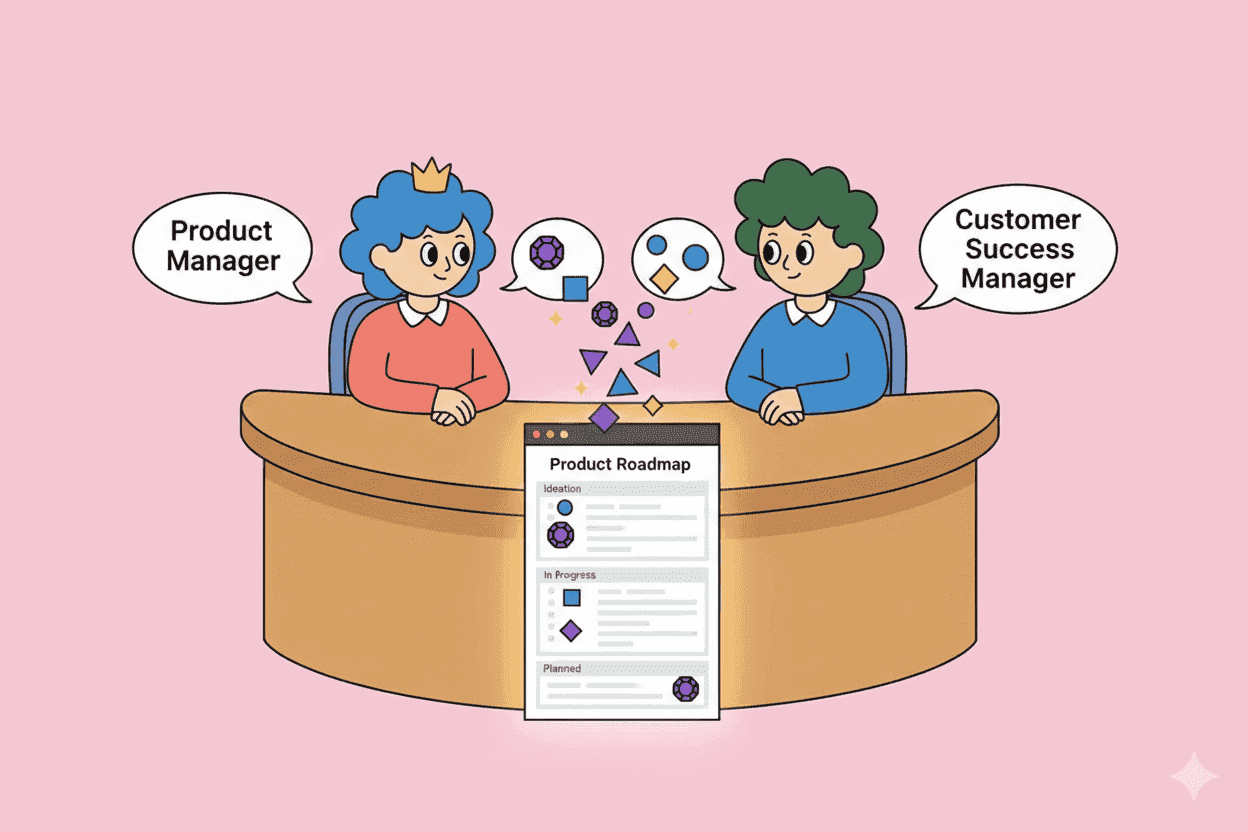
Every quarter, your customer success team has dozens of in-depth conversations with customers who are deciding whether to continue paying you. These renewal discussions contain some of the most honest, high-stakes feedback your product will ever receive—and most product teams never see it.
The median Net Revenue Retention for venture-backed SaaS sits at 106%, while top performers achieve 115-125%. The difference often comes down to how well companies listen during renewals and act on what they hear.
TL;DR: Key Takeaways
- Renewal conversations contain uniquely honest feedback because customers have skin in the game
- Most product teams never systematically capture renewal insights
- Building a feedback loop between CS and Product can directly improve NRR
- AI tools can help analyze renewal conversation patterns at scale
- Start with a simple template and iterate based on what matters most
Why Renewal Feedback Is Different (and Better)
Customer feedback comes from many sources: support tickets, NPS surveys, sales calls, user interviews. But renewal conversations occupy a special place in the feedback hierarchy.
The Stakes Are Real
When a customer is deciding whether to renew, they're not giving you theoretical feedback or wish-list items. They're telling you exactly what made them stay—or almost leave. Research shows that customers who submit feedback are 14% more likely to stay than those who don't, suggesting that the act of being heard itself impacts retention.
You Get the Full Picture
Unlike point-in-time surveys, renewal conversations capture the entire customer journey. A customer at renewal can articulate patterns they've noticed over 12 months, compare your product's evolution to their expectations, and contextualize individual frustrations within their broader experience.
Decision-Makers Are Present
Renewal calls often involve economic buyers and decision-makers who rarely participate in day-to-day feedback channels. Their perspective on ROI, competitive alternatives, and strategic fit is invaluable for product positioning and roadmap prioritization.
The Hidden Cost of Ignoring Renewal Insights
Most companies treat renewals as a pure customer success or sales function. Product teams might get a Slack message when something comes up, but there's no systematic process for capturing, analyzing, or acting on renewal feedback.
This creates several problems:
You're flying blind on churn drivers. Without structured renewal data, you can't distinguish between customers who churned because of product gaps versus pricing, support, or competitive pressure.
Feature requests lack context. A feature request from a renewal conversation—where the customer explicitly tied it to their renewal decision—should be weighted differently than a casual suggestion. But without tracking, they look the same in your backlog.
Expansion opportunities go unnoticed. Renewals often reveal upsell opportunities that product can enable. When customers say "we'd pay more if you had X," that's roadmap gold.
Patterns emerge too late. By the time you notice that five customers mentioned the same missing integration during renewals, two of them have already churned.
Building a Renewal-to-Roadmap Pipeline
The good news: you don't need to overhaul your entire process. Start with these foundational elements and iterate.
Step 1: Standardize What Gets Captured
Work with your CS team to create a simple renewal feedback template. At minimum, capture:
- Renewal outcome (renewed, expanded, contracted, churned)
- Primary decision factors (what made them stay or leave?)
- Product-specific feedback (features loved, features frustrating, features missing)
- Competitive mentions (who else did they evaluate? why?)
- Expansion blockers (what would make them spend more?)
The key is making this easy for CSMs to complete. As customer success experts note, using real metrics and concrete feedback positions CS as a growth enabler rather than a cost center.
Step 2: Create a Regular Sync
Schedule a bi-weekly or monthly sync between Product and CS specifically focused on renewal insights. This isn't a general "what are customers saying?" meeting—it's focused on:
- Patterns in recent renewal conversations
- High-value customers at risk and why
- Feature requests tied to expansion opportunities
- Competitive intelligence from renewal evaluations
Step 3: Weight Renewal Feedback Appropriately
Not all feedback is created equal. Build a scoring system that accounts for:
- Revenue at stake: A $500K ARR customer's renewal feedback matters more than a $5K customer's survey response
- Frequency: The same feedback from multiple renewal conversations is a strong signal
- Outcome correlation: Features mentioned by churned customers deserve extra scrutiny
- Expansion potential: Feedback tied to "would pay more" carries weight
Step 4: Close the Loop
When you ship something that addresses renewal feedback, tell the customers who asked for it. This does three things: it shows you listen, it improves adoption of the new feature, and it makes future renewals easier.
What to Listen For: A Practical Framework
During renewal conversations, certain phrases signal high-value product insights:
"We almost left because..."
This reveals near-churn moments that usage data might not capture. These are your highest-priority product issues—problems severe enough to threaten revenue but not quite severe enough to cause immediate churn.
"We evaluated [Competitor] and they had..."
Competitive intelligence from actual evaluation is gold. Customer success teams should leverage roadmap slides in renewal conversations to demonstrate momentum, but the reverse is equally valuable: understanding what competitors showed that tempted your customers.
"If you had X, we'd expand to more teams"
Expansion blockers are some of the most actionable feedback you can get. The customer is telling you exactly what to build to grow revenue without acquiring new customers.
"We love it, but our users complain about..."
This gap between buyer satisfaction and user satisfaction often explains low adoption rates. Economic buyers might renew, but if users are frustrated, you're building churn debt.
"We had to build a workaround for..."
Workarounds indicate product gaps that customers care enough about to invest their own resources to solve. These are validated problems, not speculative feature requests.
Analyzing Renewal Feedback at Scale
If you have more than a handful of renewals per month, manual analysis becomes impractical. This is where AI-powered tools become essential.
Pattern Detection
Modern AI can identify themes across dozens or hundreds of renewal conversations, surfacing patterns that would take humans weeks to spot. Instead of reading through transcripts, you can see: "Integration issues mentioned in 34% of at-risk renewals, up from 12% last quarter."
Sentiment Tracking
Beyond what customers say, how they say it matters. Sentiment analysis can flag conversations where a customer renewed but expressed significant frustration—a leading indicator of future churn.
Competitive Intelligence Aggregation
When customers mention competitors during renewals, AI can aggregate and categorize these mentions: which competitors are appearing more frequently? What specific features are they citing?
Tools like Pelin are specifically designed to help product teams aggregate and analyze customer feedback from multiple sources—including renewal conversations—to surface actionable patterns without manual synthesis.
Common Pitfalls to Avoid
Treating All Renewal Feedback as Equal
A customer churning over price is different from one churning over product gaps. Segment your renewal feedback by outcome and reason to identify what product can actually influence.
Overreacting to Single Data Points
One customer's renewal complaint isn't a mandate to change your roadmap. Look for patterns across multiple renewals and validate with other feedback sources before prioritizing.
Ignoring the Positive Feedback
Don't just focus on what's broken. Understanding what makes customers renew enthusiastically helps you double down on strengths and protects features that customers love.
Letting the Data Go Stale
Renewal insights have a shelf life. A pattern from six months ago might not reflect current customer needs. Build in regular reviews and sunset old data points.
Metrics That Matter
Track these metrics to measure the effectiveness of your renewal-to-roadmap pipeline:
- Renewal feedback capture rate: What percentage of renewals include structured product feedback?
- Time to action: How long between feedback and product response?
- Feedback-to-feature conversion: How many shipped features originated from renewal insights?
- Repeat issue rate: Are the same problems appearing in renewal conversations quarter over quarter?
- NRR correlation: As your process matures, does NRR improve?
Getting Started This Week
You don't need a complete system to start capturing value. Here's a minimal viable approach:
- Today: Ask your CS team to forward you the next three renewal conversation summaries
- This week: Create a simple spreadsheet to capture the feedback using the template above
- Next week: Review the patterns with your CS counterpart
- This month: Prioritize one product improvement based purely on renewal insights
- Next quarter: Evaluate whether to invest in tooling for scale
The companies achieving top-quartile NRR of 115-125% aren't doing anything magical. They're systematically listening to customers at the moments that matter most—and renewals are one of those moments.
Conclusion
Your customer success team is sitting on a goldmine of product insights. Every renewal conversation contains signals about what's working, what's breaking, and what would drive expansion. The only question is whether you're capturing it.
Start small, stay consistent, and build feedback loops that turn renewal conversations into roadmap confidence. Your customers are already telling you what to build—you just need to listen.
Want to automatically capture and analyze customer feedback from renewal conversations and beyond? Try Pelin to turn scattered customer insights into clear product priorities.