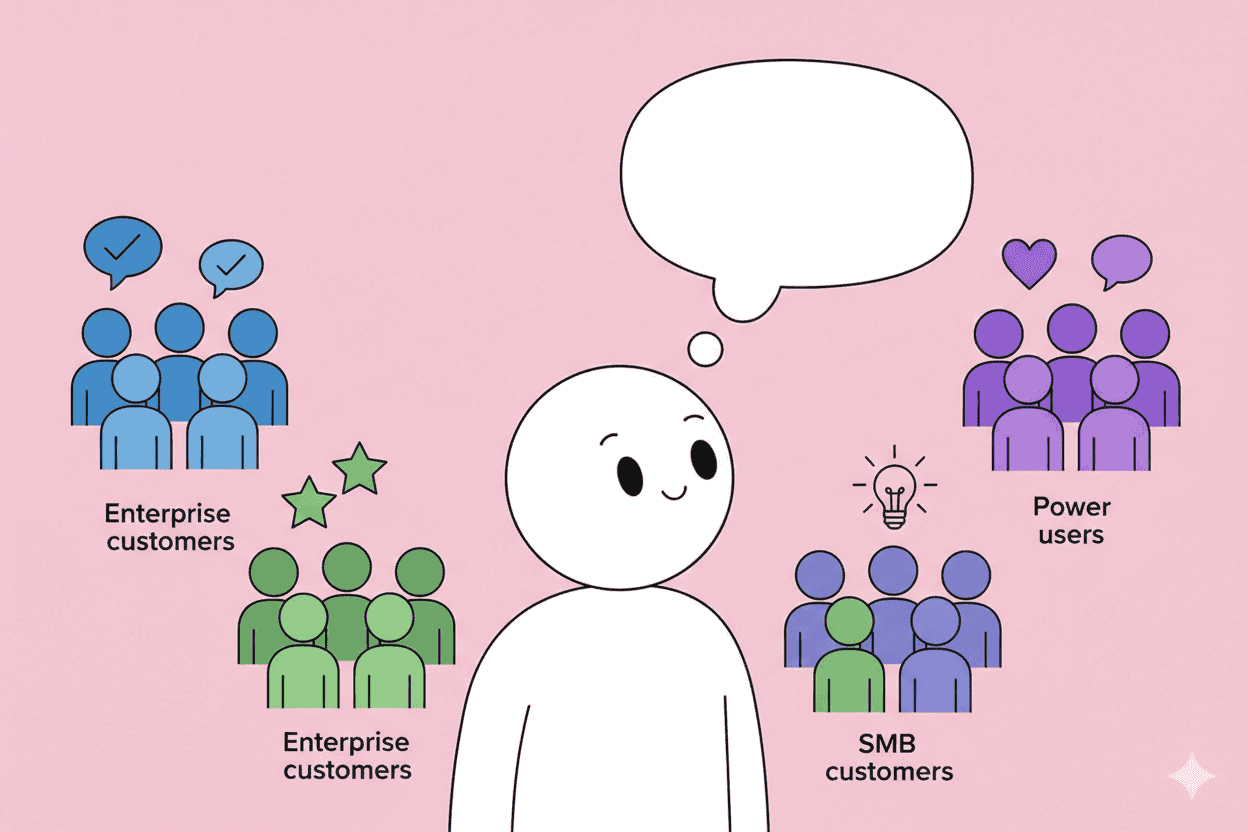
Your enterprise customer wants deeper integrations. Your SMB users want simpler pricing. Power users demand advanced features. New users can't find the basics.
Everyone has opinions. Everyone thinks their feedback matters most.
They're all right. And that's exactly the problem.
TL;DR: Key Takeaways
- Not all feedback is equal — segment context determines weight
- Revenue isn't the only factor — growth potential, strategic fit, and retention signals matter
- Create explicit weighting frameworks — remove gut-feel from prioritization
- Track segment-specific outcomes — measure if your prioritization actually works
- Automate the aggregation — manual segment tagging doesn't scale
The Segment Prioritization Problem
Here's a scenario every product team faces: You have 50 feature requests this quarter. Twenty come from your enterprise accounts (15% of users, 60% of revenue). Twenty-five come from SMB customers (70% of users, 30% of revenue). Five come from your highest-growth accounts.
Which requests get priority?
If you default to "whoever pays more," you'll build an enterprise product that new customers can't use. If you chase volume, you'll commoditize yourself into a race to the bottom. If you ignore segments entirely, you'll build a Frankenstein product that pleases nobody.
Research from Harvard Business Review shows that acquiring a new customer costs 5-25x more than retaining an existing one. But retention strategies differ wildly by segment. What keeps an enterprise customer is not what keeps a startup.
Understanding Your Customer Segments
Before you can prioritize feedback, you need to know who's talking.
Segment by Value (But Define Value Carefully)
The obvious segmentation is revenue: enterprise, mid-market, SMB. But revenue alone misses critical context.
Factors beyond current revenue:
- Expansion potential: A $5k/month account growing 20% MoM matters more than a flat $15k account
- Logo value: Some customers are worth less in revenue but massive in credibility
- Referral behavior: According to Nielsen, 92% of consumers trust recommendations from people they know — referral-heavy segments punch above their weight
- Support cost: A $10k account requiring $8k in support isn't a $10k account
Segment by Usage Pattern
Revenue segments tell you who pays. Usage segments tell you who actually uses your product.
Key usage-based segments:
- Power users: Deep feature adoption, daily usage, workflow integration
- Casual users: Core features only, weekly or monthly usage
- At-risk users: Declining usage, support tickets, payment issues
- Champions: High usage AND active advocates internally
Gainsight's research indicates that usage patterns predict churn 3-6 months before revenue signals do. Power user feedback often reveals product ceiling problems. At-risk user feedback reveals floor problems.
Segment by Lifecycle Stage
A new user's "confusing onboarding" complaint means something different than a 3-year customer's "confusing onboarding" complaint (why are they still in onboarding?).
Lifecycle stages that matter:
- Trial/evaluation: First impressions, comparison shopping
- Onboarding (0-90 days): Time to value, quick wins
- Established (90 days - 2 years): Depth, integrations, workflows
- Mature (2+ years): Platform evolution, avoiding disruption
Building a Segment Weighting Framework
Now for the practical part: how do you actually weigh feedback from different segments?
The Weighted Scoring Approach
Create explicit weights for each segment dimension. Here's a starting framework:
Revenue Tier Weight (1-5)
- Enterprise ($50k+ ARR): 5
- Mid-market ($10-50k ARR): 4
- SMB ($1-10k ARR): 3
- Free/trial: 1
Strategic Fit Weight (1-3)
- Core ICP match: 3
- Adjacent ICP: 2
- Outlier/non-ICP: 1
Growth Signal Weight (1-3)
- Expanding/upgrading: 3
- Stable: 2
- Contracting/churning: 1
Usage Depth Weight (1-3)
- Power user (top 20% usage): 3
- Regular user: 2
- Light user: 1
Final weight = Revenue × Strategic Fit × Growth Signal × Usage Depth
A $30k mid-market account (4) that's a core ICP match (3), actively expanding (3), and a power user (3) gets a weight of 108.
A $100k enterprise account (5) that's an outlier ICP (1), contracting (1), and a light user (1) gets a weight of 5.
The mid-market account's feedback is 21x more valuable for prioritization purposes.
Handling Segment Conflicts
What happens when segments directly conflict?
Enterprise wants X, SMB wants Y, and they're mutually exclusive.
This is where strategy overrides math. Ask:
-
Which segment is your growth engine? If you're betting on enterprise growth, enterprise feedback gets tiebreaker.
-
Which request aligns with your product vision? Sometimes both segments want something that doesn't fit your roadmap. Neither wins.
-
Can you solve the underlying problem differently for each? The feature request isn't the insight — the problem is. Maybe there's a solution that serves both.
-
What's the cost of ignoring each segment? Enterprise churn costs more per account but SMB churn at scale can be existential.
Superhuman's approach to product-market fit focuses on users who would be "very disappointed" without the product. Segment your feedback by disappointment level, not just segment size.
Practical Implementation
Step 1: Tag Everything by Segment
Every piece of feedback needs segment metadata attached:
- Account ID → Revenue tier, ARR, growth trajectory
- User ID → Role, usage level, lifecycle stage
- Source → Support ticket, interview, NPS survey, feature request
If you're manually tagging, you'll miss context and burn hours. This is where AI tools like Pelin become essential — automatically enriching feedback with account context so you can slice by segment instantly.
Step 2: Create Segment Dashboards
You need separate views for:
- Top requests by segment: What does each segment want most?
- Cross-segment requests: What do ALL segments want? (Usually infrastructure/reliability)
- Segment-specific requests: What does ONLY one segment want? (Niche vs platform)
Step 3: Run Segment-Specific Reviews
Don't mix segment feedback in the same prioritization meeting. Enterprise customers have different timelines, success metrics, and relationship dynamics than SMB.
Weekly cadence suggestion:
- Monday: Enterprise feedback review
- Tuesday: SMB/self-serve feedback review
- Wednesday: Cross-segment synthesis
- Thursday: Prioritization decisions
- Friday: Communication to stakeholders
Step 4: Measure Segment-Specific Outcomes
Prioritization isn't just about inputs. Track:
- NPS by segment: Is your prioritization improving satisfaction where it matters?
- Retention by segment: Are the segments you're prioritizing actually retaining better?
- Expansion by segment: Are priority segments expanding as expected?
- Request-to-delivery time by segment: Are you actually shipping what segments ask for?
Common Pitfalls
The "Loudest Customer" Trap
Enterprise customers have more access to your team. They get executive escalations. They have dedicated CSMs advocating internally.
This creates a volume bias where enterprise feedback seems more urgent simply because it's more visible. Meanwhile, 100 SMB customers with the same problem never make it past the support queue.
According to Zendesk, only 1 in 26 unhappy customers actually complain — the rest just leave. The feedback you see is already filtered. Segment visibility compounds this filtering.
Fix: Weight by segment size, not feedback volume. If 5% of enterprise accounts mention a problem and 5% of SMB accounts mention the same problem, the SMB signal represents more customers even if it's fewer tickets.
The "Strategic Account" Exception
"But this is a strategic account!" becomes an excuse to override any prioritization framework.
Yes, some accounts genuinely are strategic. But if every quarter has 10 "strategic exceptions," you don't have a prioritization framework — you have executive appeasement theater.
Fix: Define explicit criteria for strategic exceptions. Logo value, reference potential, expansion opportunity. If it doesn't meet the criteria, it doesn't get an exception.
The "Future Customer" Fantasy
"If we build this, we'll attract a whole new segment!"
Maybe. But existing customer feedback is evidence. Future customer desires are speculation. Weight them accordingly.
Fix: Validate new segment hypotheses with actual prospect conversations before prioritizing their imaginary feedback over existing customer reality.
When to Ignore Segments Entirely
Sometimes segment prioritization is the wrong lens.
Ignore segments when:
- It's a universal problem: Performance, reliability, and security affect everyone. Don't overthink it.
- It's a platform bet: Major architecture changes shouldn't be segment-gated.
- The data is too thin: If you have 3 enterprise customers and 3,000 SMB customers, enterprise "segment data" is just 3 opinions.
- You're pivoting: If your strategy is shifting segments, historical segment weights are irrelevant.
Automating Segment-Based Prioritization
Manual segment tagging and weighting doesn't scale. By the time you've categorized 500 feedback items by segment, the quarter is over.
Modern product intelligence platforms like Pelin automatically:
- Enrich feedback with account metadata (revenue, usage, lifecycle)
- Cluster requests across segments to find cross-cutting themes
- Surface segment-specific trends before they become escalations
- Weight and score feedback using your custom segment framework
The result: You spend time on prioritization decisions, not data wrangling.
Making the Call
At the end of the day, segment prioritization is about making explicit trade-offs instead of implicit ones.
When you prioritize enterprise feedback, you're choosing retention over acquisition. When you prioritize power user feedback, you're choosing depth over breadth. When you prioritize at-risk segments, you're playing defense.
None of these are wrong. But you should know which game you're playing.
Build your segment weights. Document your rationale. Track your outcomes. Adjust quarterly.
The goal isn't perfect prioritization. It's intentional prioritization — knowing why you're building what you're building, and for whom.
Next Steps
- Audit your current feedback — Can you segment it? If not, that's your first problem.
- Define 3-4 segment dimensions — Don't overcomplicate. Revenue tier + usage depth + lifecycle stage covers most cases.
- Create explicit weights — Write them down. Share them with the team.
- Build segment dashboards — Separate views for separate segments.
- Review quarterly — Are your weights producing the outcomes you want?
Your customers are telling you what they need. The question is: which customers are you listening to?