There's a number from ServiceNow's 2026 Customer Experience Report that should make every product leader uncomfortable: service representatives spend only 48% of their time actually resolving customer issues.
The other half? Administrative tasks. Reporting. Summarizing call notes. Logging into an average of four different systems just to answer a single query.
Meanwhile, 44% of customers say they're willing to switch to a competitor over poor or slow service. And 48% cite a lack of empathy as their top frustration—yet only 19% of business leaders even recognize empathy as a problem.
Welcome to the empathy gap. It's not a people problem. It's a systems problem. And it's eating your retention rates alive.
The Four-System Shuffle
Here's a scene playing out in support teams everywhere, right now:
A customer emails about a billing issue. The support rep opens the ticketing system. Then opens the CRM to check account history. Then opens the product analytics dashboard to see usage patterns. Then opens Slack to ask someone on the product team for context. Then opens the billing system to actually investigate the problem.
By the time they've gathered enough context to respond with empathy and accuracy, twenty minutes have evaporated. The customer is waiting. The queue is growing.
According to ServiceNow's research, this isn't an edge case—it's the norm. 80% of service representatives have to log into multiple systems to address a single customer query. Complex issues take an average of 39 hours to resolve. And 30% of reps say having too many tools actively slows them down.
This is what fragmented customer data looks like in practice. Not a theoretical problem on a roadmap—an active drain on your team's ability to deliver good experiences.
The Real Cost of Siloed Feedback
Product teams often think of customer feedback as something that lives in a few discrete places: NPS surveys, support tickets, user interviews. Maybe a feature request board if you're organized.
But real customer sentiment is scattered across dozens of touchpoints:
- Support conversations that reveal friction points
- Social media mentions that surface unexpected use cases
- Sales call recordings that capture competitive intel
- Community forum posts that highlight power user needs
- App store reviews that expose onboarding failures
- Cancellation surveys that explain churn drivers
When these signals live in separate systems—owned by separate teams, analyzed with separate tools—you get what ServiceNow calls the "empathy gap." Your frontline people can't see the full picture. They respond to incidents, not patterns. They react to symptoms, not causes.
And customers can feel it. The report found that 45% of customers report being transferred between multiple people or departments, reinforcing perceptions of fragmented and impersonal service.
This isn't just a CX problem. It's a product strategy problem. If your team can't connect customer signals across channels, you're building blind.
Why AI Alone Won't Fix This
Here's where it gets interesting. The ServiceNow report also found that 53% of service reps say AI is critical to delivering next-generation customer experiences, and 52% say AI has already reduced their workload and stress.
AI is clearly part of the answer. But here's the catch: only 30% of business leaders have optimized their CRM systems for seamless issue resolution, and just 57% have connected people, data, and processes via AI-driven workflows.
In other words: most companies are investing in AI capabilities that can't actually deliver value because the underlying data infrastructure is a mess.
This is the uncomfortable reality of the 2026 AI landscape. The technology is ready. The organizational infrastructure isn't.
You can deploy the most sophisticated sentiment analysis model in the world, but if it's only seeing one-third of your customer feedback, it's going to give you one-third of the insight you need. Garbage in, garbage out—except it's not garbage, it's just incomplete.
The Unified Customer Intelligence Imperative
The ServiceNow research points to what they call the "platform imperative"—the idea that seamless customer experiences are powered by connected platforms, not patchworks of point solutions.
For product teams, this translates into a simple principle: you need unified visibility into customer sentiment before you can act on it intelligently.
What does that actually look like in practice?
1. Aggregate First, Analyze Second
Stop trying to derive insights from individual channels in isolation. The pattern that explains churn might span three different touchpoints: a frustrated support ticket, followed by decreased usage, followed by a negative G2 review. If you're only looking at one signal, you'll miss the story.
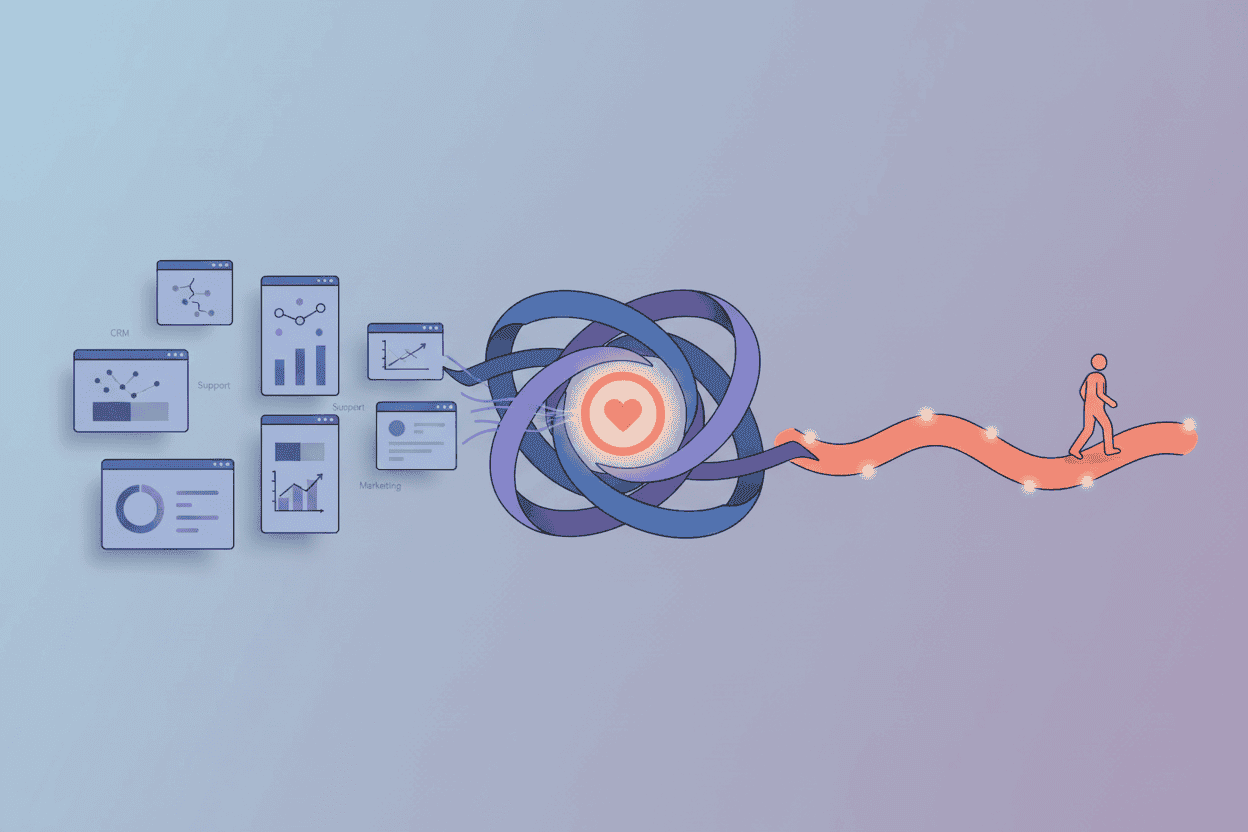
Modern customer intelligence platforms pull feedback from everywhere—support tickets, surveys, social mentions, sales calls, product analytics—and synthesize them into unified views. This isn't about having more data. It's about having connected data.
2. Surface Context at the Moment of Action
The insight needs to arrive when decisions are being made. A dashboard that shows aggregated sentiment scores is useful for quarterly planning. But a contextual alert that shows "this customer has mentioned billing confusion three times across two channels" at the moment a rep opens their ticket? That's actionable intelligence.
The best customer insights tools don't just store information—they surface it at the right moment, to the right person, with recommendations for what to do next.
3. Close the Loop Between Frontline and Product
Here's where most organizations fail: the feedback comes in, gets logged in a ticketing system, and maybe—maybe—ends up in a monthly report that someone on the product team skims. The signal-to-action loop takes weeks, if it closes at all.
World-class product organizations create direct channels between customer-facing teams and product decision-makers. When support starts seeing a pattern, product knows about it the same day. When customers keep asking for the same thing, it surfaces automatically in prioritization conversations.
This isn't about drowning PMs in noise. It's about intelligent aggregation that separates signal from noise and escalates what matters.
The Empathy Gap Is a Data Gap
Let's return to that 48% number—the amount of time service reps actually spend helping customers.
The ServiceNow report frames this as an efficiency problem, and they're right. But there's a deeper issue: when your team spends half their day navigating systems instead of understanding customers, empathy becomes structurally impossible.
Empathy requires context. It requires knowing not just what the customer is asking, but what they've asked before. What they've experienced. What they're trying to accomplish. Whether they're a power user or still getting started. Whether this is their first frustration or their fifth.
When that context is scattered across four different systems that don't talk to each other, empathy gets replaced by efficiency theater. Faster responses. Canned templates. "I've escalated your issue" instead of "I understand why this is frustrating."
Customers notice. And increasingly, they leave.
What This Means for Product Teams
If you're a product leader reading this, the implications are uncomfortable but clear:
Your feedback infrastructure is part of your product strategy. How you collect, connect, and act on customer signals isn't an operational detail—it's a competitive advantage or a structural weakness.
AI readiness starts with data readiness. Before you worry about which AI models to deploy, worry about whether your customer data is connected enough to make those models useful.
The empathy gap is your responsibility. If your support team is toggling between four systems to answer a single question, that's not a training problem or a hiring problem. It's a product and tooling problem. Someone owns it—and if you're building customer-facing software, that someone might be you.
The companies winning on customer experience in 2026 aren't the ones with the most sophisticated AI. They're the ones who've done the unsexy work of connecting their customer data into unified platforms that enable intelligent action.
The empathy gap isn't inevitable. It's a design choice. And it can be redesigned.
Moving Forward
ServiceNow's report includes a striking statistic: businesses collectively lose billions in productivity every year due to fragmented service experiences. But the inverse is also true—companies that get this right unlock massive efficiency gains.
The first step isn't deploying new AI tools. It's auditing your current customer feedback landscape:
- Where does feedback live today?
- Who has access to which signals?
- How long does it take for a frontline insight to reach a product decision?
- Can a support rep see the full context of a customer's journey?
The answers will probably be uncomfortable. That's the point.
Because the empathy gap isn't about caring more. It's about knowing more. And in 2026, that's increasingly a question of infrastructure, not intention.
Your customers are telling you exactly what they need. The question is whether your systems are listening.