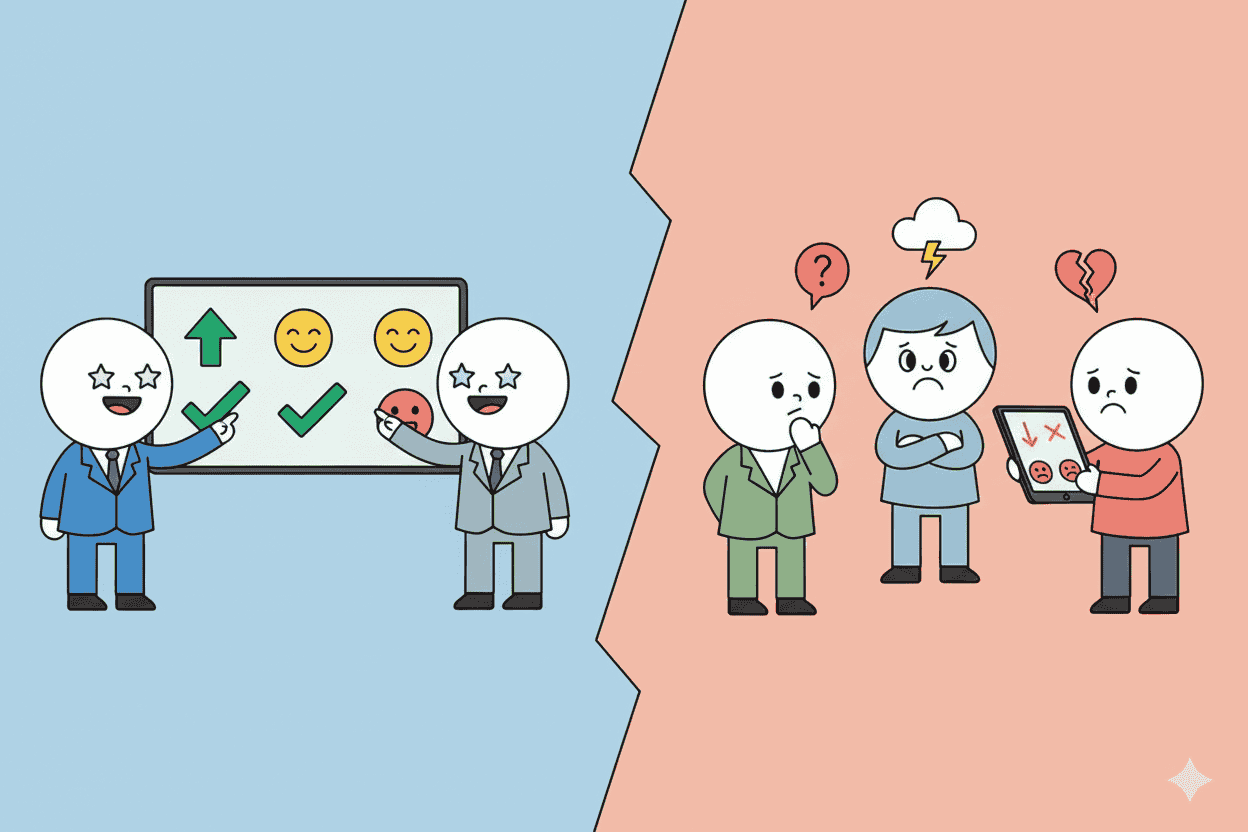
Something uncomfortable is happening in customer experience right now.
According to Medallia's 2026 State of CX report, 66% of CX professionals believe customer experience has improved over the past year. Sounds great, right?
Here's the problem: only 17% of customers agree.
That's not a gap. That's a canyon. And if you're a product leader, it should make you deeply uncomfortable.
The Feedback Black Hole
The same research reveals something even more troubling. Between 30-40% of departments across organizations aren't acting on customer feedback at all. They're collecting it—surveys, NPS scores, support tickets—but nothing happens next.
This is what CX Today calls the "measurement trap": teams get so focused on tracking metrics that they forget the entire point was to actually do something with those insights.
You've probably seen this yourself. The quarterly NPS report lands in everyone's inbox. There's a brief discussion. Someone says "we should look into that." And then... nothing. Everyone goes back to their roadmap, their sprint, their own priorities.
The feedback sits in a spreadsheet somewhere, slowly becoming irrelevant.
Why This Keeps Happening
The perception gap isn't about bad intentions. Most product teams genuinely want to build things customers love. The problem is structural.
Feedback arrives too late. By the time survey results are compiled and distributed, the moment has passed. The frustrated customer has already churned. The bug has already damaged your reputation. Historical data tells you what went wrong, but it can't help you fix it in real-time.
Nobody owns the next step. Feedback collection often sits with one team (CX or research), while the ability to act lives with another (product or engineering). Without clear ownership, insights fall through the cracks.
Volume overwhelms signal. Modern products generate enormous amounts of feedback—support tickets, reviews, survey responses, social mentions, sales call notes. Without the right tools, teams either cherry-pick convenient data points or simply give up trying to synthesize it all.
Reporting gets mistaken for progress. Dashboards and reports create the feeling of being customer-centric without requiring actual change. It's easy to point to your NPS tracking and claim you're listening to customers, even when nothing in the product reflects that.
From Measurement to Action
The companies closing this perception gap aren't necessarily collecting more feedback. They're fundamentally changing how they process and respond to it.
The key shift: moving from periodic reporting to continuous intelligence.
Think about the difference:
Periodic reporting: "Our NPS dropped 8 points last quarter. We should investigate."
Continuous intelligence: "Handle time spiked this morning because customers can't find the new billing settings. Route these tickets to specialists and update the knowledge base now."
The first approach tells you what happened. The second helps you actually fix it.
This requires what some are calling an "execution loop"—a systematic process for detecting changes, diagnosing causes, assigning owners, acting within workflows, and measuring impact. If your analytics can't support that loop, you're doing expensive reporting, not improvement.
Practical Steps for Product Teams
If you're a PM or product leader looking to close the perception gap, here's where to start:
1. Shrink the Feedback Loop
The longer feedback takes to reach decision-makers, the less useful it becomes. Look for ways to surface customer signals in near real-time rather than waiting for monthly or quarterly reports.
This doesn't mean bombarding your team with every individual complaint. It means having systems that can detect patterns and anomalies as they emerge, not weeks later.
2. Connect Feedback to Specific People
Abstract metrics create abstract responses. When feedback is tied to real customer contexts—their usage patterns, their support history, their segment—it becomes much harder to ignore and much easier to act on.
"5% of users complained about onboarding" is easy to deprioritize. "47 enterprise customers in their first week couldn't complete setup because of the same integration issue" demands immediate attention.
3. Build Feedback Into Workflows
Customer insights shouldn't live in a separate "research" silo. They need to flow directly into the tools and processes where decisions happen—sprint planning, roadmap discussions, design reviews.
If accessing customer feedback requires leaving your normal workflow and logging into a separate system, it won't happen consistently.
4. Measure Action, Not Just Collection
Track how quickly your team responds to feedback, not just how much you collect. The goal isn't a 40% survey response rate. It's reducing the time between "customer reports problem" and "problem gets fixed."
Create accountability for closing loops. When someone raises an issue, someone specific should own the resolution.
5. Predict, Don't Just Report
The most valuable feedback often isn't what customers explicitly tell you—it's what their behavior signals before they even complain. Dropping engagement. Increasing support contacts. Feature adoption stalling.
Conversational intelligence and behavioral analytics can surface satisfaction signals without waiting for survey responses (which increasingly, customers don't bother completing anyway).
The Stakes Keep Rising
Customer expectations aren't staying static. Every seamless experience from consumer apps raises the bar for B2B products. Every competitor who actually listens makes your silence more obvious.
The perception gap will only widen for teams who keep doing reporting-as-usual. And it will close for teams who figure out how to turn feedback into genuine, rapid action.
The good news: this is a solvable problem. Not with more surveys or prettier dashboards, but with systems that actually connect what customers say to what your team does.
Your customers are already telling you what they need. The question is whether your organization is built to hear them—and act before it's too late.
Pelin helps product teams turn scattered feedback into clear priorities. Stop drowning in data and start building what customers actually want. See how it works →