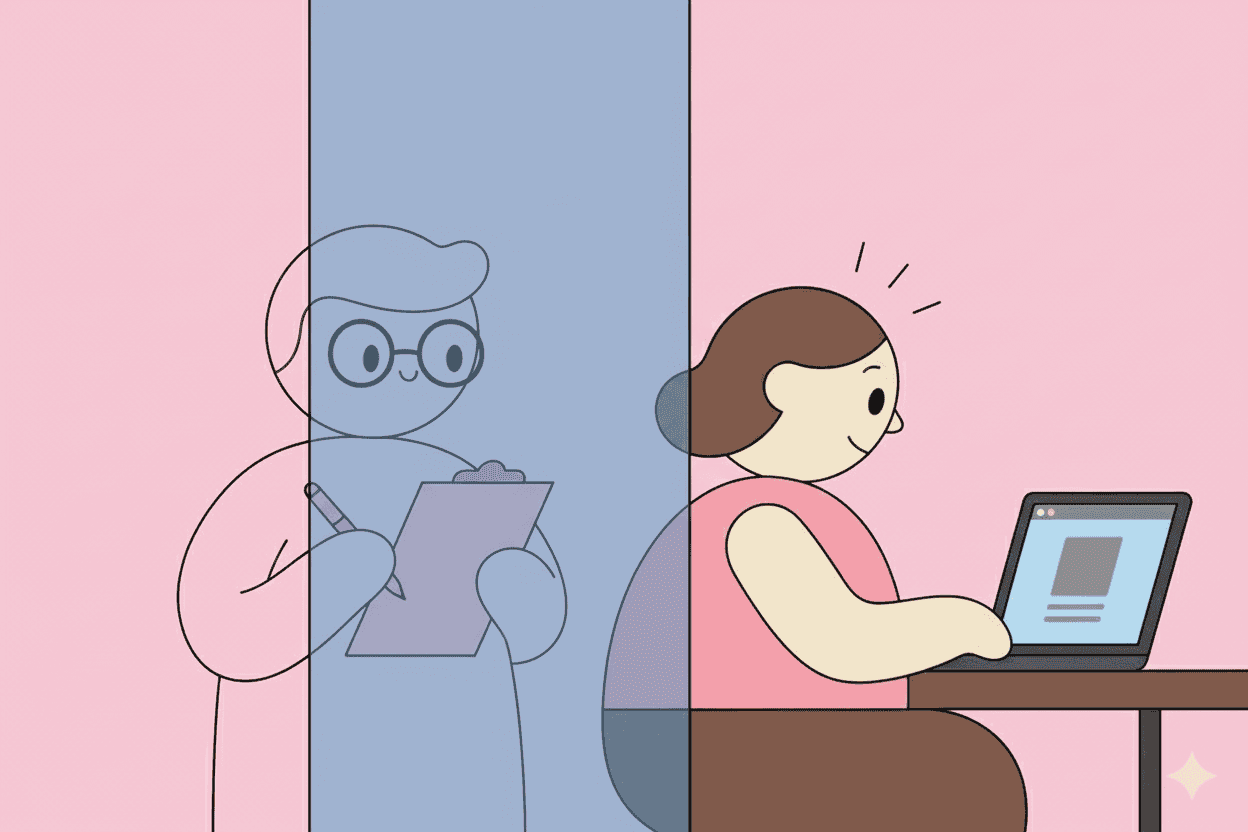
Your UX researcher just invited you to observe a user research session. You're excited—finally, a chance to see real customers interact with your product. But then the anxiety kicks in: What do I actually do during the session? How do I take useful notes? What if I mess something up?
You're not alone. Most product managers, engineers, and stakeholders have never been trained to observe research effectively. Yet organizations where research informs strategy nearly tripled in 2025—jumping from 8% to 22%. More people are watching research than ever before.
This guide will teach you how to be the kind of observer researchers actually want in the room.
TL;DR: Key Takeaways
- Stay invisible: Sit behind the participant, stay silent, and resist the urge to help
- Write everything: One observation per note, include quotes and click-paths
- Never answer questions: Even friendly ones—redirect to the facilitator
- Bring expertise, not opinions: Your job is to notice patterns, not validate assumptions
- Debrief immediately: Insights decay fast—synthesize while memories are fresh
Why Observing User Research Matters
You might wonder: can't I just read the research report later?
You can. But according to Nielsen Norman Group research on stakeholder involvement, there's a massive difference between reading findings and witnessing them firsthand:
"Actually being there while something happens has a bigger impact than seeing a recording after the fact, which itself has higher impact than simply reading about it."
When you observe live research:
- Credibility increases: You've seen how insights are derived, so you believe them
- Buy-in happens naturally: You participated in discovery, so you advocate for action
- Memory sticks: Bullet points fade; watching someone struggle with your feature doesn't
Teams where stakeholders observe research are 2× more likely to report that research influences strategic decisions. That's not correlation—it's the power of direct observation changing how decisions get made.
Before the Session: Preparation Checklist
1. Understand the Research Goals
Ask the researcher:
- What questions are we trying to answer?
- What scenarios will participants complete?
- What should I watch for specifically?
Don't walk in blind. Knowing the goals helps you focus your attention and take relevant notes.
2. Review the Observer Guidelines
Most researchers have a protocol. NN/g's observer guidelines recommend:
- Turning off phone notifications (seriously—do it now)
- Preparing your note-taking materials
- Understanding where to sit and when to stay silent
3. Leave Your Assumptions at the Door
This is the hard part. You've probably already formed opinions about users and features. The whole point of research is to challenge those assumptions.
Enter the room curious, not confirming.
During the Session: The Art of Invisible Observation
Where to Sit
Behind the participant, out of their line of sight. You want to see their screen and body language without becoming part of the experience.
If you're in an observation room watching via screen share, position yourself where you can:
- See the participant's screen clearly
- Hear their verbal feedback
- Take notes without distracting others
The Golden Rules of Observer Behavior
According to NN/g's guidelines for usability research, these rules are non-negotiable:
1. Stay Silent
No laughing (unless they make a joke). No sighing. No whispering. Sound carries, and participants are hypersensitive to audience reactions.
2. Never Answer Questions
This is harder than it sounds. When a participant turns and asks, "Is this button supposed to do that?"—your instinct is to help. Don't.
Instead, say: "I'll be glad to talk with you about that later" and look to the facilitator.
Why? Because your answer introduces information that biases the research. Even a facial expression can signal "you're doing it wrong."
3. Don't Fidget
Your posture, phone checking, even subtle expressions affect participant comfort. If you need to leave, do so quietly between tasks.
4. Type Constantly (If You're Taking Notes)
Ironically, consistent typing is better than sporadic typing. Constant keyboard sounds become background noise; sudden typing signals "they just did something notable" and makes participants self-conscious.
What Researchers Wish You Knew
From years of running sessions, researchers share these observer pain points:
- Don't coach from the sidelines: Your eye contact, nodding, or subtle cues can guide participants toward "correct" behavior
- Resist fixing bugs live: Yes, you know why it broke. Note it for later
- Trust the facilitator: They know what they're doing, even when questions seem obvious
How to Take Notes That Actually Help
Good observation notes are the difference between useful insights and forgotten sessions. Here's how to do it right:
One Observation Per Note
Don't write paragraphs. Each note should capture one discrete observation:
✅ "User hesitated 8 seconds before clicking 'Submit'"
❌ "User seemed confused by the submit process and hesitated before clicking, then looked relieved when it worked and mentioned they expected something different"
Why? Single observations can be sorted and categorized later during synthesis. Paragraphs can't.
What to Write Down
Based on NN/g's notetaking instructions, capture these:
Mistakes and Errors
- "Skipped the 'Company Name' field"
- "Clicked 'Back' instead of 'Cancel'"
Click Paths (Navigation Sequences)
- "Home → Settings → Integrations → Back → Settings → Back (looking for 'API')"
These reveal mental models and navigation expectations.
Quotes (Exact Words)
- "I expected this to work like Notion"
- "Where the hell is the save button?"
Quotes are gold. They're memorable, credible in presentations, and reveal emotional reactions.
Workarounds and Tools
- "Opened calculator app to convert currency"
- "Took screenshot and opened in Paint to annotate"
Workarounds reveal gaps in your product.
Body Language and Hesitation
- "Leaned back, crossed arms after error message"
- "Hovered over 3 buttons before committing"
These moments are invisible in analytics but obvious in person.
Include Context
Mark each note with:
- Scenario/task letter (A, B, C)
- Timestamp or sequence
- Your initials
This helps during synthesis when someone asks "Wait, when did this happen?"
Common Observer Mistakes (And How to Avoid Them)
Mistake 1: Confirmation Bias
You came to prove your feature works. Every success feels validating; every failure feels like an edge case.
Fix: Force yourself to write down both positive and negative observations. Better yet, count them. Are you capturing struggles at the same rate as successes?
Mistake 2: Focusing Only on Your Area
Engineers watch for bugs. Designers watch for UI issues. PMs watch for feature gaps. Everyone misses the big picture.
Fix: Pretend you're responsible for the entire experience. What would a CEO notice?
Mistake 3: Drawing Conclusions Mid-Session
"Clearly users hate the new navigation"—you think this after watching one person struggle.
Fix: Note observations, not conclusions. Synthesis happens after all sessions, with the full team. One user isn't a pattern.
Mistake 4: Checking Slack During "Boring" Parts
Setup and warmup questions seem skippable. They're not. Participants often reveal context ("I usually have my assistant do this") that explains later behavior.
Fix: Close everything except your notes. Be present.
After the Session: Making Observations Count
The most important moment in research isn't the session—it's what happens immediately after.
Debrief While It's Fresh
Memory decays rapidly. What felt obvious during the session becomes fuzzy within hours.
Best practice: Hold a 15-minute debrief immediately after each session:
- What stood out?
- What surprised us?
- What needs follow-up?
Participate in Synthesis
Don't just observe and leave. Join the analysis sessions where observations become insights. Your domain expertise adds context that pure researchers might miss.
According to NN/g research:
"The actual findings will be better when a group with broader expertise helps you analyze the observations."
Share What You Learned
The worst outcome: You watched research, gained empathy, and kept it to yourself.
Share highlights with your team. Quote users in planning meetings. Reference observations in roadmap discussions.
How AI Can Amplify Your Observations
Modern research tools are transforming how teams capture and analyze observations. With 69% of researchers now using AI in their workflows, the technology handles tasks that once consumed hours.
Tools like Pelin can:
- Transcribe sessions automatically so you can focus on watching, not typing
- Synthesize themes across sessions once interviews are complete
- Surface patterns that individual observers might miss
But here's the key finding from the 2026 Future of User Research Report: 82% of researchers say interpreting nuance and emotion remains essential human work that AI can't replicate.
AI handles the mechanical parts—transcription, initial coding, pattern detection. You handle what matters: noticing the sigh before the workaround, the hesitation that signals confusion, the phrasing that reveals mental models.
The best observers use AI to capture more while staying present for what only humans can see.
Building an Observer-Friendly Research Culture
If you're a research lead, make observation easy:
- Send guidelines in advance: Don't assume people know how to observe
- Create viewing options: Some people prefer live; others need recordings
- Make scheduling friction-free: Block calendar holds, send reminders
- Follow up with highlights: Send the best quotes within 24 hours
If you're a product manager or leader, model good behavior:
- Show up: Your presence signals research matters
- Follow the rules: If the CEO stays silent, everyone will
- Reference findings: Cite user observations in decisions
- Push for action: Turn insights into roadmap items
Your First Session: A Quick Checklist
Ready to observe? Here's your pre-session checklist:
- Phone on silent, notifications off
- Note-taking ready (document/paper + pen)
- Know the research goals and scenarios
- Seat picked (behind participant's line of sight)
- Mind open, assumptions parked
- Coffee acquired (silent sipping only)
During the session:
- Write one observation per note
- Capture quotes verbatim
- Note click-paths and navigation
- Record body language and hesitation
- Stay silent unless facilitator asks you directly
After the session:
- Join the debrief
- Share top 3 observations with your team
- Ask how research will inform decisions
Conclusion
Being a good research observer isn't complicated—it's intentional. Stay invisible, write everything, resist the urge to help, and bring your expertise to the synthesis.
The payoff is worth it. Teams that observe research together make better decisions, ship fewer bad features, and build real empathy for their users.
You've read enough reports. It's time to watch.