Most product teams think they have a Voice of Customer program. They don't.
They have a Slack channel where someone occasionally pastes a customer complaint. They have a spreadsheet from Q2 2024 that nobody's touched. They have a quarterly NPS survey that goes to the same 200 customers every time.
That's not a VoC program. That's hope dressed up as process.
Here's the uncomfortable truth: only 14% of companies consider themselves "very effective" at capturing and acting on customer feedback, according to Gartner research. The rest are somewhere between "we try" and "total chaos."
If you want to get serious about customer insight—and actually use it to build better products—you need to understand where you are and where you need to go.
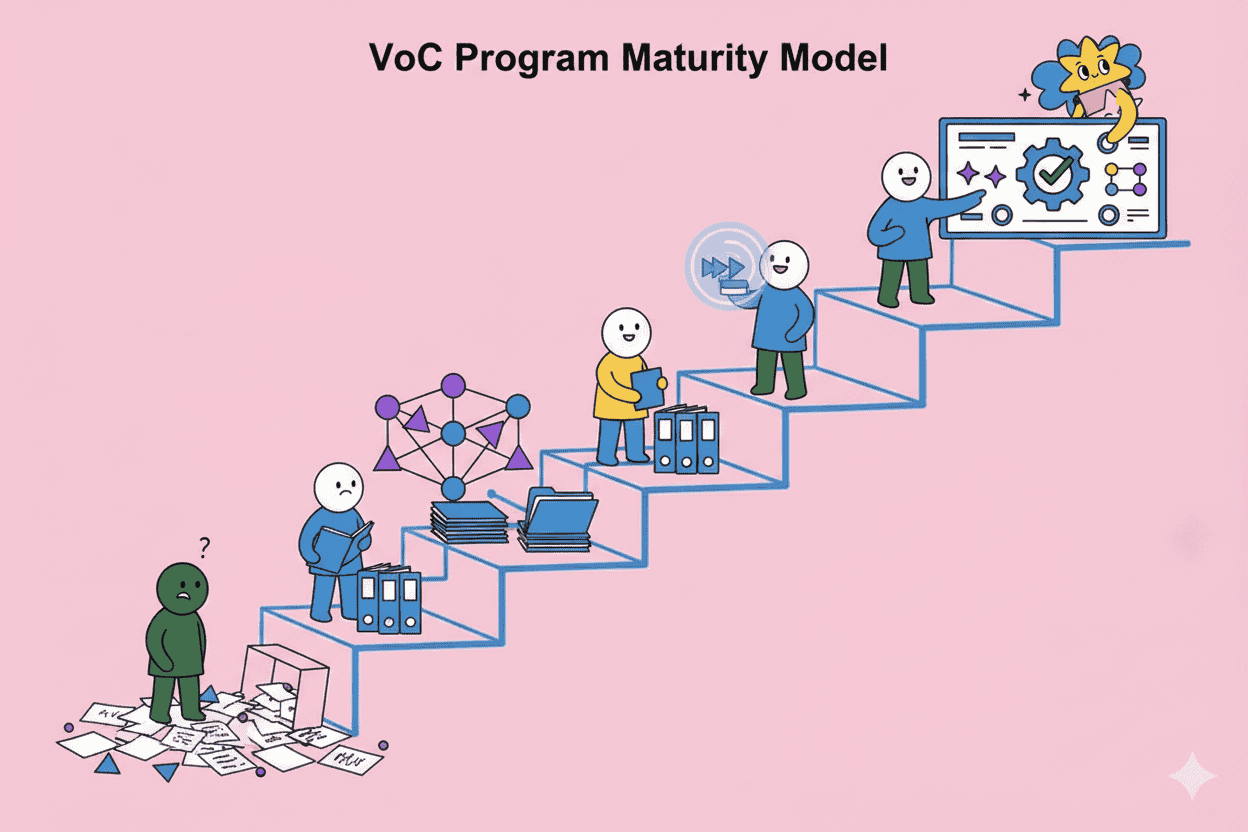
TL;DR: The 5 Stages of VoC Maturity
- Reactive – Feedback happens by accident
- Structured – Defined channels, basic collection
- Integrated – Cross-functional visibility, some analysis
- Predictive – Pattern recognition, proactive insights
- Transformative – Customer intelligence drives strategy
Most teams are stuck between stages 1 and 2. The jump to stage 3 is where real value starts. Let's break each down.
Stage 1: Reactive (The Chaos Stage)
What it looks like
- Customer feedback arrives randomly via email, support tickets, sales calls
- No central repository—insights live in individual inboxes
- The loudest customer complaint drives the roadmap
- Product decisions based on gut feel or whoever talked to a customer most recently
- "Customer research" means that one interview someone did six months ago
The telltale signs
Your PM asks "What do customers think about X?" and three people give three different answers based on anecdotal memory. When a feature ships, you have no idea if it actually solved the problem customers complained about.
Why teams get stuck here
It's the path of least resistance. Collecting feedback properly takes work, and when you're shipping features fast, process feels like overhead.
How to level up
Start with one thing: pick a single source of feedback (support tickets are usually easiest) and create a weekly ritual to review it. Don't try to build infrastructure—build a habit first.
Stage 2: Structured (The Collection Stage)
What it looks like
- Defined channels for feedback: surveys, support inbox, dedicated research calls
- Basic categorization or tagging system
- Someone (usually a PM or researcher) is responsible for collecting feedback
- Regular cadence of customer touchpoints (NPS surveys, user interviews)
- Feedback goes into a central location (spreadsheet, Productboard, Notion)
The telltale signs
You can answer "What are customers saying?" with actual data. There's a process for logging feedback. But converting that feedback into insight? Still manual and inconsistent.
Why teams plateau here
Collection is solved, but analysis isn't. Research from UserTesting shows that 72% of companies collect customer feedback but only 34% have effective processes for analyzing it. The spreadsheet grows, but nobody has time to read it.
How to level up
Start tagging feedback by theme and customer segment. Create a lightweight categorization taxonomy (5-7 categories max). Review themes monthly, not just individual tickets.
Stage 3: Integrated (The Visibility Stage)
What it looks like
- Cross-functional access to customer feedback (CS, Sales, Product, Engineering)
- Feedback linked to specific features, accounts, or customer segments
- Regular insight-sharing rituals (weekly standups, monthly reviews)
- Qualitative and quantitative data combined for decision-making
- Customer quotes and data show up in roadmap discussions
The telltale signs
When engineering asks "Why are we building this?", product can pull up actual customer verbatims in under a minute. Sales knows what features are coming because they see the same feedback driving those decisions.
Why this stage matters
This is where VoC stops being a PM side project and becomes organizational infrastructure. McKinsey found that companies with integrated customer feedback systems see 20-30% improvement in customer satisfaction scores compared to those with siloed feedback.
Common pitfalls
- Feedback access without context leads to cherry-picking
- Too many people tagging creates taxonomy chaos
- Visibility without accountability means insights still get ignored
How to level up
Assign ownership for different feedback streams. Create clear handoff protocols between teams. Institute a "customer evidence required" rule for major roadmap decisions.
Stage 4: Predictive (The Intelligence Stage)
What it looks like
- Pattern recognition across feedback sources and time
- Early warning systems for churn, feature failure, or emerging needs
- Segmentation analysis shows how different customer types experience problems
- Proactive identification of opportunities (not just problems)
- Feedback influences strategy before problems become urgent
The telltale signs
You spot the churn signal before the customer cancels. You identify the friction point before support tickets spike. Your product team surfaces opportunities customers haven't explicitly asked for yet—because you understand the underlying jobs-to-be-done.
Why most teams never get here
This requires two things most teams lack: consistent historical data and the analytical capacity to find patterns in it. According to Forrester, only 17% of firms have reached predictive maturity in their customer intelligence programs.
Manual analysis simply doesn't scale to this level. When you're processing hundreds of support tickets, interview transcripts, sales call notes, and survey responses, human pattern recognition hits a wall.
How AI changes the game
This is where AI-powered tools become genuinely valuable—not as a replacement for human judgment, but as a pattern recognition layer that humans can't replicate at scale.
Tools like Pelin can process thousands of feedback data points, identify emerging themes before they become obvious, and surface the connections between disparate customer signals that would take a human analyst weeks to find. The AI handles the "needle in haystack" problem; your team handles the "so what do we do about it" judgment call.
How to level up
Start connecting feedback data to outcome data. When did customers who churned start expressing frustration? Which feature requests correlate with expansion? Build the longitudinal view.
Stage 5: Transformative (The Strategy Stage)
What it looks like
- Customer intelligence directly shapes company strategy
- Predictive models inform resource allocation and market positioning
- Closed-loop systems automatically validate whether changes worked
- Customer insight is a competitive advantage, not just an operational function
- VoC informs product development before the roadmap exists
The telltale signs
Your board meetings include customer intelligence as a strategic input, not just a satisfaction metric. Product strategy starts with "Here's what our customer intelligence tells us about the market" rather than "Here's our roadmap."
Why this is rare
Because it requires executive sponsorship, data infrastructure, analytical capabilities, and organizational alignment. Qualtrics research shows only 8% of enterprises have achieved this level of customer intelligence maturity.
What it takes
- Dedicated customer intelligence function (not a side job for PMs)
- Integration between VoC data, product analytics, and business outcomes
- C-suite commitment to evidence-based decision making
- Technology stack that enables real-time insight synthesis
How to Assess Your Current Stage
Answer these questions honestly:
Feedback Collection
- Can anyone access customer feedback from one central place? (No = Stage 1)
- Is feedback categorized and tagged consistently? (No = Stage 2)
- Can you filter feedback by customer segment, feature area, or time period? (No = Stage 2-3)
Feedback Analysis
- Do you regularly identify themes across feedback sources? (No = Stage 2)
- Can you spot emerging issues before they become widespread? (No = Stage 3)
- Do you connect feedback patterns to business outcomes? (No = Stage 4)
Feedback Action
- Do roadmap decisions require customer evidence? (No = Stage 2-3)
- Is there a closed loop between feedback → decision → outcome measurement? (No = Stage 3-4)
- Does customer intelligence influence strategy beyond product? (No = Stage 5)
Organizational Integration
- Do non-product teams have access to customer insights? (No = Stage 2)
- Is there cross-functional ownership of customer feedback? (No = Stage 3)
- Does customer intelligence have executive sponsorship? (No = Stage 4-5)
The Realistic Path Forward
Jumping from Stage 1 to Stage 5 isn't realistic. Here's a practical roadmap:
Stage 1 → Stage 2 (3-6 months)
- Pick your primary feedback channel and create a collection process
- Set up a central repository (Notion, Productboard, even a spreadsheet)
- Establish a weekly review ritual—30 minutes, same time each week
- Create a basic tagging system (start with 5 categories max)
Stage 2 → Stage 3 (6-12 months)
- Expand access to feedback across product, engineering, CS
- Link feedback to specific features and customer segments
- Institute monthly cross-functional insight reviews
- Create documentation standards so insights have context
Stage 3 → Stage 4 (12-24 months)
- Invest in tooling that enables pattern recognition at scale
- Build historical views to spot trends over time
- Connect feedback data to outcome data (churn, expansion, adoption)
- Create early warning indicators based on feedback patterns
Stage 4 → Stage 5 (24+ months)
- Get executive sponsorship for customer intelligence function
- Integrate VoC with strategic planning processes
- Build closed-loop measurement systems
- Develop predictive capabilities that inform market strategy
Key Takeaways
-
Most teams overestimate their maturity. Having surveys and a Slack channel isn't Stage 3—it's barely Stage 2.
-
Collection without analysis is just hoarding. The goal isn't to have more feedback; it's to have better insight.
-
Stage 3 is the inflection point. This is where VoC becomes a genuine competitive advantage rather than an operational checkbox.
-
AI accelerates Stage 3 → 4. Manual analysis can't scale to predictive intelligence. Tools that synthesize patterns across thousands of data points unlock the next level.
-
Organizational change is harder than technical change. The biggest barrier to VoC maturity isn't tools—it's getting the whole company to actually use customer intelligence.
Where Pelin Fits
If you're at Stage 2-3 and trying to reach Stage 4, you're facing the classic scaling problem: too much feedback, not enough time to analyze it, and no way to spot patterns before they become obvious.
Pelin is built specifically for this transition. It aggregates feedback from wherever your customers talk (support tickets, sales calls, reviews, surveys), automatically identifies themes and trends, and surfaces the insights that matter before you have to go digging.
Think of it as upgrading from a spreadsheet to actual intelligence—without hiring a team of analysts to make it happen.
The VoC maturity model isn't about buying software. It's about building organizational capability. But the right tools make that capability possible at a scale human analysis alone can't reach.
Want to see where your feedback patterns actually point? Try Pelin free and find out what your customers have been trying to tell you.