Something fundamental is shifting in how software works. And if you're a product manager still obsessing over button placement and dashboard layouts, you might be optimizing for the wrong things.
This week, a thought-provoking piece from Corlytics dropped a truth bomb on the PM community: "We're stepping into an era where the interface isn't the product — the interaction is." Meanwhile, analysis from AI Spaces argues that traditional SaaS interfaces are becoming "translation layers" that will increasingly be bypassed by AI agents acting on users' behalf.
The numbers back this up. Salesforce's Agentforce handled over 380,000 customer support interactions and resolved 84% without human involvement. Intercom's AI agent Fin resolves support tickets at $0.99 per resolution compared to roughly $30 when humans handle it.
But here's what most people are missing in this conversation: if interfaces become irrelevant, customer feedback becomes everything.
The Interface Was Never the Point
Let's be honest about what software interfaces actually do. Every dropdown, every filter, every dashboard — they're all translation mechanisms. They translate human intent into machine-executable actions.
You want to find your highest-value customers who haven't purchased in 90 days? That's a simple goal. But to execute it, you navigate through menus, set date ranges, apply filters, maybe export to a spreadsheet, then cross-reference with another system.
The interface forces you to decompose your intent into a sequence of clicks the software can understand.
AI agents flip this entirely. You state your goal. The agent figures out the rest. As the Corlytics analysis puts it: "If users can simply ask for what they want, then the future of product management isn't about writing requirements that age faster than milk, it's about shaping systems that learn, adapt and respond in real time."
So What Actually Matters?
If interfaces are becoming commodity infrastructure — important but increasingly invisible — what becomes the competitive differentiator?
Understanding what users actually want.
Not what they click on. Not what features they request. What they're actually trying to accomplish. Their underlying jobs-to-be-done. The problems keeping them up at night. The outcomes they're willing to pay for.
This is where customer feedback transforms from "nice to have" to existential necessity.
Think about it: when an AI agent is designed to complete tasks on a user's behalf, the entire system's value depends on correctly interpreting user intent. Get the intent wrong, and the agent does the wrong thing — potentially at scale, potentially irreversibly.
The Three Levels of Customer Understanding
Most product teams operate at Level 1. The winners in the agent era will operate at Level 3.
Level 1: Feature Requests "Users are asking for dark mode." "We need a Slack integration." "Customers want faster load times."
This is surface-level feedback. It tells you what users think they want, not why they want it. And in a world where interfaces matter less, these requests become almost meaningless. Who cares about dark mode when the UI becomes a control panel that users rarely touch?
Level 2: Problem Statements "Users are struggling to find relevant information quickly." "Teams can't collaborate effectively across time zones." "Decision-makers lack confidence in the data they're seeing."
This is better. You're starting to understand the actual problems. But you're still hearing them filtered through users' assumptions about solutions.
Level 3: Intent and Outcome Patterns "Users need to answer 'which customers are at risk of churning?' within 30 seconds." "Teams need shared context on customer health without scheduling calls." "Executives need to explain revenue changes to the board with confidence."
This is where the gold is. These are the intents that AI agents will need to execute against. These are the outcomes that determine whether your product delivers value or becomes infrastructure for someone else's agent.
Why Traditional Feedback Methods Fail
Here's the problem: most companies collect feedback through methods optimized for Level 1 understanding.
Feature voting boards? They aggregate feature requests. Helpful for prioritization, useless for understanding intent.
NPS surveys? They tell you how likely someone is to recommend you, but not why or what they're trying to do.
Customer interviews? Valuable, but they don't scale. And by the time you've talked to 20 customers, the market has shifted.
Support tickets? They capture complaints, not goals.
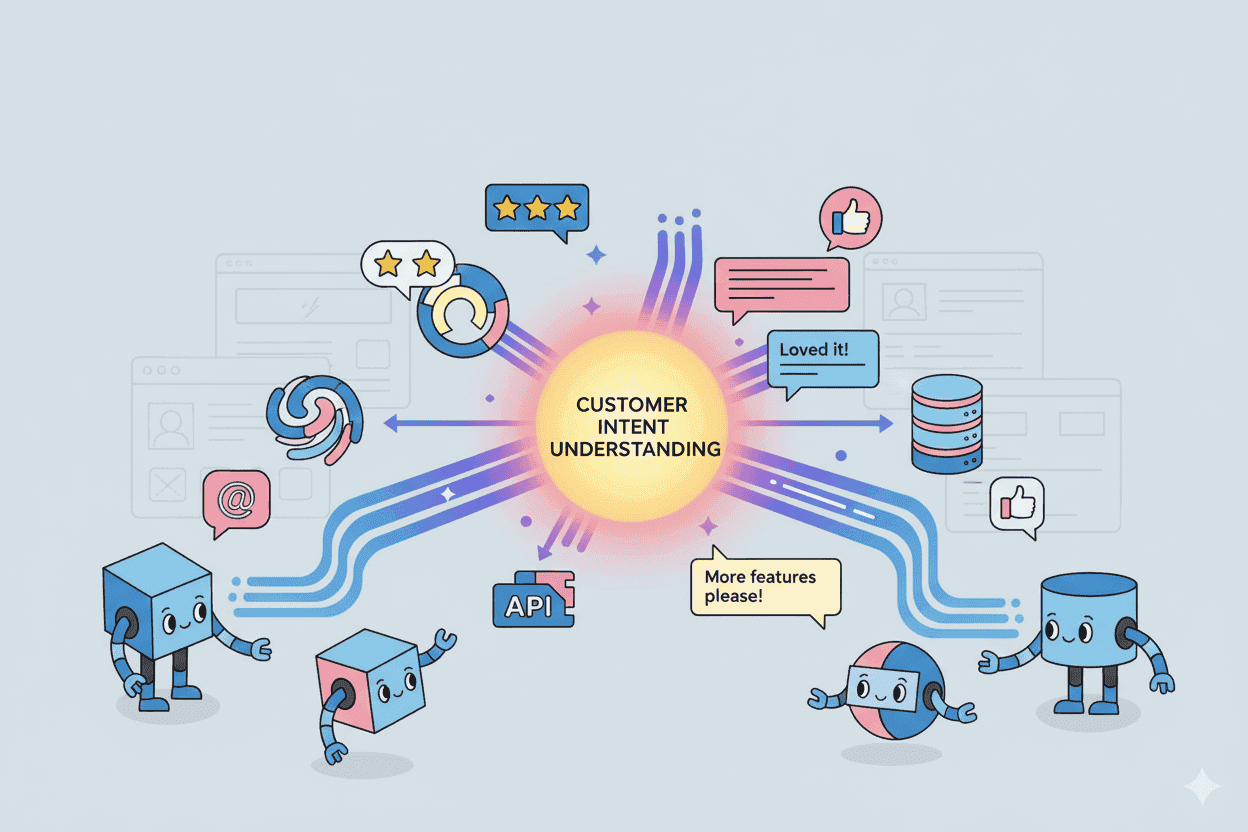
What you need is systematic capture and analysis of customer intent signals across every touchpoint. Every support conversation contains clues about what users are trying to accomplish. Every usage pattern reveals implied goals. Every piece of feedback — positive or negative — carries information about customer jobs-to-be-done.
The companies that can extract intent patterns from this noise at scale will design better agent experiences. The ones that can't will watch their products become commoditized infrastructure.
The New PM Playbook
The Corlytics piece asks a pointed question: "Is the PM role that is slowing things down, or is it our mindset that can't keep up with the velocity of change?"
Here's what the new playbook looks like:
From designing workflows to designing behaviors. Stop mapping user journeys through your interface. Start mapping the outcomes users need to achieve and the contexts that trigger those needs.
From optimizing interfaces to optimizing intent handling. Your success metric isn't time-to-complete-a-task anymore. It's how accurately your system interprets what users actually want to accomplish.
From managing features to managing autonomous execution. Features are implementation details. What matters is the portfolio of user intents your product can reliably fulfill.
From point-in-time feedback to continuous intent learning. Quarterly surveys are archaeology. You need real-time understanding of how customer needs are evolving.
What This Means for Your Roadmap
If you're building B2B software today, here are the questions your roadmap should answer:
-
What customer intents can our product fulfill? Not features — intents. "Generate a weekly report on customer engagement" is an intent. "Report builder" is a feature.
-
How accurately do we interpret those intents? When a user states a goal, how often does your system (current or future agent-enabled) deliver the right outcome?
-
What intent gaps exist? Where are customers trying to accomplish goals your product can't handle? These are your real opportunities.
-
How are intents shifting? Customer needs evolve. Are you detecting those shifts in real-time, or discovering them six months later in a lost customer post-mortem?
The Feedback Infrastructure You Need
To compete in the agent era, you need feedback infrastructure that captures and synthesizes intent signals at scale:
Cross-channel aggregation. Customer intent signals are scattered across support tickets, sales calls, product analytics, NPS comments, social mentions, and community forums. You need to pull these together.
Pattern extraction. Individual data points are noise. You need to identify recurring themes across hundreds or thousands of signals to surface true intent patterns.
Trend detection. New customer needs emerge constantly. Your feedback system needs to surface emerging patterns before they become obvious — and before competitors spot them.
Actionable synthesis. Data is worthless without insight. You need feedback translated into specific product decisions: which intents to prioritize, which outcomes to optimize, which gaps to close.
This is why AI-powered customer feedback analysis isn't a nice-to-have anymore. It's infrastructure for surviving the agent transition.
The Bottom Line
The pundits are right that SaaS interfaces are becoming less important. What they're missing is the corollary: customer intent understanding is becoming more important.
When your beautiful UI becomes a rarely-visited control panel, when AI agents complete tasks users used to do manually, when the experience layer gets commoditized — what's left?
Your ability to understand what customers actually want. Your capacity to interpret intent accurately. Your speed at adapting to shifting customer needs.
That's not a feature. That's not a technology. That's an organizational capability built on systematic customer feedback analysis.
The companies that build this capability now will design the agent experiences of tomorrow. The ones that don't will spend the next five years wondering why their product became infrastructure for someone else's success.
Your interface isn't your moat anymore. Your customer understanding is.
Ready to transform scattered customer feedback into actionable insights? See how Pelin helps product teams understand customer intent at scale →