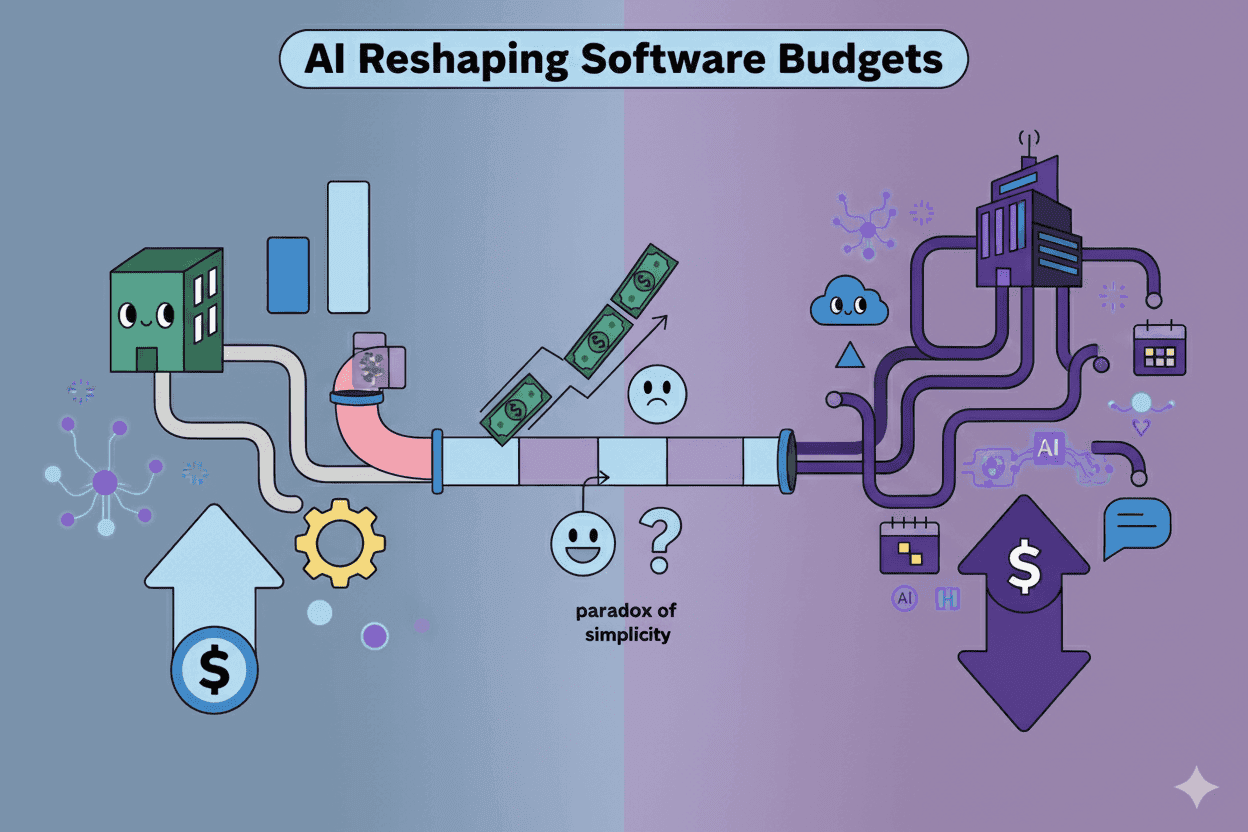
Everyone's talking about AI killing SaaS. The narrative is simple: AI agents will automate away the need for specialized software, budgets will collapse, and the golden age of enterprise software will end.
But new data tells a completely different story.
YipitData's latest analysis of B2B spending patterns reveals something surprising: AI early adopters are reshaping their software budgets in counterintuitive ways. And the patterns expose a fundamental truth about what product teams should be building right now.
The Data That Defies the Narrative
YipitData analyzed spending patterns among "AI Early Adopters"—mid-market and enterprise companies with outsized spend on AI vendors like OpenAI, Anthropic, Anysphere, and Perplexity AI. They compared these companies' software allocation against the broader market.
The findings challenge everything you've heard about AI disrupting software.
Mid-market AI adopters are cutting project management software by 50%. Companies like Asana, Atlassian, and Monday.com are seeing dramatic reductions in budget share among smaller AI-forward companies. Meanwhile, the rest of the mid-market panel only cut PM allocation by ~20%.
But here's where it gets interesting.
Enterprise AI adopters are expanding PM software spend. The exact opposite pattern. Large companies deploying AI at scale are spending more on coordination and project management tools, materially outpacing their peers.
Same technology. Opposite behaviors. What's going on?
The Coordination Paradox
YipitData's hypothesis is illuminating: "Rather than reducing the need for PM software, AI has expanded the need for software that aids coordination among enterprises."
In other words, AI implementation creates efficiency gains—but it also creates operational complexity. As organizations deploy AI across more workflows, they need more visibility into what's happening, not less. The need for cross-functional orchestration increases, even as individual tasks become automated.
This is the coordination paradox of AI adoption.
For small companies, the calculus is simple. AI handles more tasks, so you need fewer tools to manage work. But for enterprises with hundreds of teams and thousands of workflows, AI introduces new dependencies, new handoffs, and new integration points. The complexity doesn't shrink—it shifts.
Customer Support: The Bear Case That Didn't Happen
The AI disruption narrative has been particularly aggressive about customer support software. The thesis: AI agents will replace human support, eliminating the need for Zendesk, Intercom, Five9, and their ilk.
The data says otherwise.
Mid-market AI early adopters actually expanded their customer support software spend, even as the rest of the market pulled back. YipitData notes this could reflect higher-growth companies with greater demand—but the key insight is that AI adoption hasn't translated into reduced support tooling.
Why? Because AI changes how support happens, not whether it happens.
Companies still need to understand why customers are frustrated. They still need to identify patterns across tickets. They still need to route complex issues to the right people. AI can augment all of this, but it doesn't eliminate the fundamental need to manage customer relationships.
What This Means for Product Teams
If you're a product manager watching these trends, the implications are significant:
1. Don't Build for "AI Will Replace This" Paranoia
The market has been flooded with hot takes about which software categories AI will obliterate. Project management! Customer support! GTM tools!
But actual spending data shows a more nuanced picture. Categories that seem vulnerable to automation are surviving—and in some segments, thriving. The companies cutting spend are doing so selectively, based on their specific context, not because AI has rendered entire categories obsolete.
If you're building in one of these "threatened" categories, the sky isn't falling. But you do need to understand exactly what value you're providing that AI can't replicate.
2. Build for the Complexity AI Creates
Here's the counterintuitive opportunity: AI adoption creates new problems that need solving.
As YipitData's enterprise data shows, companies deploying AI at scale need more coordination tooling. They need better visibility across workflows. They need to understand how AI-augmented processes are performing versus expectations.
The companies that build for this emerging complexity—not against it—will find expanding markets rather than shrinking ones.
3. Double Down on Understanding, Not Automation
The spending patterns reveal something crucial: the categories holding value are those that help companies understand their customers.
Customer support software isn't being gutted because companies still need to know what customers are experiencing. The tools that surface patterns, identify trends, and connect feedback to product decisions are holding their value—even as transactional automation accelerates.
This is where customer insight platforms like Pelin come in. The job isn't to automate away customer understanding—it's to make understanding scalable.
The Real Question Product Teams Should Ask
When you're deciding what to build next, the question isn't "Will AI replace this?"
The better questions:
"Does this feature help our customers understand something they couldn't before?"
Features that create new understanding—that surface patterns, connect dots, and reveal insights—are durable. They don't compete with AI; they become more valuable as AI creates more data and complexity to parse.
"Does this feature help our customers coordinate better?"
The enterprise data is clear: AI adoption increases coordination needs. Tools that help teams align, prioritize, and move in the same direction become more valuable, not less, as AI accelerates individual productivity.
"Does this feature rely on context only our customers have?"
AI is powerful, but it's generic. It doesn't know your customer's specific industry, competitive landscape, or strategic priorities. Features that leverage proprietary context—customer feedback, usage patterns, historical decisions—create defensible value.
From Automation Anxiety to Strategic Clarity
Here's the shift that matters for product teams: stop thinking about AI as a replacement threat and start thinking about it as a context multiplier.
AI makes it easier to build. It makes it faster to ship. It makes it cheaper to automate routine tasks.
But it doesn't make it easier to decide what to build.
In fact, as the YipitData analysis suggests, AI adoption often makes decision-making harder. More workflows mean more data. More automation means more dependencies. More efficiency means higher stakes when you build the wrong thing.
The winners in this environment won't be the teams with the most sophisticated AI integrations. They'll be the teams with the clearest understanding of what their customers actually need.
The Customer Insight Moat, Revisited
We've written before about customer understanding as the only sustainable moat. The YipitData findings reinforce this thesis with hard spending data.
The software categories holding value share a common trait: they help companies understand and serve customers better. The categories seeing cuts are those that automated generic tasks without providing strategic insight.
For product teams, the path forward is clear:
Invest in understanding your customers—not just building features.
The teams that know why users behave the way they do, what problems are emerging before they become churn events, and how their product fits into customers' evolving workflows will make better decisions. Every time.
AI can help you build anything. But it can't tell you what's worth building.
That insight still comes from your customers—if you're listening.
Putting This Into Practice
So how do you actually shift from automation anxiety to customer-centric clarity?
Consolidate your feedback channels. If your customer insights are scattered across Slack, Zendesk, Intercom, and a forgotten spreadsheet, you're not getting the full picture. The patterns that matter often span multiple channels.
Make feedback searchable. Your PMs shouldn't have to remember that "someone mentioned that thing six months ago." Customer insights should be as searchable as your codebase.
Connect insights to decisions. When you ship a feature, you should be able to trace it back to the customer feedback that justified it. When you cut scope, you should know what you're trading off.
Measure what you're learning. Most teams track velocity, story points, and release cadence. How many track the quality and volume of customer insights informing their roadmap?
The companies that build these capabilities—whether through tools like Pelin or their own systems—will navigate the AI transition successfully. Not because they avoided automation, but because they invested in the one thing AI can't automate: genuine customer understanding.
The data is clear. The opportunity is here. The question is whether your team is building for it.