Something interesting is happening in enterprise software. After a decade of "there's a SaaS for that," companies are quietly building their own tools again—especially when it comes to AI.
And nowhere is this shift more pronounced than in product management.
The Great Unbundling of Product Tools
If you're a PM in 2026, you probably use somewhere between 8 and 15 different tools. Analytics here. Feedback there. User research in one place. Feature requests in another. Customer support tickets? That's a whole different system.
You've become an integration architect whether you wanted to or not.
The promise of SaaS was simple: specialized tools that do one thing really well. But the reality? Fragmented customer insights scattered across a dozen dashboards, none of which talk to each other in meaningful ways.
According to recent research from Gartner, 65% of companies are now using hybrid AI architectures that combine commercial APIs with internal models and tools. Even more telling: 41% cited a lack of flexibility or customization options as the primary reason for switching from purchased AI to in-house development.
Translation: the tools aren't fitting the workflow. And product teams are done pretending they do.
Why Customer Insights Hit Different
Not all software categories are equal when it comes to the build vs. buy question. Your accounting software? Buy it. Your email marketing platform? Probably buy it.
But customer insights? That's where the calculus changes.
Here's why: customer feedback isn't just data. It's context. It's the frustrated support ticket from your biggest enterprise customer. It's the offhand comment in a user interview that reveals a completely misunderstood feature. It's the pattern hiding in 10,000 NPS responses that no pre-built dashboard will ever surface.
Generic tools treat all feedback equally. But your product isn't generic. Your customers aren't generic. And the insights that drive your roadmap shouldn't be either.
ClickUp learned this lesson recently. The productivity platform, with 14 million users, evaluated wave after wave of AI providers for their go-to-market operations. None offered the right integrations or consistency. So they built their own—six custom AI tools connected to Salesforce, Zendesk, and Snowflake. The result: hundreds of automated work hours per week and $200,000 less in annual automation spending.
The Three Stages of Progressive Internalization
You don't have to go full DIY overnight. Forrester has identified what they call "progressive internalization"—a phased approach that leads to sustainable AI ROI 60% faster than jumping straight into building everything yourself.
Stage 1: Experimentation Start with pre-built APIs and SaaS platforms. Validate the value. Get some wins on the board. This is where most teams are today—using off-the-shelf tools to prove that AI-powered insights actually move the needle.
Stage 2: Extension Combine vendor APIs with your own orchestration layers. Add light customization. Connect your internal data sources in ways the vendor never anticipated. This is the "glue phase"—making external tools work for your specific context.
Stage 3: Build Launch your own fine-tuned models on your own infrastructure. Research suggests this can reduce costs by up to 40% while transforming what was once a commodity tool into a genuine competitive advantage.
The key insight: you don't have to pick a lane forever. The smartest teams design systems that can evolve.
What This Means for Product Teams
Let's get practical. If you're running product at a growth-stage company, here's what the build vs. buy shift means for how you handle customer insights:
1. Audit Your Insight Stack
How many tools touch customer feedback right now? List them. Seriously, go count. Now ask: how much time do you spend copying data between them? How many insights die in the gaps?
If the answer makes you uncomfortable, you're not alone.
2. Identify Your Integration Bottlenecks
Where does context get lost? Usually it's in the handoffs. Support knows something product doesn't. Sales heard objections that never made it into a feature request. User research findings sit in documents nobody reads.
The tools aren't bad. The silos are.
3. Consider the Hybrid Path
You don't need to build a custom AI platform from scratch. What you might need is a single layer that connects your existing tools—something that can synthesize across sources, maintain context, and surface patterns you'd never find manually.
This is increasingly what modern AI-powered insight tools do. They don't replace your existing stack; they orchestrate it.
4. Calculate the Real Cost of Fragmentation
Here's a number most PMs don't track: how many hours per week do you spend gathering context instead of acting on it?
For many teams, it's 30-40% of their time. Reading through tickets. Cross-referencing requests. Trying to remember what that customer said three months ago.
What would you build if you got that time back?
The Governance Question
Before you get too excited about building everything yourself, a reality check from Sam Altman's recent warnings: we're entering a "fast-fashion era of SaaS replacement"—an explosion of inexpensive, single-purpose tools that prioritize speed over quality.
The risks are real:
- AI-generated code without proper review has 1.7 times more errors
- 42% of companies cite insufficient technical resources as their biggest barrier
- 35% of organizations haven't established AI productivity metrics
You can't prove the ROI of what you don't measure.
The answer isn't to avoid building entirely. It's to build thoughtfully. Use managed platforms where security and governance come built-in. Measure everything. And resist the temptation to ship fast without testing properly.
The New Question: Where Do You Need Control?
The old debate was binary: build or buy. The 2026 framework is more nuanced:
Buy when you're paying for decades of edge cases, testing, and availability expectations. Accounting software. Email infrastructure. The boring stuff that just needs to work.
Build when capability is your competitive advantage. Your AI co-pilot. Your decision support systems. The insights that tell you what to build next.
Hybrid when the core functionality is standard, but your workflows and integrations are unique.
For most product teams, customer insights fall squarely into hybrid territory. You don't need to reinvent the wheel on data collection. But you absolutely need control over how that data connects, what patterns get surfaced, and how insights flow into your actual decision-making process.
The Future Is Orchestration
The companies winning with AI in 2026 aren't defined by what they own. They're defined by how well they orchestrate.
McKinsey's State of AI research found that organizations embedding AI directly into decision-making processes—rather than treating it as a mere analytics add-on—are almost three times more likely to create measurable value.
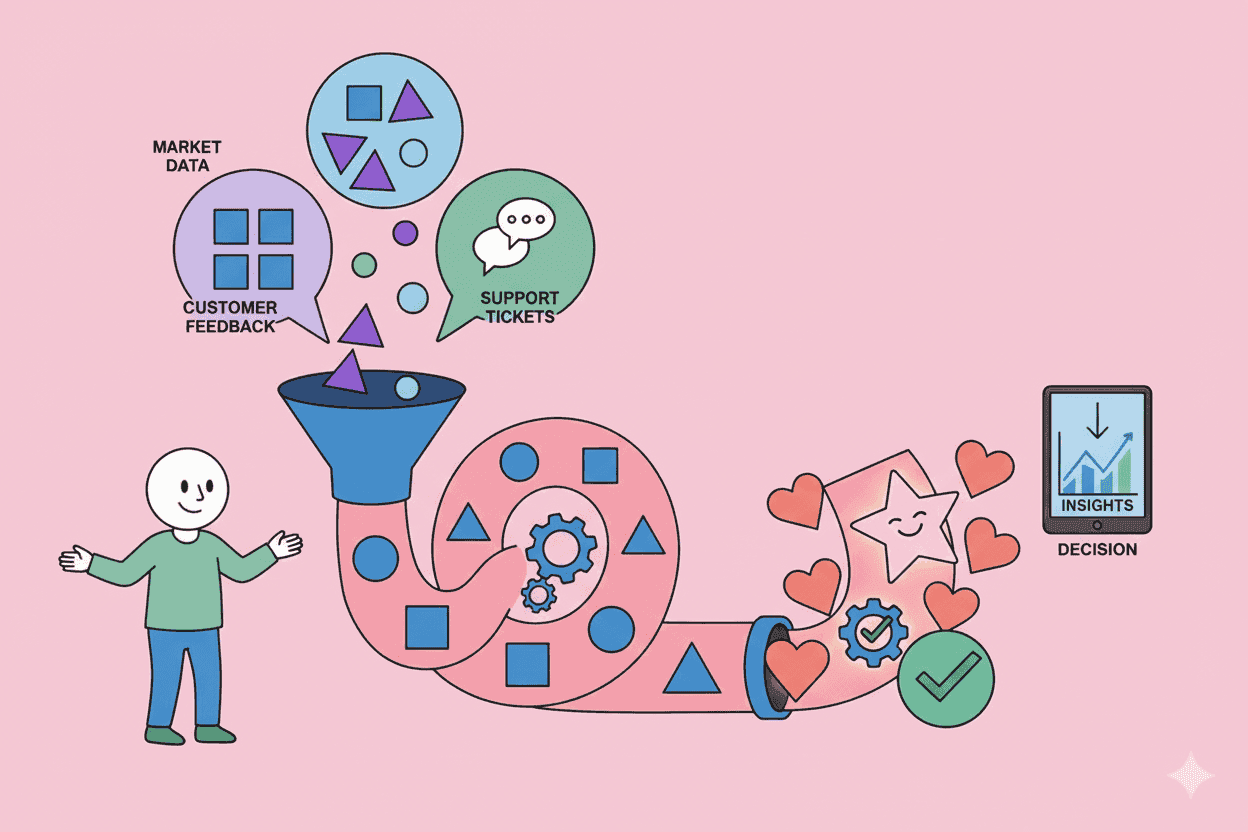
The product teams getting ahead aren't drowning in 15 different dashboards. They're not spending half their week gathering context. They're using AI to synthesize customer insights across every source—support tickets, user interviews, feature requests, churn data, behavioral analytics—into a single, coherent view of what their customers actually need.
Then they're acting on it.
Taking the Next Step
If your current insight stack feels like it's working against you instead of for you, you're probably right. The fragmentation isn't a feature—it's a historical accident of how SaaS evolved.
The good news: you don't have to live with it.
Whether you build, buy, or (most likely) take a hybrid approach, the goal is the same: get closer to your customers without drowning in logistics. Surface the patterns that matter. And make better product decisions, faster.
The tools are finally catching up to what product teams actually need. The question is whether you'll use them.
Pelin helps product teams turn scattered customer feedback into clear product direction. No more context-switching between tools—just insights that drive your roadmap. See how it works →