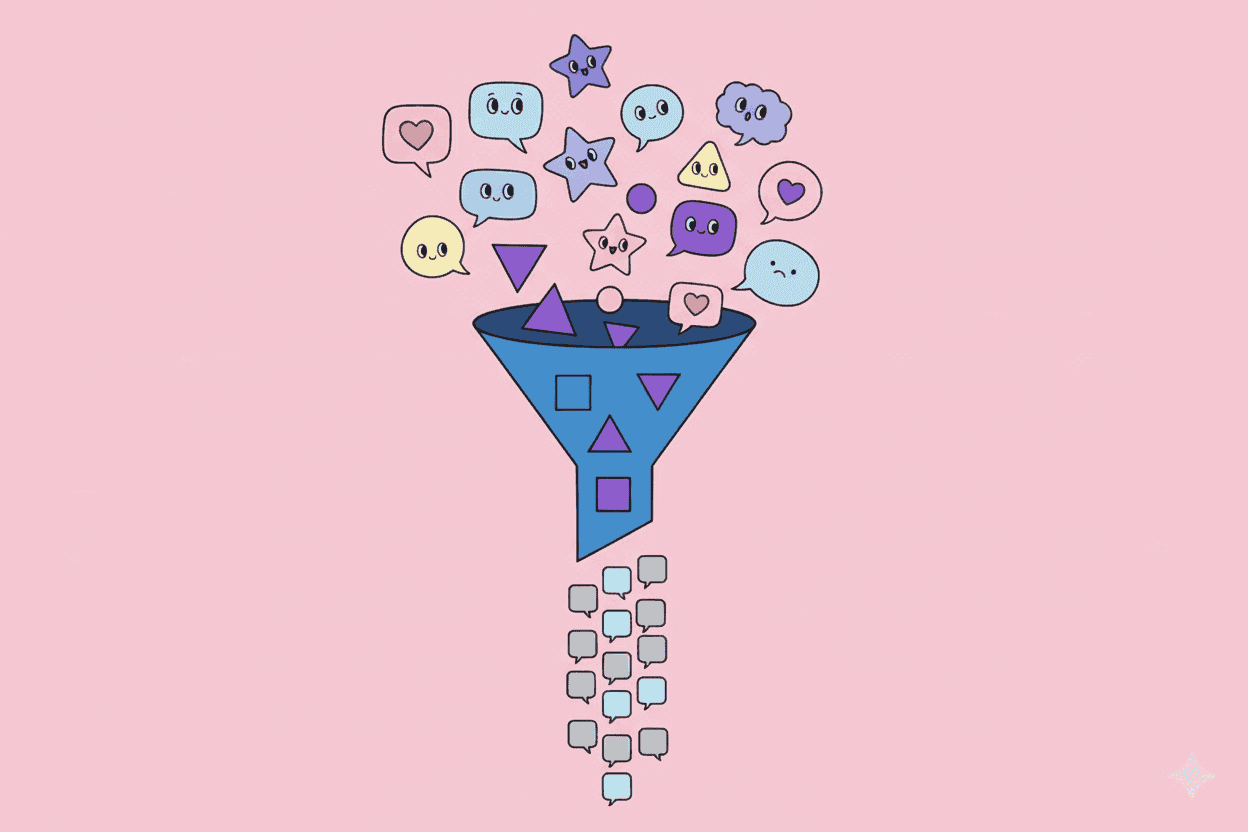
You're collecting customer feedback. That's good. But here's the uncomfortable truth: most of that feedback is distorted before it ever reaches your product roadmap.
Bias creeps into every stage of the feedback process—from who you talk to, to what questions you ask, to how you interpret the answers. According to research from McKinsey, cognitive biases affect decision-making in predictable, measurable ways, and product teams are not immune.
The result? Teams build features nobody wants. They miss critical problems. They optimize for the wrong customers. All while believing they're being "data-driven."
Let's fix that.
Why Bias in Customer Feedback Matters
When feedback is biased, your product decisions become biased. Simple as that.
A study published in the Harvard Business Review found that organizations often make significant investments based on flawed assumptions—assumptions that feel validated because they collected "data" to support them. The problem isn't lack of data; it's contaminated data.
The real cost of biased feedback:
- Building features for vocal minorities, not your actual user base
- Missing churn signals because unhappy customers don't speak up
- Prioritizing problems that sound urgent but aren't widespread
- Confirming what you already believed instead of discovering what's true
TL;DR: The 8 Biases and Quick Fixes
| Bias Type | What It Is | Quick Fix |
|---|---|---|
| Survivorship Bias | Only hearing from customers who stayed | Interview churned customers |
| Selection Bias | Talking to unrepresentative samples | Stratified sampling |
| Social Desirability Bias | Customers telling you what you want to hear | Ask about past behavior, not opinions |
| Confirmation Bias | Hearing what validates your beliefs | Have someone else analyze data |
| Recency Bias | Overweighting recent feedback | Track feedback over time |
| Loudness Bias | Prioritizing vocal customers | Weight feedback by segment value |
| Leading Question Bias | Questions that suggest answers | Use neutral, open-ended questions |
| Interpretation Bias | Seeing patterns that match your agenda | Blind analysis techniques |
Now let's dig into each one.
1. Survivorship Bias: The Silent Majority You Never Hear
What it is: You only collect feedback from customers who are still using your product. The ones who left? They took their insights with them.
Why it's dangerous: Your current users are, by definition, people who found enough value to stay. They represent the successes, not the failures. When you only listen to survivors, you optimize for people who would have stayed anyway—while remaining blind to why others left.
According to Bain & Company research, companies typically hear from less than 4% of dissatisfied customers. The other 96% just leave quietly.
Real example: A B2B SaaS company surveyed their power users about what features to build next. Users overwhelmingly requested advanced customization options. The company invested six months building them. Churn continued because the actual problem—a confusing onboarding experience—was only visible in the users who never became power users in the first place.
How to fix it:
- Implement exit interviews as a standard process
- Survey recently churned customers within 7 days of cancellation
- Track feedback from trial users who don't convert
- Compare feedback patterns between retained and churned segments
2. Selection Bias: Your Sample Isn't Your Population
What it is: The customers you talk to aren't representative of your entire user base.
Why it's dangerous: If you interview customers who respond to interview requests, you're selecting for a specific personality type—people who have time, who enjoy giving feedback, who feel strongly enough to participate. That's not everyone.
Research published in the Journal of Consumer Research consistently shows that survey respondents differ systematically from non-respondents in ways that affect the conclusions you can draw.
Common selection bias traps:
- The squeaky wheel problem: Customers who submit support tickets are often frustrated or power users—not your median user
- The friendly customer problem: People who agree to interviews tend to like you more than average
- The accessibility problem: Enterprise customers with dedicated success managers get heard more than SMB customers
How to fix it:
- Use stratified sampling across customer segments (plan tier, tenure, industry, company size)
- Actively recruit feedback from quiet customers, not just those who volunteer
- Compare feedback sources: Are support ticket themes different from survey themes?
- Weight responses by segment size when aggregating
3. Social Desirability Bias: They're Being Polite, Not Honest
What it is: Customers tell you what they think you want to hear, or what makes them look good—not what they actually think or do.
Why it's dangerous: Direct questions about your product invite socially desirable answers. "Do you like our product?" will almost always get a "yes" in a face-to-face conversation. That "yes" is worthless.
A classic study in psychological research demonstrated that people systematically overreport socially desirable behaviors and underreport undesirable ones, even in anonymous surveys.
Signs you're getting polite lies:
- Feedback is overwhelmingly positive but metrics tell a different story
- Customers say they'll use a feature, then don't
- Interview responses feel vague or non-committal
- Nobody admits to using workarounds or competitor products
How to fix it:
- Ask about past behavior: "Walk me through the last time you did X" instead of "Would you use Y?"
- Use indirect questions: "What do other people in your role struggle with?"
- Look at behavioral data alongside stated preferences
- Create psychological safety by normalizing negative feedback
- Use the Mom Test approach: ask questions that even your mom couldn't lie to you about
4. Confirmation Bias: Hearing What You Already Believe
What it is: You unconsciously pay more attention to feedback that confirms your existing beliefs and dismiss or forget feedback that contradicts them.
Why it's dangerous: This is the most insidious bias because it feels like objectivity. You genuinely believe you're being data-driven while subconsciously filtering data through your preconceptions.
Research from Princeton found that people evaluate identical evidence differently depending on whether it supports or contradicts their prior beliefs—and they're unaware they're doing it.
How it shows up:
- You remember the 3 customers who validated your idea but not the 7 who didn't
- Negative feedback gets rationalized: "That's an edge case" or "They're not our target user"
- You stop interviewing once you've heard what you wanted to hear
- Ambiguous feedback gets interpreted favorably
How to fix it:
- Have someone else analyze interview notes before you do
- Quantify feedback: count instances instead of relying on memory
- Pre-register your hypotheses: write down what you expect to find before collecting data
- Actively seek disconfirming evidence: "What would convince me I'm wrong?"
- Use research synthesis processes that force structured analysis
5. Recency Bias: The Tyranny of the Latest Conversation
What it is: Recent feedback feels more important and gets weighted more heavily than older feedback—regardless of actual significance.
Why it's dangerous: Product decisions made right after a customer call are heavily influenced by that single data point. The angry customer you talked to yesterday looms larger than the patterns across hundreds of responses from last quarter.
Behavioral economics research confirms that people systematically overweight recent information when making decisions, a phenomenon that affects professionals as much as laypeople.
Signs of recency bias:
- Roadmap priorities shift after every customer meeting
- The loudest voice in the room is whoever talked to a customer most recently
- Historical feedback rarely gets referenced
- "I just heard from a customer who..." becomes a conversation-ender
How to fix it:
- Maintain a feedback repository that makes historical data easy to access
- Wait 48 hours before making decisions based on new feedback
- Always ask: "Is this consistent with what we've heard over time?"
- Track feedback themes longitudinally, not just as point-in-time snapshots
- Require multiple data points before prioritizing any feature request
6. Loudness Bias: Volume ≠ Validity
What it is: Feedback from vocal, persistent, or high-visibility customers gets prioritized over equally valid feedback from quieter sources.
Why it's dangerous: The customers who email the CEO, create support tickets, and post on social media get attention. The ones who quietly evaluate alternatives and churn don't. You end up building for personalities, not needs.
According to research on customer feedback patterns, the correlation between how loudly customers complain and how valuable they are as customers is often weak or even negative.
Who tends to be loud:
- Enterprise customers with dedicated account managers
- Early adopters who feel ownership over the product
- Customers facing acute (not chronic) problems
- Users who enjoy giving feedback as an activity
Who stays quiet:
- Busy customers who don't have time to complain
- Customers with workarounds that "work well enough"
- Users who assume their problems are their own fault
- Customers who've already decided to leave
How to fix it:
- Weight feedback by segment size and strategic importance
- Proactively solicit feedback from silent segments
- Track feature request volume against segment penetration
- Build customer health scores that surface at-risk quiet customers
- Don't let a single loud customer override signals from many quiet ones
7. Leading Question Bias: You Got the Answer You Asked For
What it is: The way you phrase questions influences the answers you get, often in ways that confirm what you hoped to hear.
Why it's dangerous: Leading questions don't feel leading when you're asking them. They feel like efficient ways to get to the point. But they corrupt your data at the source.
Classic research on question wording demonstrated that small changes in how questions are framed can shift responses by 20-30 percentage points.
Examples of leading questions:
- "How much do you love this feature?" (assumes they love it)
- "What would make you use this more?" (assumes they want to use it more)
- "Don't you think X is a problem?" (plants the problem)
- "Most users prefer A over B. Which do you prefer?" (anchors to majority)
Better alternatives:
- "How would you describe your experience with this feature?"
- "Walk me through how you currently handle this task."
- "What's working? What's not working?"
- "Without looking at labels, which option appeals to you?"
How to fix it:
- Write interview scripts with neutral language
- Have a colleague review questions for hidden assumptions
- Start broad, then narrow: let customers surface topics before you do
- Practice customer interview techniques that prioritize listening over guiding
- Record interviews and audit your own question patterns
8. Interpretation Bias: The Story You Tell Yourself
What it is: How you interpret ambiguous feedback reflects your own assumptions, priorities, and agenda—not necessarily what the customer meant.
Why it's dangerous: Customer feedback is rarely unambiguous. "It would be nice to have X" could mean "I desperately need X" or "I'm being polite because you asked." The interpretation you choose often says more about you than about the customer.
How interpretation bias shows up:
- Different team members hear different takeaways from the same interview
- Feedback summaries lose nuance and become more extreme
- "What customers want" magically aligns with what you wanted to build anyway
- Context and caveats get dropped when insights are shared
How to fix it:
- Use verbatim quotes, not paraphrases, when sharing feedback
- Have multiple people independently analyze the same data before discussing
- Note confidence levels: distinguish "clear signal" from "possible interpretation"
- Use tools that help analyze customer interviews systematically
- Compare your interpretation to what the customer actually said
Building a Bias-Resistant Feedback System
Knowing about biases isn't enough. You need systems that correct for them automatically.
1. Diversify Your Feedback Sources
Don't rely on any single channel. Combine:
- Proactive interviews (selection bias risk)
- Support tickets (negativity bias risk)
- NPS/surveys (social desirability risk)
- In-app feedback (engagement bias risk)
- Usage data (interpretation bias risk)
- Churned customer interviews (hindsight bias risk)
Each source has different biases. Together, they approximate truth better than any single source.
2. Separate Collection from Interpretation
The person who collects feedback shouldn't be the only one who interprets it. Create separation:
- Raw notes go into a shared repository
- Multiple team members review before synthesizing
- Quantitative and qualitative data get triangulated
- Interpretations get documented with supporting evidence
3. Quantify Before Prioritizing
Don't prioritize based on intensity of feeling. Quantify:
- How many customers mentioned this?
- What percentage of each segment?
- How does this compare to last quarter?
- What's the business impact if we address it vs. don't?
Numbers don't eliminate bias, but they constrain the stories you can tell yourself.
4. Build in Delay
Urgency amplifies bias. When feedback feels urgent:
- Wait 48 hours before acting
- Cross-reference with existing data
- Ask: "Is this new information or just recent information?"
- Consider who's not represented in this feedback
5. Use AI to Surface Patterns You'd Miss
This is where tools like Pelin help. AI doesn't have the same cognitive biases humans do. It won't:
- Forget feedback that contradicts your roadmap
- Weight recent conversations more than older ones
- Get tired and start skimming
- Interpret ambiguous feedback to match preferences
AI can analyze customer interviews at scale, find patterns across hundreds of conversations, and surface insights you'd never notice. It won't tell you what to build—but it can show you what customers are actually saying, without the distortion filter.
Key Takeaways
- Bias is everywhere — If you think your feedback process is objective, you're probably just blind to its biases
- Survivorship bias is the silent killer — You're not hearing from customers who left or never converted
- Ask about behavior, not opinions — Past actions predict future actions; hypotheticals predict nothing
- Quantify everything — Numbers constrain the stories you tell yourself
- Separate collection from interpretation — Have someone else analyze your data
- Build systems, not willpower — Design processes that correct for bias automatically
- Triangulate across sources — No single feedback channel tells the whole truth
The goal isn't bias-free feedback—that's impossible. The goal is feedback that's less biased than your intuition alone. With awareness, better processes, and the right tools, you can get there.
Building products based on distorted feedback is like navigating with a broken compass. Fix your feedback systems first, then trust where they point.