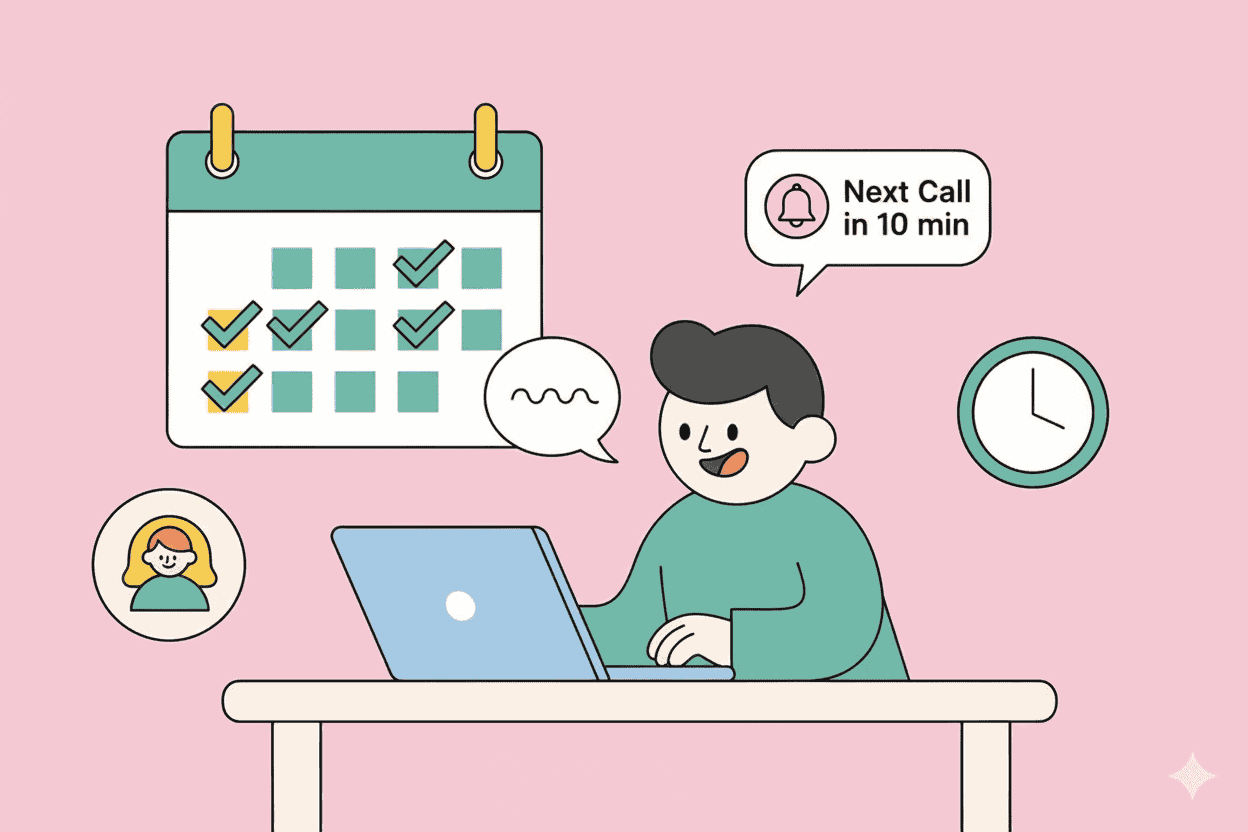
You blocked 30 minutes for a discovery interview. Sent the calendar invite. Prepared your questions. Five minutes past the scheduled time, you're still staring at an empty Zoom waiting room.
Sound familiar?
Customer interview no-shows are one of the most frustrating parts of product discovery. Research from UserTesting shows that typical no-show rates range from 20-40%, meaning nearly half your scheduled interviews might never happen. That's not just wasted time—it's delayed insights that could shape your roadmap.
The good news? Most no-shows are preventable. Here's how to build a scheduling system that gets customers to actually show up.
TL;DR: Key Takeaways
- Book within 48-72 hours of initial outreach for highest show rates
- Send 3 reminders: 24 hours, 2 hours, and 15 minutes before
- Offer calendar flexibility with multiple time slots, not single options
- Make the value exchange clear—explain what's in it for them
- Reduce friction: Use one-click scheduling tools, not email ping-pong
Why Customers Ghost Your Interviews
Before fixing the problem, understand why it happens. Research from Calendly's State of Scheduling report reveals the main culprits:
1. Too Much Time Between Booking and Interview
When someone agrees to a call next week, their enthusiasm fades. Life gets in the way. By day 7, they've forgotten why they agreed in the first place.
2. Friction in the Scheduling Process
Every email exchange doubles the chance of drop-off. If confirming an interview requires 4+ messages, you've already lost people.
3. Unclear Value Proposition
"Can I pick your brain for 30 minutes?" is not compelling. If customers don't see what's in it for them, they'll prioritize literally anything else.
4. No Reminder System
People book things and forget. Without reminders, you're relying on their memory and calendar hygiene—risky bets.
The 48-Hour Rule: Schedule Fast, Interview Soon
The single biggest lever for reducing no-shows is time compression. According to InsideSales.com research, response rates drop by 400% after the first 5 minutes of initial contact. The same principle applies to interview scheduling.
Here's the approach:
Reach Out When Interest Is Fresh
- Contact customers within 24 hours of a trigger event (support ticket, NPS response, feature request)
- Reference the specific trigger: "I saw your feedback about X and would love to learn more"
- Strike while the context is still top of mind
Offer Immediate Availability
Instead of "What does your calendar look like next week?", try:
"I have slots available tomorrow at 2 PM or Thursday at 10 AM—would either work for 20 minutes?"
Book Within 48-72 Hours
Interviews scheduled within 72 hours of initial contact show dramatically higher completion rates—often 80%+ compared to 50-60% for interviews booked a week out.
Building a Friction-Free Scheduling Flow
Every step in your scheduling process is a potential drop-off point. Here's how to minimize them:
Use Self-Service Scheduling Tools
Tools like Calendly, SavvyCal, or HubSpot Meetings let customers book in one click. Calendly reports that self-service scheduling reduces no-shows by up to 40% compared to email-based coordination.
Key settings to configure:
- Buffer time: 15 minutes between calls to avoid back-to-back stress
- Minimum notice: At least 4 hours to prevent last-minute bookings that conflict
- Working hours: Only show slots during your actual available times
Limit Options, Increase Commitment
Paradoxically, offering too many time slots decreases booking rates. Research on the paradox of choice shows that 3-5 options is the sweet spot—enough flexibility without decision paralysis.
Embed Scheduling in Natural Touchpoints
Don't make customers hunt for a scheduling link. Embed it where they already are:
- Post-survey thank you pages
- Email signature of customer-facing teams
- In-app prompts after feature usage
- Support ticket resolution messages
The 3-Touch Reminder Sequence
Reminders are where most teams under-invest. A well-designed reminder sequence can boost show rates by 15-25%.
Reminder #1: 24 Hours Before
Goal: Confirm the interview is still happening
Content should include:
- Friendly reconfirmation of time, date, and timezone
- One-click reschedule option (better to move than no-show)
- Brief reminder of the interview's purpose
Example:
"Looking forward to our call tomorrow at 2 PM EST! We'll be discussing your experience with [feature]. If anything's changed, you can reschedule here: [link]"
Reminder #2: 2 Hours Before
Goal: Get the interview on their radar before lunch meetings take over
Content should include:
- Meeting link front and center
- Any prep instructions (none is best)
- Your phone number as backup
Reminder #3: 15 Minutes Before
Goal: The final nudge
Content should include:
- Just the meeting link
- "See you in 15!" energy
Channel Optimization
SMS reminders have 98% open rates compared to 20% for email. If you can get phone numbers, a simple text reminder 2 hours before can be a game-changer.
Crafting the Value Exchange
Customers are doing you a favor. Make sure they know what they get in return.
Beyond Gift Cards
Monetary incentives work, but they're not the only lever:
- Early access: "You'll be first to try the new feature you helped shape"
- Influence: "Your feedback directly influences our Q2 roadmap"
- Recognition: "We'd love to feature your story in a case study"
- Peer connection: "Join our beta community of 50 power users"
Match Incentives to Customer Segments
| Customer Type | Effective Incentive |
|---|---|
| Enterprise decision-makers | Executive summary of industry insights |
| Power users | Early access + direct line to product team |
| Churned customers | Gift card + genuine curiosity about their experience |
| Trial users | Extended trial or discount |
Be Explicit About Time Investment
"This is a 20-minute conversation—I promise to keep us on track and respect your time."
When customers trust you'll be efficient, they're more likely to show up.
Handling Common Objections
Sometimes you need to save the interview before it's scheduled.
"I don't have time this week"
Response: "Totally understand. I have a 15-minute micro-session option—would that be easier? We can cover the essentials in half the time."
"I already gave feedback in the survey"
Response: "Your survey response was super helpful! I'm reaching out because I want to understand the story behind your answer—what was happening when you experienced X?"
"I'm not sure I'm the right person"
Response: "Your perspective is exactly what I'm looking for. You don't need to be an expert—I want to understand how real users experience the product."
Building Sustainable Interview Pipelines
One-off interview scheduling is exhausting. Here's how to systematize:
Create a Continuous Recruitment System
Instead of scrambling to find participants before each research sprint, build an always-on pipeline:
- Intercept surveys: Catch users in the moment with quick feedback asks
- Research panel: Maintain a list of customers who've opted in for ongoing feedback
- Trigger-based outreach: Auto-flag customers hitting specific milestones for outreach
Segment Your Panel
Not all participants are equal. Tag them by:
- Product area expertise
- Customer segment (SMB, enterprise, etc.)
- Communication preference
- Past participation history
Use AI to Scale Personal Outreach
This is where tools like Pelin become valuable. Instead of manually reading through support tickets and NPS responses to find interview candidates, AI can:
- Surface customers who recently expressed frustration or enthusiasm
- Draft personalized outreach based on their specific feedback
- Prioritize who to contact based on signal strength
The goal isn't to automate away the human connection—it's to spend your limited time on the highest-value conversations.
Measuring Interview Program Health
Track these metrics to spot problems early:
Show Rate
Target: 75%+ for customers, 85%+ for internal stakeholders
Calculate: (Completed interviews / Scheduled interviews) × 100
Time-to-Schedule
Target: <48 hours from outreach to booked slot
Long delays signal friction in your process.
Reschedule vs. No-Show Ratio
Target: Reschedules should outnumber no-shows 3:1
If people are ghosting instead of rescheduling, your reminder flow needs work.
Source Quality
Track show rates by recruitment channel. You might find that NPS respondents show up 90% of the time while cold outreach barely hits 50%.
The Anti-Pattern: What Not to Do
A few scheduling habits that tank show rates:
- The single-slot gambit: "Are you free Tuesday at 3?" forces a yes/no and often gets ignored
- The vague ask: "Would you be open to a call sometime?" Never converts
- The essay invitation: 4-paragraph emails explaining your research methodology—no one reads these
- The forgettable link: Sending a Calendly link with zero context about why they should click it
- The aggressive follow-up: 3 emails in 2 days comes across as desperate, not professional
Putting It All Together
Here's a complete scheduling playbook:
- Trigger identification: Use feedback analysis to identify high-value interview candidates
- 48-hour outreach: Contact within 24 hours of trigger, with slots available within 72 hours
- One-click scheduling: Send a personalized message with an embedded scheduling link
- Clear value exchange: Explain what's in it for them (early access, influence, etc.)
- 3-touch reminders: 24 hours, 2 hours, 15 minutes before
- Backup plan: Include your phone number for day-of troubleshooting
- Measure and iterate: Track show rates by channel, segment, and time-to-schedule
The companies that excel at customer discovery aren't necessarily better at conducting interviews—they're better at making interviews happen in the first place.
Want to spend less time hunting for interview candidates and more time actually talking to customers? Pelin uses AI to surface the right customers for interviews based on their feedback patterns—so you can focus on the conversations that matter.