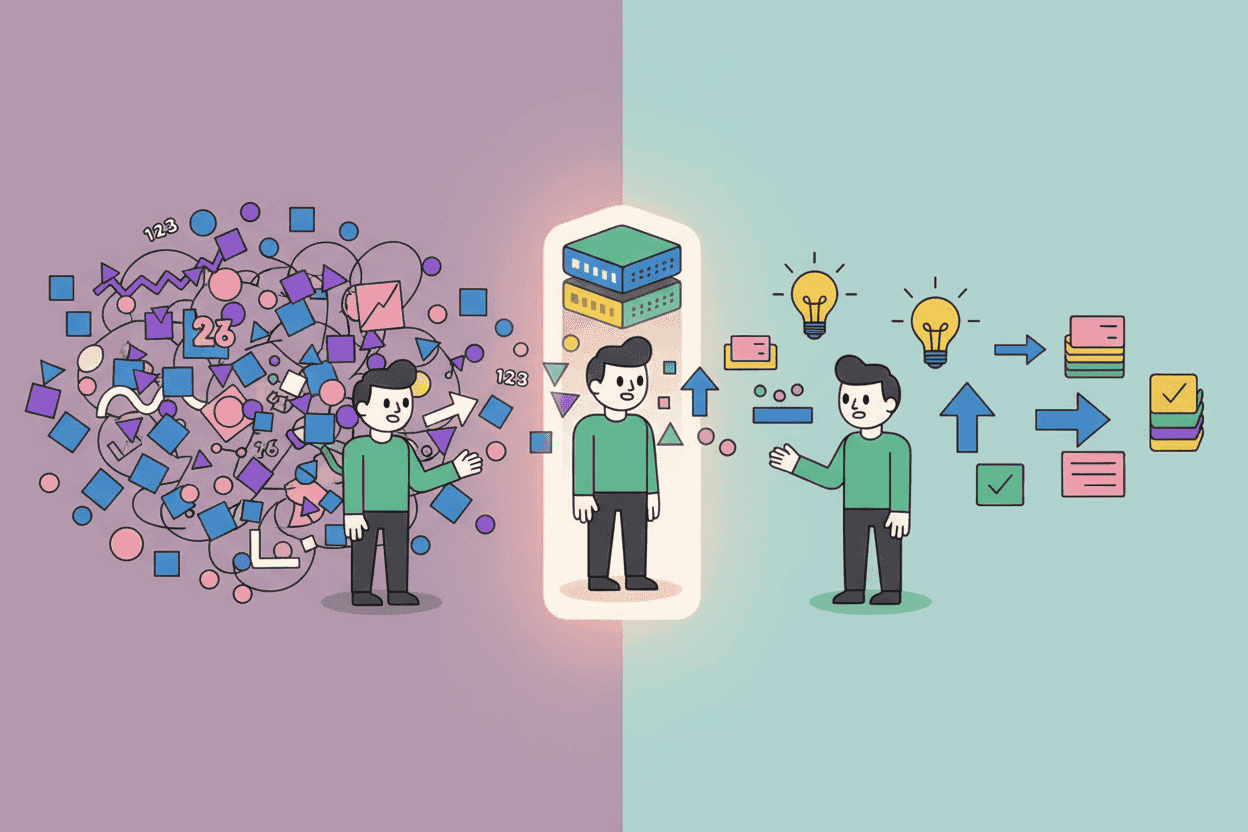
Your product team has more data than ever before. User analytics. NPS scores. Support tickets. Feature requests in Notion. Sales call notes in Gong. Customer interviews in a Google Drive folder nobody remembers creating.
And yet, when it comes time to decide what to build next, everyone's still guessing.
This paradox—drowning in data while starving for clarity—has become the defining challenge of modern product management. A new analysis from Metapress puts it bluntly: teams "optimize pages without understanding product intent, build features without full user context, and prioritize roadmaps based on internal assumptions rather than evidence."
Sound familiar?
The Real Problem Isn't Data Collection
Let's be honest about what's happening inside most product organizations.
You've got Amplitude or Mixpanel tracking every click. Intercom capturing every support conversation. A feedback portal that's technically collecting feature requests. Quarterly NPS surveys that generate depressing spreadsheets. Customer success managers with context in their heads that never makes it anywhere useful.
The data exists. The problem is that nobody can make sense of it all.
According to the 2026 ProcureCon CPO Report, only 11% of organizations say they're "fully ready" to leverage AI and machine learning in their operations. Among those who aren't ready, 54% cite "insufficient data quality and integration" as a major barrier.
Translation: even executives know their data is a mess, and they don't know how to fix it.
For product teams, this creates a familiar dysfunction. You spend hours in dashboards, trying to correlate feature adoption with retention. You read through dozens of support tickets looking for patterns. You schedule yet another customer call to understand what that cryptic NPS comment meant.
And then, when stakeholders ask why you're prioritizing Feature A over Feature B, you piece together a narrative from fragments and hope it sounds convincing.
The Gap Between Analytics and Action
Traditional product analytics tools are excellent at answering "what" questions. What percentage of users completed onboarding? What features have the highest adoption? What's our month-over-month retention?
They're terrible at answering "why" questions. Why did users drop off at step three? Why is this cohort churning? Why are enterprise customers asking for a feature that SMBs ignore?
This gap—between knowing what happened and understanding why—is where product decisions go to die.
As Verinext's 2026 CX predictions report notes, organizations are sitting on "extensive customer data" but struggling to make it actionable. The report predicts that 2026 will be the year when "customer experience strategies increasingly rely on predictive insights to guide interactions before issues escalate."
The keyword there is "predictive." Not reactive. Not forensic. Predictive.
This is the shift that AI enables. Instead of manually correlating signals across tools—behavioral analytics here, feedback data there, support trends somewhere else—AI can surface patterns that connect these dots automatically.
What Actually Changes With AI-Powered Insights
Let's get specific about what this looks like in practice.
Pattern recognition across sources. A customer mentions "confusing" in a support ticket. Another mentions "unclear" in an NPS comment. Three more use "complicated" in feature feedback. A human analyst might never connect these across different tools. AI sees the semantic pattern: something about your product's complexity is causing friction.
Intent detection at scale. When you have thousands of feedback items, manually categorizing them is impossible. AI can identify that 34% of requests relate to workflow efficiency, 22% to integrations, and 18% to reporting—even when customers use wildly different language to describe the same underlying need.
Evidence-based prioritization. Instead of relying on the loudest stakeholder or the most recent customer call, teams can see aggregate patterns. Feature X has been requested 47 times in the last quarter, correlates with churn risk among your highest-value segment, and aligns with the strategic goal you set in January. That's a different conversation than "I think we should build X."
Real-time signal detection. Customer sentiment shifts don't announce themselves. But AI can flag when negative feedback about a specific feature starts trending upward—before it becomes a crisis you discover in next quarter's NPS results.
Why Product Teams Keep Getting This Wrong
The honest answer is that bridging data silos is hard, and most organizations have underinvested in it.
Product teams end up with a constellation of point solutions. Feedback lives in Productboard. Analytics in Amplitude. Customer success data in Gainsight. Sales intelligence in Gong. Support insights in Intercom.
Each tool is optimized for its own domain. None of them are optimized for giving product teams a unified view of customer truth.
So PMs become human middleware. They export CSVs, attend syncs, read through Slack threads, and try to synthesize a coherent picture from fragments. This is time-consuming, error-prone, and fundamentally unscalable.
The Metapress analysis identifies this clearly: "fragmented analytics often remain fragmented—SEO tools in one place, product analytics in another, customer feedback elsewhere. The result is decision-making based on partial information."
Partial information leads to partial decisions. And partial decisions lead to building things customers didn't actually need.
The Shift Toward Insight-First Product Strategy
What's emerging in 2026 is a fundamentally different approach to product intelligence.
Instead of treating customer data as something you analyze periodically—before planning cycles, during quarterly reviews—leading teams are treating insights as a continuous input to decision-making.
This means investing in tools that consolidate customer signals into a unified layer. Tools that don't just aggregate data but actually synthesize it into actionable intelligence. Tools that help teams understand not just what customers are saying, but what they mean—and what to do about it.
The Metapress report puts it well: "AI bridges this gap by surfacing recommendations, highlighting patterns, and connecting cause with effect. Instead of manually interpreting dozens of signals, teams gain a clearer narrative around what is happening and why."
For product teams, this narrative is everything. It's the difference between entering a prioritization meeting with hunches and entering with evidence. It's the difference between building features based on assumptions and building features based on aggregate customer truth.
Practical Implications for Product Teams
If you're a PM or product leader reading this, here's what actually matters:
Audit your data sources. List every place customer feedback, behavior data, and signals currently live. You'll probably find more than you expected—and realize how little of it you're actually using.
Identify your synthesis bottleneck. Who in your organization is currently trying to connect dots across these sources? How much of their time does it take? This is the work that AI can accelerate.
Question your prioritization process. When you commit to building something, what evidence supports that decision? If the answer is "a few customer calls" or "stakeholder intuition," you're prioritizing with partial information.
Look for semantic patterns. Your customers are telling you what they need, but they're using different words for the same problems. The "export data" request, the "reporting flexibility" request, and the "custom analytics" request might all be the same underlying need expressed differently.
Think continuity, not campaigns. Customer intelligence isn't something you generate quarterly. It's something you maintain continuously. The best product decisions come from teams who are always listening, not teams who occasionally check in.
The Competitive Reality
Here's the uncomfortable truth: while some teams are still manually exporting CSVs and scheduling synthesis meetings, others are using AI to surface insights in real-time.
The teams with better insight systems will ship more relevant features. They'll detect churn signals earlier. They'll understand their market faster. And they'll make prioritization decisions with confidence instead of anxiety.
As markets become more competitive and customer expectations rise, as the Metapress analysis notes, "the companies that win are those that learn faster. Insight becomes a competitive advantage—not just knowing what is happening but understanding it before others do."
The age of guessing what customers want is over. The teams that embrace AI-powered customer intelligence won't just ship better products—they'll ship them faster, with more confidence, and with dramatically better odds of success.
The only question is whether your team will be one of them.
Pelin helps product teams cut through data overload with AI-powered customer intelligence. Instead of manually synthesizing signals across tools, Pelin automatically surfaces the insights that matter—so you can build what customers actually need.