Something shifted in the enterprise AI conversation this week. According to fresh analysis from The AI Journal, Gartner now predicts that 40 percent of enterprise applications will feature task-specific AI agents by the end of 2026—up from less than 5 percent in 2025. That's not incremental adoption. That's a phase change.
For product teams, this has profound implications. Not because AI agents will replace product managers—they won't—but because the gap between teams who harness agentic AI and those who don't is about to become a chasm.
Let's talk about what this actually means for how you understand your customers.
The Customer Insights Bottleneck
Here's the uncomfortable truth most product organizations won't admit: they're drowning in customer feedback and starving for customer insight.
The average B2B SaaS company collects customer signals from a dozen different sources. Support tickets pile up in Zendesk. Sales calls get recorded in Gong. Feature requests accumulate in Intercom. NPS surveys sit in spreadsheets. Customer success notes live in Notion. And somewhere in Slack, a customer champion just posted a screenshot of a competitor's new feature that's making prospects nervous.
The data exists. The patterns are there. But synthesizing it all into actionable insight? That takes a human analyst days or weeks of work. By the time the insight reaches the product team, the moment has often passed.
This is the bottleneck agentic AI was built to solve.
What Makes Agentic AI Different
Traditional AI tools respond to prompts. You ask a question, you get an answer. Useful, but limited.
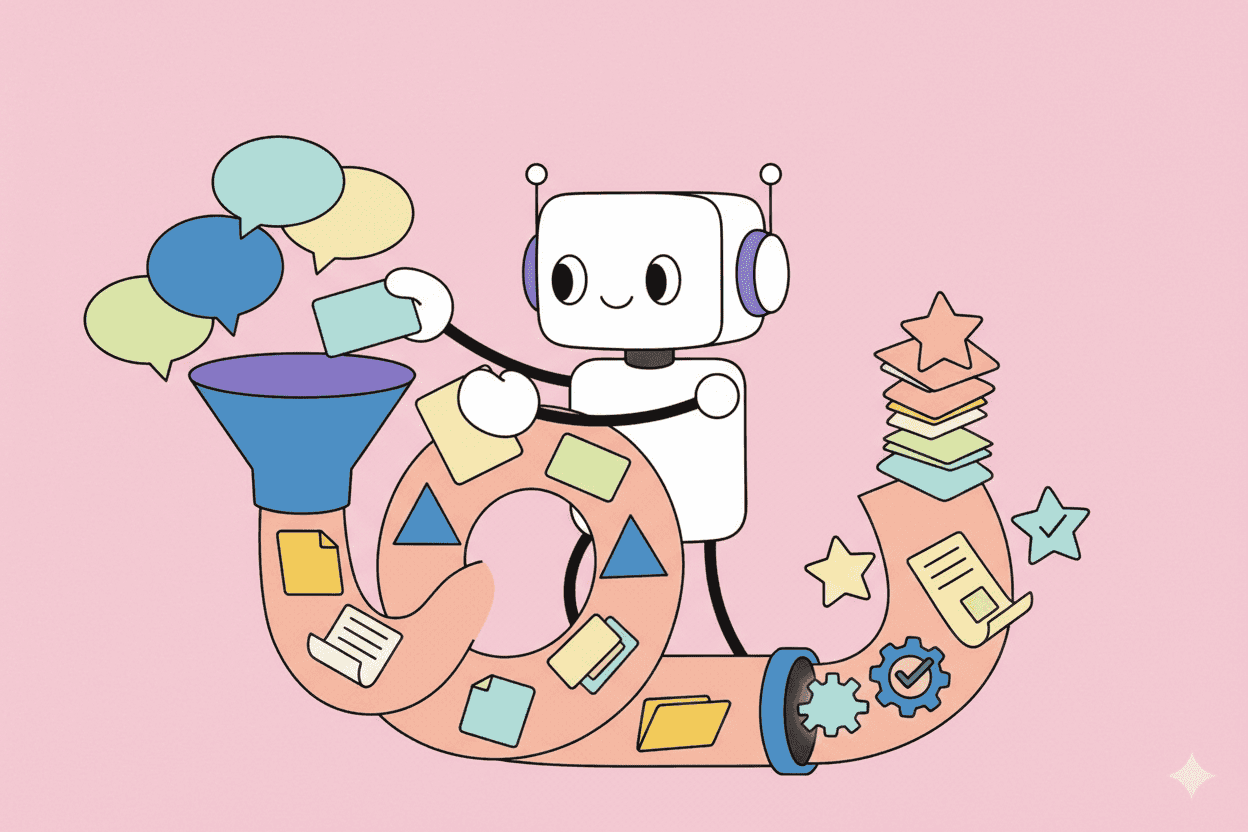
Agentic AI is fundamentally different. These systems can reason, plan, and execute multi-step tasks autonomously. They don't just answer questions about your customer feedback—they can proactively surface patterns, connect dots across data sources, and deliver insights before you knew to ask for them.
The distinction matters. A traditional chatbot can tell you what customers said about your onboarding flow if you ask. An agentic system can monitor all incoming feedback, detect when onboarding sentiment shifts negative, correlate it with specific user segments, draft a summary of the key issues, and flag it for your attention—all without a prompt.
This isn't science fiction. These capabilities exist today. The question is whether your organization is positioned to leverage them.
The Data Foundation Problem
Here's where most AI initiatives stumble, and it's worth understanding before you get too excited about agents.
The AI Journal piece makes this point sharply: "IT environments with fragmented systems and poor data visibility are one of the leading causes of failed AI initiatives." When customer data is trapped in silos—a separate system for support, another for sales, another for product analytics—even the most sophisticated AI agent can't synthesize insights it can't access.
This is why the first step toward agentic customer insights isn't buying an AI tool. It's auditing your data architecture. Ask yourself:
- Can you trace a single customer's journey across all touchpoints in your product?
- When a support ticket mentions a feature, can you automatically link it to that customer's usage patterns?
- Do your sales call transcripts exist in a format AI can actually process?
If you answered "no" to any of these, you have work to do before agents can help. The good news: solving this foundation problem pays dividends far beyond AI readiness.
Five Ways Agentic AI Changes Customer Insights
Let's get concrete. Here's how agentic AI is already transforming customer feedback workflows for teams who've built the right foundation:
1. Continuous Theme Detection
Instead of quarterly analysis sprints, agentic systems monitor incoming feedback continuously. When a new pain point emerges—say, complaints about a recent API change—the system detects the cluster, assigns confidence scores, and alerts the relevant team immediately.
The insight reaches you in hours, not months. That's the difference between a quick fix and a churned enterprise account.
2. Cross-Source Correlation
A customer mentions "slow" in a support ticket. A sales prospect asks about performance benchmarks on a call. Three users on your community forum discuss load times. Separately, these signals are noise. Together, they're a pattern.
Agentic AI excels at this kind of correlation. It can connect feedback across channels, normalize language differences ("slow," "laggy," "performance issues"), and surface the unified pattern even when no single source made it obvious.
3. Sentiment Trajectory Analysis
Point-in-time sentiment scores are useful. Sentiment trajectories are actionable.
An agentic system can track how specific customer segments feel about specific features over time. It can detect when enterprise customers are souring on your reporting module two weeks before renewal conversations start. That early warning is worth its weight in gold.
4. Competitive Intelligence Synthesis
Your customers mention competitors constantly—in support chats, sales objections, community discussions, review sites. An agentic system can compile these mentions, categorize them by competitor and feature area, and maintain a living competitive landscape document that updates itself.
No more scrambling to build battlecards before a big deal. The intelligence is always current.
5. Automated Insight Delivery
Perhaps most importantly, agentic systems can deliver insights to the right people at the right time. A churn risk signal goes to customer success. A feature request pattern goes to the PM who owns that area. A competitive mention goes to sales enablement.
The insight finds its audience instead of waiting to be discovered.
The Human Element Doesn't Disappear
Let's be clear about what AI agents don't do: they don't replace product judgment.
An agent can tell you that 47 customers mentioned difficulty with your API authentication this month. It cannot tell you whether redesigning that flow should be your top priority given your strategic context, technical debt, and competitive position.
The teams getting this right use agentic AI to compress the insight generation cycle dramatically while preserving human judgment for prioritization and action. They're not removing people from the loop—they're removing the drudgery that prevented people from spending time in the loop that matters.
Think of it this way: before agentic AI, your best product thinkers spent 80% of their time gathering and organizing data and 20% actually thinking. Flip that ratio, and the leverage is enormous.
Practical Steps for Product Teams
If you're convinced agentic AI matters for customer insights—and you should be—here's how to start:
Audit your data sources. List every place customer feedback lives in your organization. Be exhaustive. Include the informal channels (that Slack channel where sales reps share prospect objections? That counts).
Map the connections. Can you link a piece of feedback to a specific customer? To their usage patterns? To their segment? To their renewal date? The value of AI agents scales with data connectivity.
Start narrow. Don't try to boil the ocean. Pick one high-value use case—maybe churn risk detection or competitive mention tracking—and prove value there before expanding.
Invest in data quality. Garbage in, garbage out applies doubly to AI systems. If your support tickets have inconsistent tagging and your sales calls aren't being transcribed reliably, fix that first.
Build feedback loops. When an AI agent surfaces an insight, track what happened. Did the team act on it? Was it accurate? This feedback improves the system over time.
The Window Is Closing
Here's the uncomfortable reality: the gap between AI-ready and AI-late organizations is widening.
The companies that have spent the past two years organizing their customer data, building unified views of their users, and experimenting with AI-assisted analysis are now positioned to capture enormous value from agentic systems.
The companies that haven't? They'll spend 2026 doing foundational work while competitors pull ahead.
The Gartner prediction—40% of enterprise apps with AI agents by year's end—isn't a distant future. It's happening now. The question isn't whether agentic AI will transform customer insights. The question is whether your team will be leading that transformation or catching up to it.
Customer feedback is the lifeblood of product development. The teams that can process it fastest, synthesize it most accurately, and act on it most decisively will build the best products. Agentic AI is the leverage that makes that possible at scale.
The foundation work isn't glamorous. But neither was building the data infrastructure that made modern SaaS analytics possible. The teams that did that work early are the ones who now move fastest.
Your customers are telling you what they need. The question is whether you'll have the systems in place to hear them.