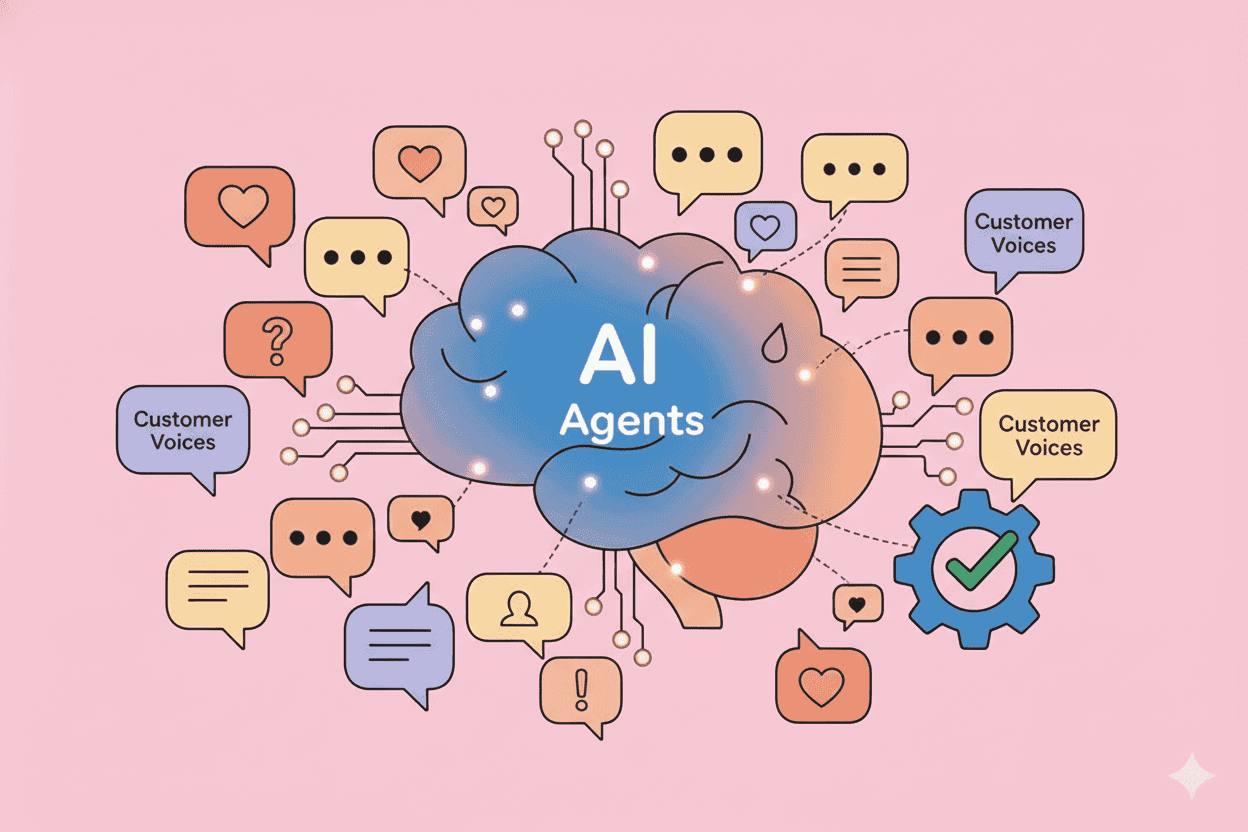
Last week, Zapier CEO Wade Foster revealed something that stopped product teams in their tracks: Zapier now has more AI agents than employees. Let that sink in. 800+ employees, and more AI agents than people.
When GPT-4 launched in March 2023, Foster called a company-wide "code red"—a term he'd never used before—and shut down the entire company for a week-long hackathon. Before that week, 10% of employees were using AI regularly. After? Over 50%. Within months, AI adoption hit 90%+.
It's an inspiring transformation story. But as I read it, one question kept nagging at me: Are these AI agents actually listening to customers?
The AI Arms Race Has a Blind Spot
Every product team I talk to is racing to deploy AI. Chatbots. Copilots. Automated workflows. Agents that handle support tickets, write code, and generate reports.
But here's what's getting lost in the rush: Most of these AI agents are designed to respond to customers—not to understand them.
There's a critical difference.
An AI chatbot can answer a support question. But can it tell you that 47 customers this month asked variations of the same question because your onboarding flow is confusing?
An AI agent can summarize a customer call. But can it connect that feedback to the three other calls this week where customers mentioned the same pain point?
An AI copilot can help you write PRDs faster. But is it helping you write the right PRDs—the ones based on what customers actually need?
The Feedback Fragmentation Problem
Zapier's transformation is built on a powerful insight: AI agents can automate repetitive work, freeing humans to focus on what matters.
But what matters most for product teams?
Understanding customers.
And here's the uncomfortable truth: Enterprise feedback management has become more critical than ever. Yet most organizations are drowning in fragmented data—feedback scattered across support tickets, sales calls, user interviews, surveys, social media, and Slack channels.
The average B2B SaaS company collects customer feedback from 8-12 different channels. Most of that feedback sits in silos, never connected, never analyzed, never acted upon.
You can deploy a hundred AI agents. But if those agents aren't synthesizing customer signals into actionable insights, you're automating the wrong things.
From Seat-Based to Outcome-Based
One of the most interesting revelations from Foster's interview is how AI is breaking traditional SaaS pricing models. As he puts it, seat-based pricing is "structurally broken" in an AI-first world.
Why? Because AI agents don't need seats. They need tasks.
The same shift is happening in how we think about customer feedback. It's not about how many feedback tools you have. It's about whether you're generating outcomes—real insights that change what you build.
Traditional feedback workflows look like this:
- Collect feedback (surveys, interviews, support tickets)
- Store it somewhere (spreadsheets, Notion, your email inbox)
- Maybe tag it if you have time
- Review it quarterly (if you remember)
- Make decisions based on gut feel plus a few anecdotes
That's seat-based thinking applied to customer intelligence. You're paying for tools, but you're not getting outcomes.
AI-native feedback workflows look different:
- Every customer touchpoint is automatically captured
- Signals are synthesized across channels in real-time
- Patterns emerge without manual tagging
- Insights surface when they're actionable, not months later
- Decisions are backed by the full picture, not cherry-picked quotes
The "Code Red" Moment for Product Teams
When Foster called his code red, he had a clear signal: GPT-4's improvements over GPT-3.5 were so dramatic, and came so quickly, that waiting was no longer an option. As he explained, "If you play that forward six months, even a fraction of those improvements would be massively disruptive."
Product teams are facing their own code red moment—but around customer understanding, not AI deployment.
The signal is equally clear: Customer expectations are accelerating faster than product teams can adapt. Buyers are more informed. Competition is fiercer. The gap between what customers want and what teams build is widening, not shrinking.
According to recent industry data, only 14% of product teams feel they have a complete view of customer needs. The other 86%? They're making educated guesses.
You can hire more PMs. You can run more surveys. You can schedule more user interviews. But these linear approaches won't close the gap. The volume and velocity of customer feedback has outpaced human capacity to process it.
What AI-Powered Customer Intelligence Actually Looks Like
So what does it mean to apply Zapier-level AI transformation to customer feedback?
It's not just about automating survey analysis (though that helps). It's about building a system that:
Connects the dots across every channel. When a customer mentions the same friction point in a support ticket, a sales call, and a user interview, you shouldn't need a human to manually connect those signals.
Surfaces patterns you didn't know to look for. The best insights often come from questions you didn't think to ask. AI can identify emerging themes across thousands of feedback snippets—themes that wouldn't show up in any individual conversation.
Quantifies the qualitative. "Customers are frustrated with onboarding" becomes "47% of churn-risk accounts mentioned onboarding complexity in the last 30 days, up from 23% last quarter." That's the difference between a feeling and a fact.
Prioritizes ruthlessly. Not all feedback is equal. The feature request from your biggest enterprise account matters more than a random tweet. AI can weight signals by business impact, not just volume.
Closes the loop automatically. When a pain point gets addressed, the customers who raised it should know. That loop should close without a PM manually tracking it.
The Humans-in-the-Loop Imperative
Here's what Zapier got right: They didn't replace humans with AI. They augmented humans with AI.
Foster is clear about this: "Humans still are valuable too. I think they're both pretty uniquely useful."
The same principle applies to customer intelligence. AI should handle the heavy lifting—processing, synthesizing, pattern-matching across thousands of data points. But the strategic decisions about what to build, when to pivot, how to position—those remain deeply human.
The best product teams are using AI to become more customer-centric, not less. They're spending less time on manual tagging and spreadsheet wrangling, and more time on the high-judgment work that actually matters: interpreting insights, making tradeoffs, and building products that customers love.
Practical Steps for Your Own "Code Red"
If Zapier's transformation inspires you to rethink how your team handles customer feedback, here's where to start:
1. Audit your feedback fragmentation. Map every channel where customer feedback lives. Support tickets. Sales call transcripts. User interviews. NPS surveys. Social mentions. Slack channels. G2 reviews. Be honest about how much of this is actually connected and analyzed.
2. Identify your synthesis bottlenecks. Where does feedback go to die? Usually it's in the handoff—from support to product, from sales to marketing, from interview to insight. These bottlenecks are where AI can have the biggest impact.
3. Start with one high-value use case. Don't try to transform everything at once. Pick one feedback channel that's clearly underutilized—maybe call recordings that no one has time to review—and build an AI pipeline that turns it into actionable insights.
4. Measure insights, not activities. Stop counting how many surveys you sent or interviews you conducted. Start measuring how many product decisions were influenced by customer data. That's the outcome that matters.
5. Make insights accessible, not locked away. The best customer intelligence systems democratize access. Every PM, designer, and engineer should be able to query customer insights without filing a ticket with the research team.
The Next Wave of AI Transformation
Zapier's journey from "code red" to AI-first company took about two years. Foster went from suggestively posting about ChatGPT in Slack to fundamentally restructuring how the company operates.
The same transformation is coming to customer feedback.
Teams that figure out how to harness AI for customer understanding—not just customer service—will build products that win. They'll spot market shifts earlier, prioritize features better, and reduce churn by actually listening at scale.
The companies that don't? They'll have plenty of AI agents. Just not the kind that tell them what their customers actually want.
Wade Foster never used the term "code red" before GPT-4. Maybe it's time for product teams to call their own—not about AI deployment, but about whether their AI is actually making them more customer-centric.
Because having more agents than employees is impressive. But having agents that truly understand your customers? That's the transformation that matters.
Pelin uses AI to turn scattered customer feedback into actionable product insights. No more spreadsheets. No more blind spots. Just a clear view of what your customers actually want.