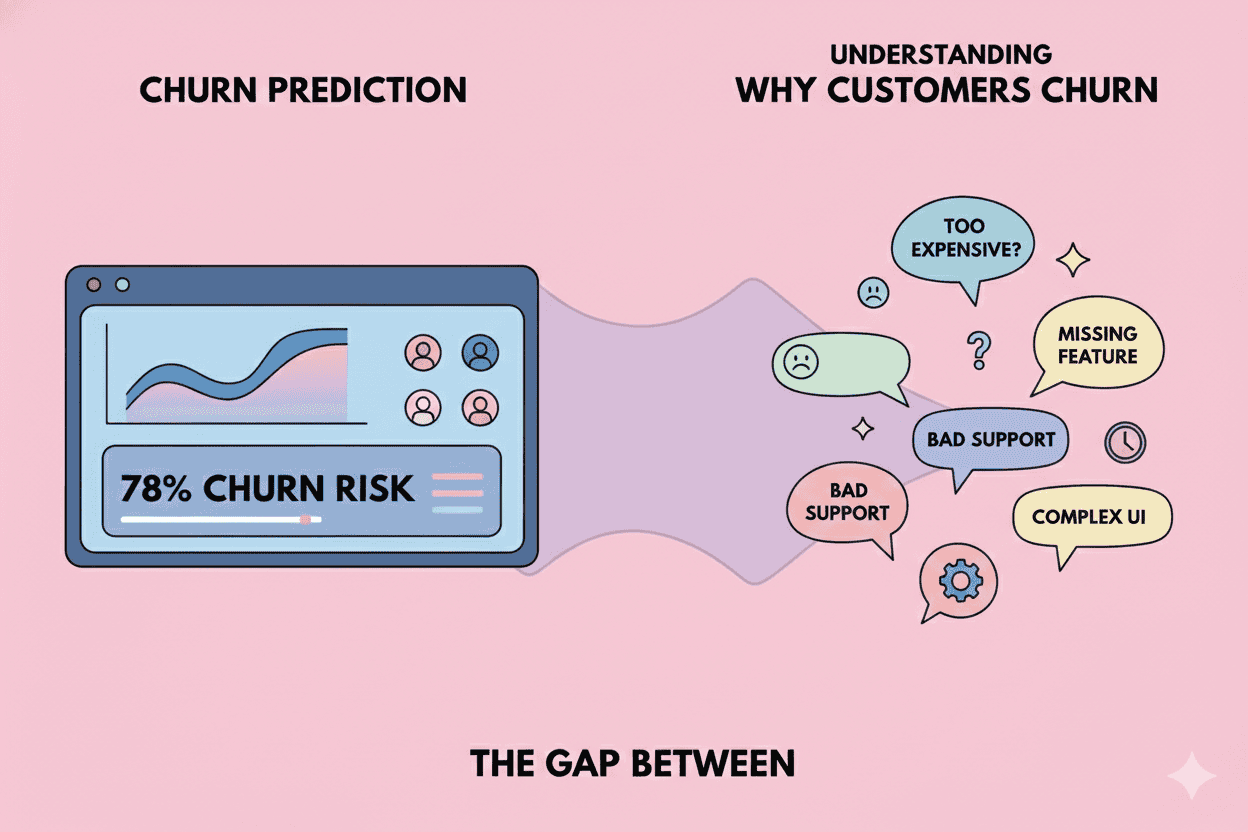
There's a curious paradox in today's customer success stack.
The tools are getting smarter. AI can now predict which customers will churn with frightening accuracy. It can spot usage drops, sentiment shifts, billing anomalies, and relationship decay before anyone on your team notices. According to G2's 2026 expert survey on AI in churn reduction, platforms like ChurnZero, Chargebee, and Velaris are reporting churn reductions of 15-25% through embedded AI workflows.
That's impressive. And yet, something isn't quite right.
The same survey identifies the biggest barrier to churn prevention: it's not the lack of data, not the lack of models, but "the gap between insight and consistent action at scale."
In other words, companies know who's about to leave—they just don't know why.
The Data Problem Hiding in Plain Sight
Modern churn prediction is built on behavioral signals. Product usage patterns. Feature adoption curves. Support ticket volumes. NPS scores. Login frequency. Time-to-value metrics.
These are all lagging indicators.
By the time usage drops, something has already gone wrong. By the time support tickets spike, frustration has already set in. By the time NPS dips, the customer has already made up their mind.
The G2 survey confirms this: platforms reported that "no single signal tells the full story." Churn emerges from patterns—declining engagement combined with sentiment shifts, stalled onboarding paired with unclear value realization.
But here's what's fascinating: nearly every one of those patterns has a root cause that customers have already articulated somewhere. In a support ticket. In a sales call. In a product review. In a Slack message to their team.
The signal isn't missing. It's just buried.
Why Customer Feedback Is the Leading Indicator
Traditional churn prediction works backward from outcomes. AI models learn that customers who exhibit Pattern X are 40% more likely to churn. But Pattern X is the symptom, not the cause.
Customer feedback works forward from intent. When someone says "this workflow is confusing" or "I wish you had X feature" or "our team stopped using this because of Y," they're giving you the cause directly.
The problem? That feedback is scattered across dozens of systems. It's trapped in support tools, survey platforms, CRM notes, community forums, app store reviews, and social media mentions. No single system aggregates it, analyzes it, and connects it to churn risk.
This is the blind spot in the current AI stack.
Consider what ChurnZero told G2 about their Engagement AI: it "analyzes customer interactions across emails, meetings, support tickets, and surveys to surface sentiment, tone, and relationship dynamics."
That's valuable. But it's still reactive. It tells you the relationship is cooling—not why. It surfaces that sentiment is shifting—not what specific issue triggered it.
The gap isn't in detection. It's in understanding.
What "Actionable Insight" Actually Means
The G2 survey found that "AI features that fit naturally into existing workflows and help teams move faster are adopted more readily than standalone dashboards or static scores."
This is the crux of the problem with most churn tools today. They give you a score. Maybe a dashboard. Perhaps a playbook trigger. But they don't give you the conversation starter.
Imagine your CS team gets an alert: "Acme Corp churn risk: HIGH." What do they do next? Call the customer and say, "Hey, we noticed you're at risk of churning"?
Now imagine that alert came with context: "Acme Corp churn risk: HIGH. Root cause analysis shows three support tickets in the past month mentioning 'export functionality' and negative sentiment in two NPS comments about 'reporting speed.' Primary user mentioned 'evaluating alternatives' in a recent call."
That's a conversation your team can actually have.
The Feedback-to-Churn Pipeline
What's missing in most customer success stacks is a systematic way to connect qualitative feedback to quantitative churn signals. Here's what that pipeline should look like:
1. Aggregate feedback from everywhere. Support tickets, surveys, calls, reviews, social mentions, community posts—all of it needs to flow into a single system. Not as raw text, but as structured insights.
2. Extract themes and sentiment at scale. AI can categorize feedback by topic, detect sentiment, identify friction points, and surface feature requests. This turns thousands of unstructured comments into a searchable, queryable intelligence layer.
3. Connect feedback to accounts. This is where most tools fall short. Feedback analysis happens in a silo. Churn prediction happens in another. The two never meet. But when you can trace "users mentioning reporting issues" directly to "accounts with high churn risk," you've found the actionable insight.
4. Surface root causes, not just risk scores. Instead of just flagging churn risk, surface the top three reasons why—based on actual customer feedback. "This account is at risk because: (1) primary user complained about slow exports, (2) no engagement with new dashboard feature, (3) three feature requests for mobile app."
5. Enable proactive action. Give your team the context to intervene before it's too late. Not "this account might churn" but "this account might churn because of X, and here's what you can say to address it."
Why This Matters for Product Teams
The implications go beyond customer success.
Product managers are drowning in feedback. It comes from everywhere—sales calls, support tickets, G2 reviews, user interviews, social media. The challenge isn't getting feedback; it's making sense of it at scale.
When you connect feedback to churn, you create a direct line between customer voice and business impact. That feature request that's been sitting in your backlog? If you can show it's mentioned by 40% of churned accounts, it suddenly moves up the priority list.
The G2 survey noted that "customer success platforms are moving beyond basic churn scores toward AI that combines usage, sentiment, relationship, and billing signals."
The next evolution is obvious: combining all of that with structured customer feedback.
This isn't just about preventing churn. It's about building products that customers actually want.
The Retention Drivers That Actually Work
The survey asked platforms what behaviors correlate most strongly with long-term retention. The answers were revealing:
- Clear value realization (customers achieving their stated goals)
- Deep feature adoption (not just login frequency, but actual workflow usage)
- Positive sentiment trends over time
- Strong stakeholder engagement
Notice what's not on this list: "high NPS scores" or "low support ticket volume." Those are outcomes, not drivers.
The common thread? Customers who retain understand why your product matters to them. They've internalized the value. They're not just using it—they're dependent on it.
The only way to know if customers have reached that point is to listen to them. Not just track their behavior, but understand their perspective.
Building the Insight-to-Action Loop
The gap identified by G2—between insight and consistent action at scale—won't be closed by better churn scores. It'll be closed by better customer understanding.
Here's what that looks like in practice:
For customer success teams: Every churn alert should come with context. Not just "this account is at risk," but "here's what they've been saying." Enable CSMs to have informed conversations, not guessing games.
For product teams: Every feature decision should be informed by churn data. Which missing features are mentioned most by churned customers? Which pain points appear in both active and churning accounts? Where's the retention leverage?
For leadership: Churn should be traceable to root causes. Not "we lost 12% of revenue to churn last quarter," but "we lost 8% to competitors with better mobile apps, 3% to pricing issues, and 1% to poor onboarding." That's how you actually fix the problem.
The Tools Are Ready. The Process Isn't.
The G2 survey shows that AI churn prediction has matured significantly. Platforms are now combining product usage, support tickets, sentiment, and billing data into unified views. Predictive accuracy is improving. Automated playbooks are triggering interventions.
But the gap remains.
Customers are telling you why they're leaving. They're saying it in support tickets, in reviews, in surveys, in sales calls. That signal is there—it's just not connected to your churn stack.
The next wave of retention tools won't just predict who will churn. They'll explain why. And that explanation won't come from behavioral patterns alone. It'll come from listening to what customers actually say.
Moving From Prediction to Prevention
Prediction is a solved problem—or close enough. AI can tell you who's at risk with reasonable accuracy.
Prevention is the unsolved problem. And prevention requires understanding.
The companies that reduce churn most effectively in 2026 and beyond won't be the ones with the best prediction models. They'll be the ones who actually understand their customers—who know what they're struggling with, what they wish the product did, and what would make them stay.
That understanding doesn't come from dashboards. It comes from feedback.
The question isn't whether your AI can predict churn. The question is whether your team knows what to do about it—and that answer is hiding in what your customers have already told you.
Pelin helps product teams transform scattered customer feedback into structured insights that connect directly to business outcomes. See how AI-powered voice of customer analysis can close your feedback gap.