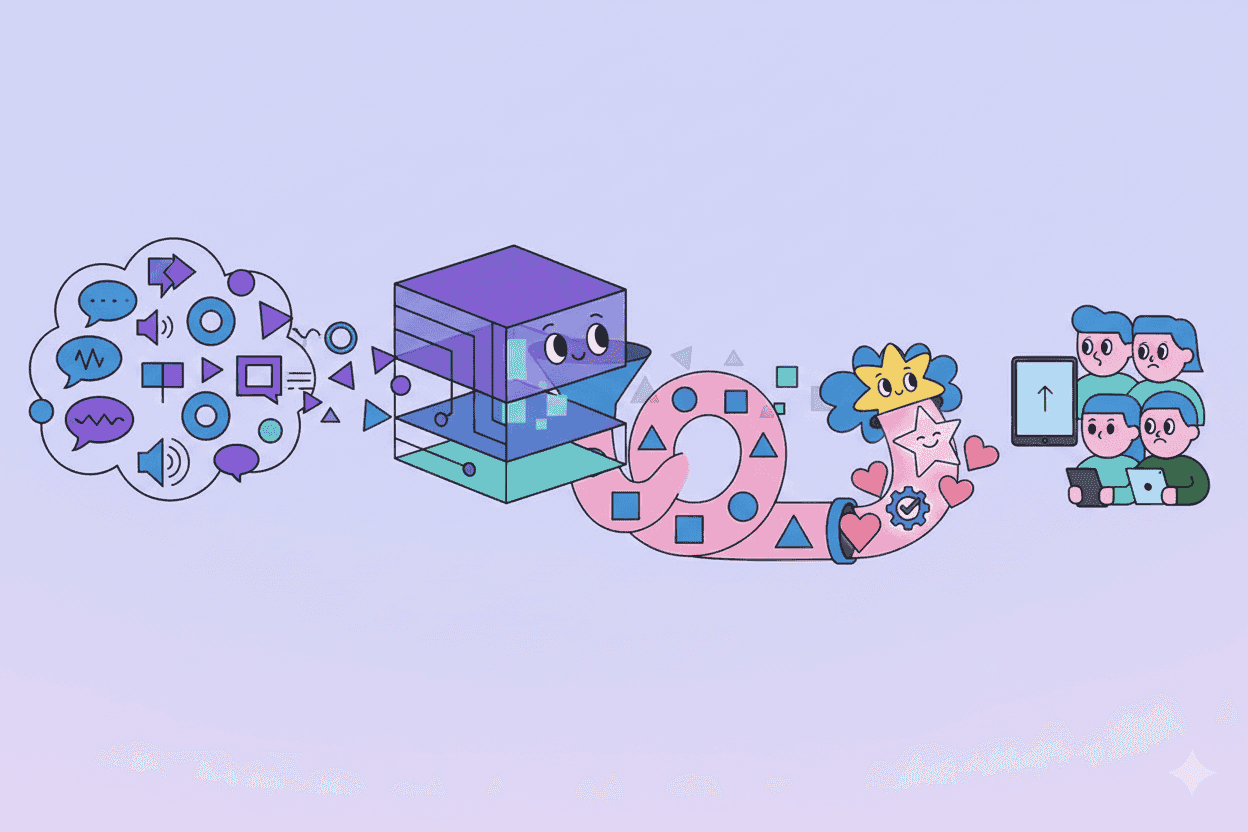
There's a new gatekeeper between your product and your customers. And it's not a person.
According to OneSignal's 2026 State of Customer Engagement Report, 48% of marketers are already concerned about AI filtering systems deciding which messages actually reach their customers. Even more telling: 17% say it's already impacting their deliverability.
Welcome to the era of the AI middleman.
iOS 26 shipped expanded notification summaries. Gmail routes messages through Gemini before users ever open their inbox. Every major platform is now inserting an algorithmic layer between sender and recipient. The assumption that a sent message equals a seen message? That's dead.
But here's what nobody's talking about: this same phenomenon is happening in reverse. The AI layer isn't just filtering what customers see — it's starting to filter what companies hear.
The Two-Way Filter Problem
Most discussions about AI filtering focus on outbound communication. How do you get your marketing emails through? How do you ensure push notifications land?
Fair questions. But product teams face a different challenge entirely.
Think about the signals you rely on to understand what customers actually want:
- Support tickets (increasingly handled by chatbots before escalation)
- Survey responses (often summarized by AI before reaching human analysts)
- App reviews (aggregated and abstracted by platform algorithms)
- Social mentions (buried in algorithmic feeds)
- Sales call notes (transcribed and summarized by AI assistants)
Each of these feedback channels now has an AI intermediary. And those intermediaries are making editorial decisions about what's "important" enough to surface.
The MarTech roundup from this week highlights a telling acquisition: Apollo.io bought Pocus to scan customer signals and prioritize sales tasks. AI identifies which users are "ready to buy" based on product usage patterns.
That's useful for sales. But notice what's happening: AI is deciding which customer signals matter. It's filtering the voice of the customer before product teams ever hear it.
Why This Changes Everything for Product Discovery
Traditional product discovery assumes you can get direct access to customer voices. You run interviews. You analyze support conversations. You read the actual words people use to describe their problems.
But in an AI-filtered world, that direct access is eroding.
Consider this scenario: A customer has a nuanced complaint about your product's workflow. They submit a support ticket. Your AI-powered support system handles the initial response, categorizes the ticket, and maybe even resolves it automatically. By the time (if ever) a human sees this interaction, it's been summarized to: "User reported workflow issue. Resolved."
Gone is the specific language. Gone is the emotional context. Gone is the insight that could have sparked your next feature breakthrough.
The OneSignal report notes that 65% of teams are experimenting with AI in their workflows, but only 8% have fully operationalized it. That gap means most companies are in a messy middle state — using AI assistance inconsistently, without clear governance about what gets filtered and what gets preserved.
The Hidden Cost of Summarized Feedback
Here's a product management truth that gets lost in efficiency discussions: the specific words customers use are data.
When a user says "this makes me feel stupid," that's different from "confusing interface." When someone writes "I've tried everything and nothing works," that's different from "feature request: better documentation."
AI summarization flattens these distinctions. It optimizes for brevity and actionability at the expense of nuance and emotion.
This matters because product decisions are often made at the margins. The difference between a good product and a great one isn't usually a missing feature — it's understanding the texture of customer experience well enough to know which small things matter most.
When you lose access to raw customer voice, you lose the ability to catch those small things.
What High-Performing Product Teams Are Doing Differently
The OneSignal data shows a remarkable performance gap: behavior-triggered messages outperform standard sends by 4-9x on click-through rate. Why? Because they map to moments users are already in.
There's a parallel lesson for product discovery.
The teams pulling ahead aren't fighting the AI filtering trend. They're building systems that capture customer voice before it gets filtered.
1. They're going direct, earlier
Instead of waiting for feedback to trickle through support queues and survey tools, leading teams are embedding feedback mechanisms directly in product experiences. Quick reactions, in-context prompts, micro-surveys that capture voice in the moment.
The closer you get to the actual experience, the less opportunity for AI intermediaries to abstract away the nuance.
2. They're preserving raw data
Even when using AI to help analyze feedback, smart teams maintain access to the original source material. Summaries are useful for scanning, but you need the ability to drill down into actual customer words when making decisions.
Think of it like journalism: you can read the headline, but sometimes you need to check the quotes.
3. They're building intentional listening channels
The OneSignal report mentions that teams using automated Journeys report better results with fewer messages — 63% saw improvements while actually sending less. The insight: quality and timing beat volume.
The same applies to listening. Rather than trying to capture every piece of feedback everywhere, leading teams are creating specific, high-quality channels where customers know their voice will be heard directly. These become the protected spaces where AI filtering doesn't mediate the conversation.
4. They're synthesizing, not just summarizing
There's a difference between letting AI summarize your feedback (reducing it) and using AI to synthesize across feedback sources (connecting it). The first loses information. The second adds it.
The most effective approaches use AI to find patterns across multiple customer voices while preserving the ability to hear each voice individually.
The Return of the Customer Interview
Here's an unexpected prediction: we're going to see a renaissance in direct customer interviews.
As AI filters increasingly mediate written communication, synchronous conversation becomes more valuable. A 30-minute call with a customer can't be pre-filtered by an algorithm. The nuances of tone, the follow-up questions, the moments of surprise — these happen in real-time.
Yes, calls are less scalable than surveys. Yes, they're harder to analyze. But in a world where everything else gets algorithmically processed, the unfiltered nature of direct conversation becomes a competitive advantage.
Product teams that maintain strong customer interview practices will develop insights their competitors literally cannot access through filtered channels.
Practical Takeaways for Product Teams
If you're leading a product team in 2026, here's what this means for your practice:
Audit your feedback pipeline. Map every place customer feedback enters your organization. Identify where AI filtering or summarization is happening. Decide intentionally which stages should preserve raw voice versus optimize for efficiency.
Protect at least one direct channel. Whether it's customer interviews, a dedicated feedback board, or in-product voice capture — maintain at least one channel where customer words reach product decision-makers unfiltered.
Train your team to read source material. It's tempting to rely on AI summaries. Resist. Regularly review actual customer language, not just synthesized insights. The patterns that matter most often hide in the words people choose.
Design for voice capture, not just feedback collection. There's a difference between asking "How satisfied are you?" (generates a number) and "Tell us about your experience" (generates voice). When you need qualitative insight, design your touchpoints to capture actual expression.
Use AI to find, not to filter. The best application of AI in customer research is helping you identify which conversations to pay attention to — not replacing the need to pay attention. Let AI help you prioritize and discover; don't let it summarize away your access to direct insight.
The Attention Economy's Next Phase
We've spent a decade talking about the attention economy — the battle for customer eyeballs. Now we're entering a new phase: the access economy.
AI filtering means reaching customers is harder. But it also means hearing customers is harder. The companies that build systems to maintain direct access to customer voice will have structural advantages in understanding what to build next.
The irony is almost poetic. As AI gets better at mediating communication, the most valuable thing becomes communication that isn't mediated.
Your customers are still talking. The question is whether you've built the channels to actually hear them.
Pelin helps product teams cut through the noise with AI-powered voice of customer analysis. Get insights from real customer conversations without losing the nuance that matters. Learn more at pelin.ai